Every few weeks a brand sends us a formula with a note: "remove the magnesium stearate, remove the titanium dioxide, make it clean."
Sometimes that is the right call. Often it is a request that adds cost, shortens shelf life and solves a problem the customer never had. The difference between the two outcomes is knowing what each excipient actually does, and what happens on the line when it is gone.
This is a practical guide to the ingredients nobody puts on the front of the label.
What an excipient is for
An excipient is anything in the product that is not the active ingredient. In a tablet it can be 10 to 40 percent of the weight. It exists for one of a small number of reasons:
| Function | Common examples | Typical level | What happens without it |
|---|---|---|---|
| Filler or diluent | Microcrystalline cellulose, dicalcium phosphate | 20 to 60 percent | Dose too small to form a tablet |
| Binder | Povidone, HPMC, starch paste | 2 to 10 percent | Tablet crumbles or caps |
| Disintegrant | Croscarmellose sodium, sodium starch glycolate | 2 to 8 percent | Tablet passes through intact |
| Lubricant | Magnesium stearate, stearic acid | 0.25 to 2 percent | Sticking and punching problems |
| Glidant | Silicon dioxide | 0.1 to 1 percent | Poor flow, weight variation |
| Coating | HPMC, shellac, talc | 2 to 5 percent | Taste, moisture, colour problems |
| Sweetener and texture | Sorbitol, maltitol, pectin, gelatin | 30 to 80 percent in gummies | No gummy at all |
| Colour | Iron oxides, spirulina, beta carotene | under 1 percent | Visual identity lost |
| Preservative | Potassium sorbate, sodium benzoate | under 0.5 percent in liquids | Microbial growth |
Read the last column again. Most excipients are not there for the factory's convenience. They are there because the product does not exist without them in a form a customer will accept.
Magnesium stearate: the most searched excipient in the world
It is a salt of stearic acid, a naturally occurring fatty acid. It is used at 0.25 to 2 percent as a lubricant, so powder does not stick to the punches and dies.
The claim that made it famous is that it forms a film around particles, reduces absorption and creates biofilm in the gut. The honest summary of the evidence:
- The film-forming behaviour is real at high use levels in some systems, and it can slow dissolution. That is why formulators keep it low and check dissolution.
- Stearic acid is a normal dietary fatty acid, present in chocolate, cheese and meat at vastly higher quantities than a tablet contains.
- There is no credible evidence that magnesium stearate at lubricant levels creates harmful biofilm in the human gut.
The practical position most manufacturers take: use the minimum effective level, verify dissolution, and do not market against it. Removing it entirely is possible - stearic acid, sodium stearyl fumarate or a change in granulation can replace it - but the line runs slower, weight variation increases, and cost per unit usually rises.
If a customer asks whether your product contains magnesium stearate, the answer is a fact, not a verdict.
Titanium dioxide: the one with a real regulatory story
Titanium dioxide, E171, is a white pigment. In 2022 the EU stopped authorising it as a food additive, and that removal applies to food supplements in the EU market. Other markets, including the US, still permit it.
What that means practically:
- If you sell in the EU, you need a titanium dioxide free formula, which usually means a different opacifier or no opacifier at all.
- The white colour of an uncoated tablet comes from the excipients themselves in most cases, so removal is often a visual issue rather than a functional one.
- In capsules, the shell colour is a separate matter and follows the same market rules.
This is the clearest example of an excipient question with a legal answer rather than a marketing answer: check the destination market before the formula is fixed, not after the artwork is printed.
Other ingredients customers ask about
- Silicon dioxide. An anti-caking agent at 0.1 to 1 percent. Almost always replaceable with better granulation, at a cost in process time.
- Artificial colours. In the EU, certain colours require the warning "may have an adverse effect on activity and attention in children". That warning on a children's product is a commercial problem regardless of the science.
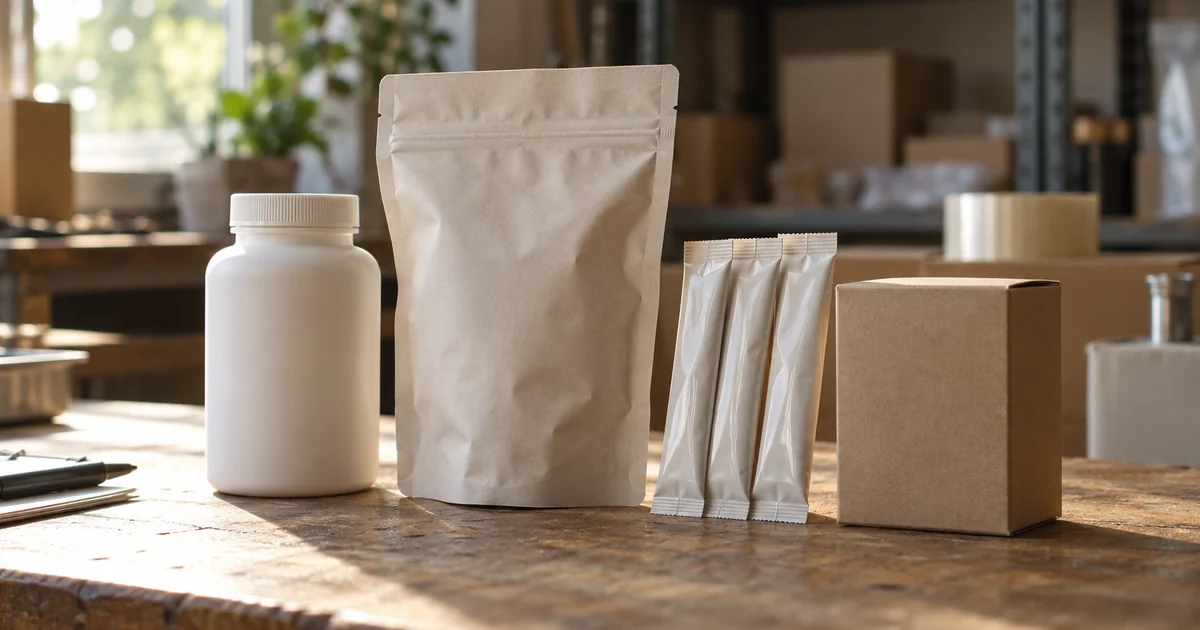
- Gelatin capsules. Animal derived. Replacing with HPMC makes the product vegan and vegetarian suitable, and costs more per capsule. Details of shell options and sizes are on our capsule manufacturing page.
- Talc. A traditional glidant and anti-caking agent. Supply chain purity and asbestos screening matter more than the ingredient itself.
- Carrageenan and other thickeners in liquids. Frequently requested for removal, rarely a technical problem to replace with xanthan or gum arabic.
- Sugar and sugar alcohols in gummies. Removing them changes the product category, not the formula. Pectin and gelatin are the structural ingredients of a gummy; there is no gummy without one of them.
One pattern to notice: the excipients people ask about are usually the cheap ones. The expensive excipients - the pectin that makes a real gummy, the enteric coating that protects a probiotic - are rarely questioned, because the product does not work without them.
What removing an excipient actually costs
| Removal | Reformulation work | Effect on cost | Effect on quality |
|---|---|---|---|
| Magnesium stearate | New lubrication and granulation trial | Up 3 to 10 percent | Dissolution must be re-verified |
| Titanium dioxide | Opacifier change, colour match | Up 2 to 8 percent | Visual only |
| Silicon dioxide | Granulation change or added process step | Up 3 to 8 percent | Better flow if done well |
| Gelatin to HPMC capsule | None in formula, new shell | Up 10 to 25 percent per capsule | Vegan claim secured |
| Synthetic colour to natural | Stability and colour matching | Up 5 to 20 percent | Colour drifts over shelf life |
| Sugar to sugar alcohol in gummies | Full texture rework | Up 10 to 30 percent | Texture and taste change |
Note that none of these are zero. A clean label reformulation is a project with a validation batch attached, not a line edit.
The dose problem behind most excipient requests
There is a constraint that decides more formulas than any marketing brief: the size of the pill.
A 1,000 mg capsule can hold roughly 600 to 700 mg of powder once the shell and the fill tolerance are taken into account. A tablet has similar limits before it becomes too large to swallow. This is why high-dose products are full of excipients - not because the factory likes them, but because the dose has to fit somewhere.
Two consequences follow:
- Reducing excipients often means increasing the dose count. A 500 mg dose with 200 mg of excipients becomes a 700 mg tablet. The same formula with 50 mg of excipients may need two tablets per serving, which doubles the pack cost and changes the front-of-pack claim.
- Serving size is a cost decision. Going from one capsule to two per serving multiplies the capsule cost, the bottle count and the freight, which is exactly the arithmetic in our packaging cost breakdown.
So before asking for a cleaner formula, ask what the maximum single-unit dose is. The answer usually determines whether the request is a reformulation or a redesign.
What "clean label" legally means
Nothing. There is no definition, no certification and no enforcement, which is exactly why every brand uses the phrase differently.
The claims that are real, because they are certified or regulated:
| Claim | What it actually requires |
|---|---|
| Organic | Certified operation and ingredient chain, annual inspection |
| Non-GMO | Verification program, ingredient documentation |
| Vegan | No animal derived ingredients, including the capsule and the carrier |
| Halal | Certified facility and ingredient approval |
| Gluten free | Tested below the regulatory threshold, documented |
| No artificial colours | A formula fact, verifiable on the label |
If a claim is not on that list, it is marketing copy, and it should not be the reason you pay 20 percent more per unit.
How to make the decision properly
Work in this order:
- Choose the markets first. EU access alone rules out titanium dioxide.
- Choose the claims second. Vegan, halal, organic and gluten free each remove or add specific ingredients.
- Then write the formula, with the excipients needed to make that formula at that dose in that format.
- Then price it, because the clean version of the same product is usually more expensive and always slower to qualify.
Doing it in the reverse order - formula first, claims later - is how brands end up reformulating three months before launch, with printed labels in the warehouse.
Frequently asked questions
Is magnesium stearate harmful?
At the levels used as a lubricant there is no credible evidence of harm, and stearic acid is a normal part of the diet. The legitimate concern is technical: too much can slow dissolution, which is why the level is kept low and tested.
Can I make a tablet with no excipients at all?
Not at a commercial dose. A tablet needs something to give it bulk, something to hold it together and something to release it. What you can do is choose which excipients, and how many.
Is titanium dioxide banned?
In the EU it is no longer authorised as a food additive, which covers food supplements. Other markets still permit it. Check the destination market before finalising the formula.
Do vegan capsules cost more?
Yes, typically 10 to 25 percent more per capsule than gelatin, depending on size and volume.
Will removing an excipient change my shelf life?
It can. Lubricants and glidants affect how the tablet behaves in moisture, and natural colours fade faster than synthetic ones. Any reformulation needs its own stability check.
The takeaway
Excipients are the engineering of the product, not the filler. Question them with data: what does it do, what happens without it, what does the destination market allow, and what does the certification you want actually require. Then decide whether the change is worth the cost, rather than reacting to a phrase a customer read somewhere.
Send us the formula and the markets you intend to sell in, and we will tell you which excipients you can remove without a validation project, and which ones your claims depend on. Our private label range lists the full excipient panel for every format before you commit.