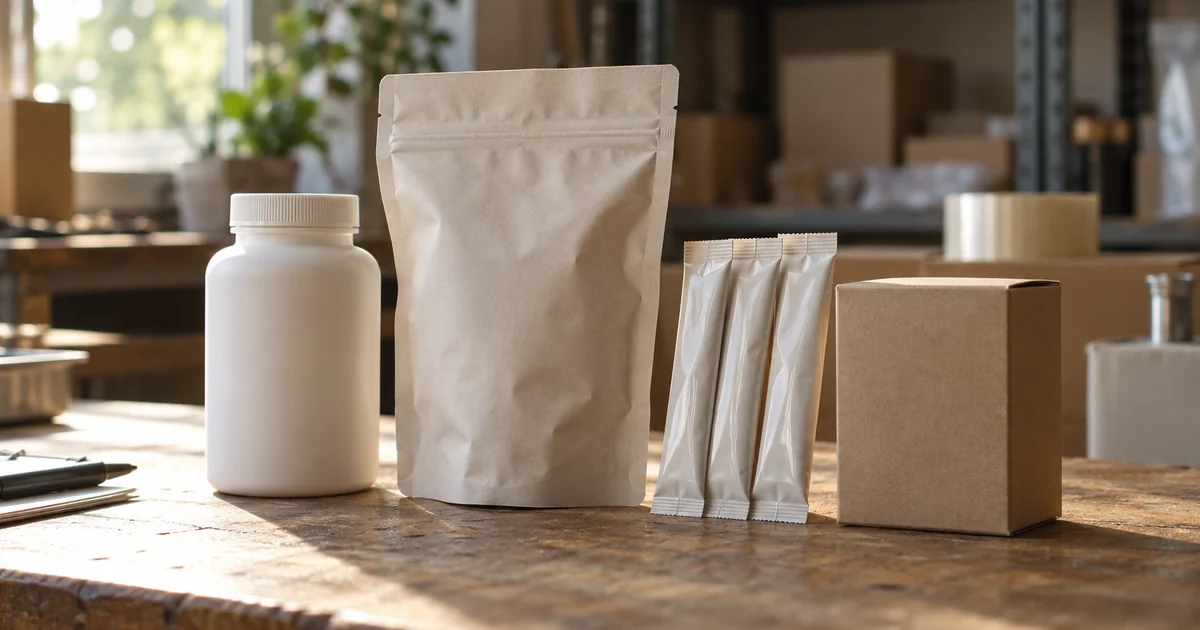
Brands obsess over the cost of the formula and ignore the cost of the box it goes in. That is backwards, because on a 60-count bottle the packaging can easily be 40 to 60 percent of your landed cost - and unlike the formula, it does not get cheaper when you negotiate well. It gets cheaper when you order more.
This is the layer-by-layer breakdown, with the numbers that decide whether your first run makes money.
The short answer
A supplement pack has four cost layers, and two hidden ones:
- Primary container - bottle, jar, pouch, blister, stick pack
- Closure and seal - cap, liner, induction seal, shrink band
- Label - material, print, plates, application
- Secondary packaging - carton, insert, shipper
Hidden: tooling (moulds, dies, print plates) and minimum print quantities (the MOQ of the packaging supplier, which is usually higher than the MOQ of the filler).
On a 60-count HDPE bottle at 1,000 units, the four layers typically add 0.45 to 0.90 USD per unit. At 1,000 units the same pack can cost 0.90 to 1.70 USD, because setup costs are spread over a fifth of the volume.
Format comparison
Typical ranges for Asia-sourced packaging in 2026. Your quote will move with bottle size, decoration and print colours.
| Format | Unit cost at 1,000 | Unit cost at 5,000 | Packaging MOQ | Freight impact |
|---|---|---|---|---|
| HDPE bottle, 60 to 120 cc | 0.75 to 1.40 | 0.45 to 0.90 | 5,000 to 10,000 | High, bulky and heavy |
| PET bottle, clear | 0.85 to 1.50 | 0.50 to 0.95 | 5,000 | High |
| Glass jar | 1.60 to 3.00 | 1.00 to 2.00 | 3,000 to 5,000 | Highest, fragile |
| Stand-up pouch, 250 g | 0.55 to 1.10 | 0.28 to 0.60 | 5,000 to 10,000 | Low, flat packs |
| Stick pack (film only) | 0.10 to 0.22 per stick | 0.05 to 0.12 per stick | 50 to 100 kg of film | Low per dose, high per unit count |
| Blister card | 0.60 to 1.20 | 0.30 to 0.65 | 10,000 plus tooling | Medium |
| Sachet, 5 g to 10 g | 0.20 to 0.45 | 0.10 to 0.25 | 10,000 | Low |
Two things jump out of that table.
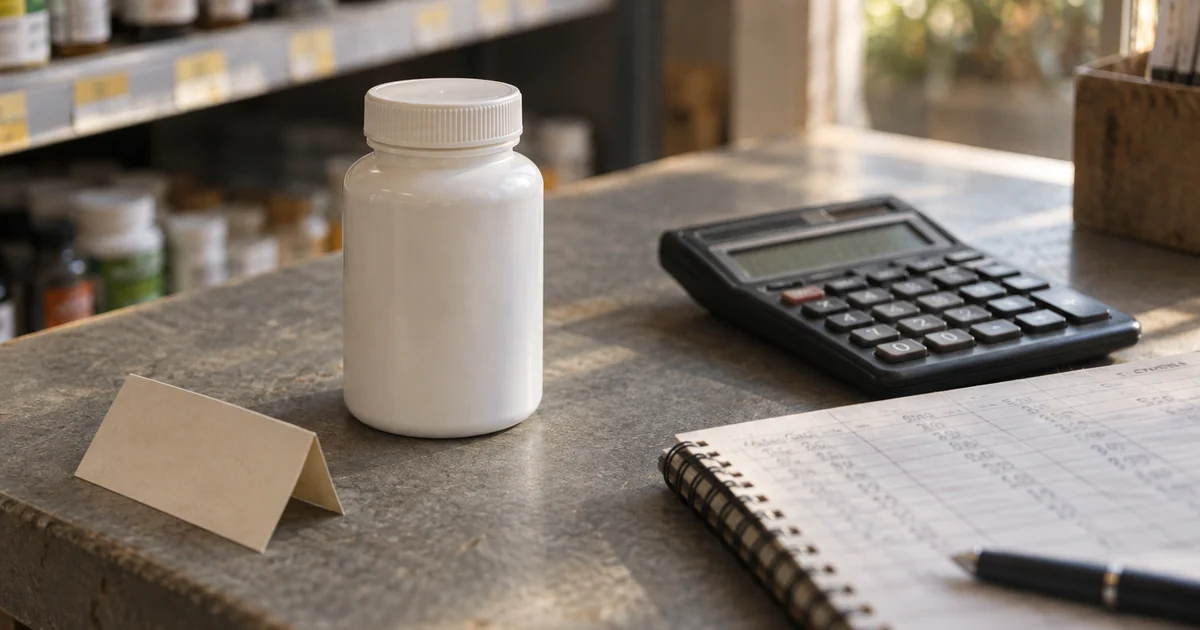
Bottles cost more than the formula at small volume. A 60-count bottle at 1,000 units can add more to your unit cost than the actives inside it.
Pouches and stick packs are the small-brand formats. They have lower unit cost at low volume and much lower freight, because you are shipping flat film instead of air.
The four layers, worked out
A 60-count HDPE bottle with a printed label, induction seal and carton, at two order sizes:
| Layer | At 1,000 units | At 1,000 units |
|---|---|---|
| Bottle | 0.32 | 0.21 |
| Cap and induction seal | 0.11 | 0.07 |
| Label (printed, applied) | 0.28 | 0.11 |
| Carton and shipper | 0.35 | 0.18 |
| Total per unit | 1.06 | 0.57 |
The formula did not change. The bottle did not change. The difference is that the label's print setup and the carton's die and print run were spread over five times as many units, and the bottle supplier moved from a 1,000-unit short run to a 5,000-unit price break.
That is also why a manufacturer's packaging quote at "1,000 units" can look almost the same as at "1,000 units" for the product, and completely different for the pack.
The label is the cheapest item and the most expensive mistake
A label costs a few cents. Getting it wrong costs thousands.
- Print plates or digital setup: 100 to 400 USD per colour in flexo, often zero for digital short runs.
- Minimum print quantity: usually 5,000 to 10,000 labels regardless of how many bottles you fill. You will pay for labels you will not use for a year.
- Artwork revisions: each round of proofing adds days, and each reprint adds a full setup charge.
- Application: machine-applied labels are cheap per unit; hand application on a small run is not.
- Compliance content: net quantity, ingredient list, allergen statement, supplement facts panel, storage and batch fields. A missing field can mean reprinting the whole run.
The practical rule: finalise the label before you book the filling date, and proof it against a printed sample, not a PDF on a screen. Colours shift, small text fills in, and barcodes fail to scan more often than anyone expects.
Why small runs pay more, in one paragraph
Packaging suppliers price in steps: 1,000, 3,000, 5,000, 10,000. Each step re-covers the same setup cost across more units. Below 1,000 units you are almost always paying a short-run premium on the bottle, a full plate charge on the label, and a minimum print run on the carton. The filler's MOQ is often the smallest number in the chain - it is the packaging that sets your real minimum, which is why the answer to "can I do 500 units" is usually "yes, at a price that makes 1,000 look cheap".
Freight is part of the packaging decision
A 60-count bottle weighs roughly 40 to 60 g empty and occupies far more volume than the product inside it. A pouch of the same product weighs a fraction of that and ships flat.
For a 1,000-unit order shipped by air, the difference between bottles and pouches can be 1,500 to 3,000 USD in freight alone. That single line item has killed more first launches than any formula cost.
If your product is a powder, a stick pack or a pouch is not just cheaper to pack, it is cheaper to move. If your product must be counted, protected from moisture, or look like a supplement on a shelf, you need the bottle and you should budget for it.
Where to save without hurting the product
| Lever | Saving | Risk |
|---|---|---|
| Stock bottle plus custom label | 30 to 50 percent of primary cost | Looks less premium |
| One or two label colours instead of four | 0.05 to 0.15 per unit | Design constraint only |
| Stock cap and liner | 0.02 to 0.05 per unit | None if seal is intact |
| Drop the carton for e-commerce | 0.15 to 0.35 per unit | Weaker shelf presence |
| Concentrate the formula, smaller bottle | 0.10 to 0.30 per unit plus freight | Serving size changes |
| Pouch instead of bottle for powders | 0.20 to 0.60 per unit plus freight | Different customer expectation |
| Order packaging for two runs at once | 10 to 20 percent on the pack | Cash tied up, storage needed |
The one saving to avoid: cheap closures. A leaking cap or a failed induction seal destroys more value in one shipment than the entire saving across the run.
Regulatory details that force a reprint
These vary by market, so treat them as a checklist to confirm with your regulatory contact, not as legal advice.
- Net quantity must appear in the required units and format for the market.
- Supplement Facts (US) or nutrition declaration (EU) must match the actual fill, not the formula sheet.
- Allergen statements are mandatory in most markets and depend on excipients, not just actives.
- Country of origin and manufacturer or distributor address may be required.
- Recyclability and packaging claims: "recyclable", "compostable" and "made with recycled content" are regulated claims in the EU and increasingly in the US. Do not put them on a label without documentation.
- Child-resistant closures are required for some products and some markets, and they cost more.
Every one of these lives on the label, which is the cheapest component to change on paper and the most expensive to change after printing.
What to ask before you approve packaging
- What is the packaging MOQ, separate from the filling MOQ?
- Are plates, dies or moulds included, or charged separately?
- Which parts are stock and which are custom?
- What is the label minimum print run, and how long does a reprint take?
- What is the packed weight and carton dimension, so I can quote freight?
- Can I see a physical proof or a filled sample before the full run?
- Which regulatory fields do you check, and who signs off the artwork?
- What happens if the packaging arrives damaged, and who owns that risk?
- What is the lead time for the pack versus the fill?
- Can I hold packaging stock at your warehouse for a second run?
Frequently asked questions
How much does supplement packaging cost per unit?
For a 60-count bottle with label and carton, plan on 0.45 to 0.90 USD at 1,000 units and roughly double that at 1,000. Pouches and stick packs are cheaper at low volume and much cheaper to ship.
Can I use my own packaging supplier?
Usually yes, but confirm who takes responsibility for compatibility, and expect the filler to run a trial with your components. Many fillers will not warranty a seal on a bottle they did not supply.
Why is my label quote higher than the bottle?
Because of plates and minimum print runs. The label itself is a few cents; the setup is hundreds of dollars and is charged whether you order 1,000 or 10,000.
Do I need custom packaging to look professional?
No. A stock bottle with a well-designed label reads as a real brand. Custom moulds only make sense above roughly 30,000 to 50,000 units per year.
Should I order packaging for two production runs at once?
If cash allows, yes. Print and moulding setup is charged per order, and the second run is materially cheaper when the plates already exist.
The takeaway
Packaging is not a detail you finalise at the end. It is the layer that decides your minimum order, your landed cost and your freight bill, and it is the one place where a small order pays a visible premium. Choose the format first, price the four layers at your real volume, finalise the label before the fill date, and never save money on the closure.
If you send us your target volume, dosage form and market, we will price the pack and the fill together, so you can see which format actually works at your order size. We quote stock, semi-custom and fully custom formats through our private label program, and can price the same product in two formats side by side.