

Quality Control & Certifications
Certification
Our Quality Control Process
- ✓Incoming material identification and supplier documentation review
- ✓In-process controls on every production line
- ✓Finished-product release testing before shipment
- ✓Third-party laboratory testing on request
- ✓Batch records and certificates of analysis retained for every order
Certified Entity
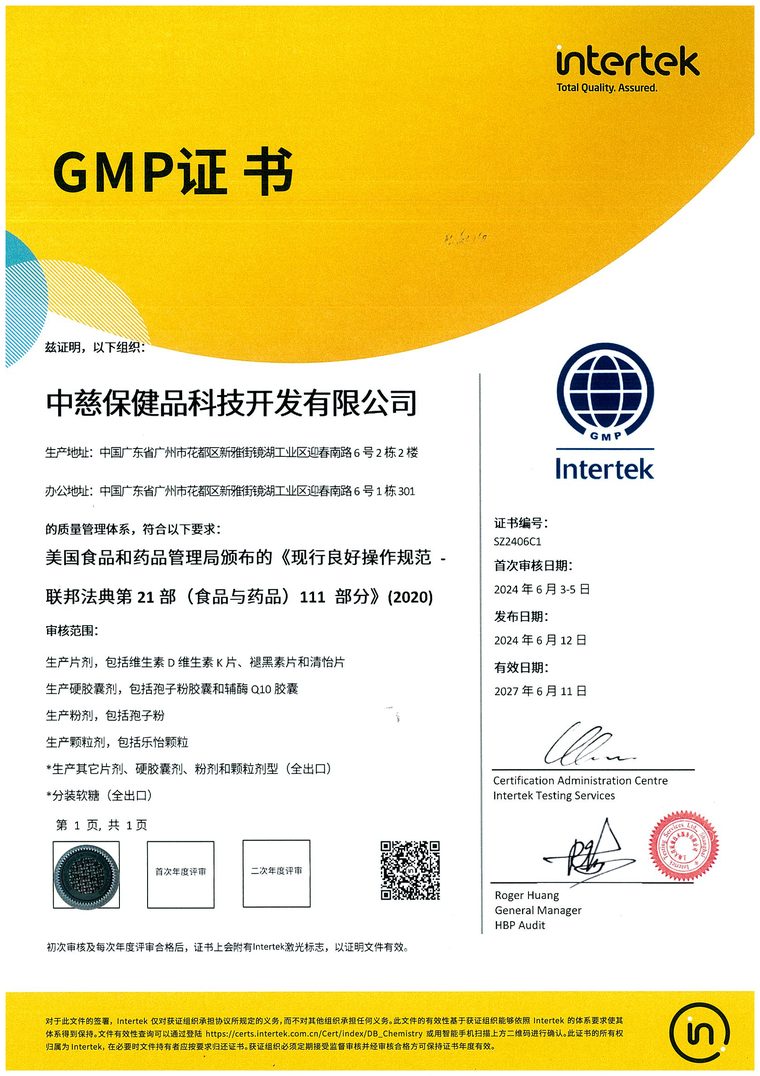
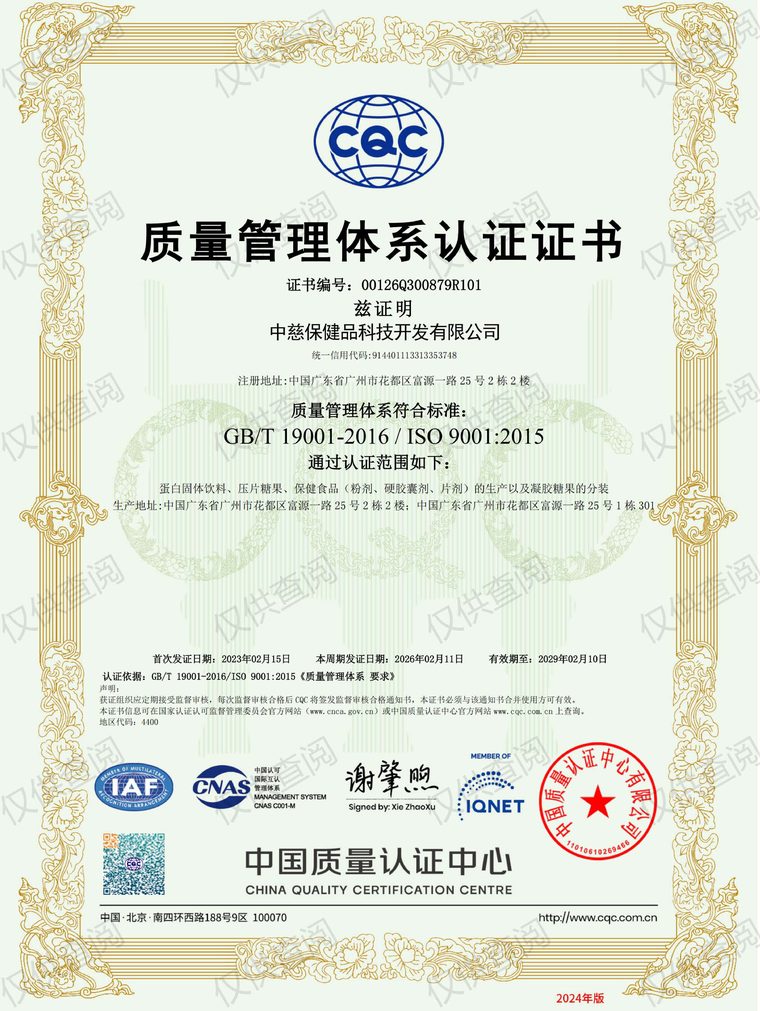
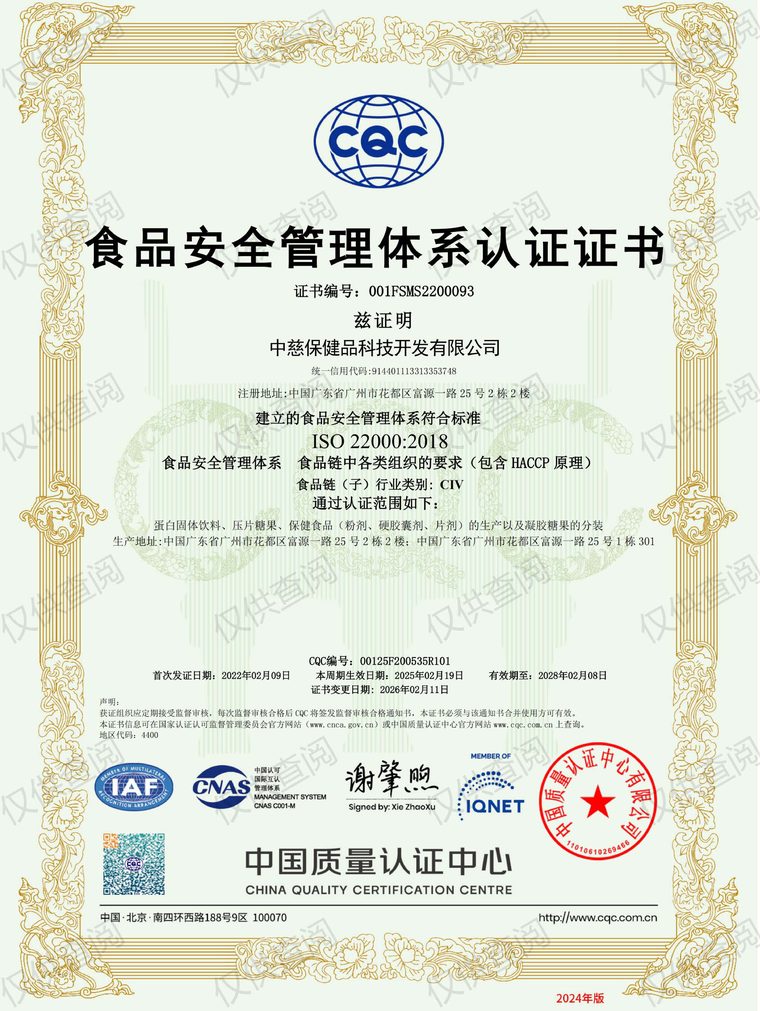
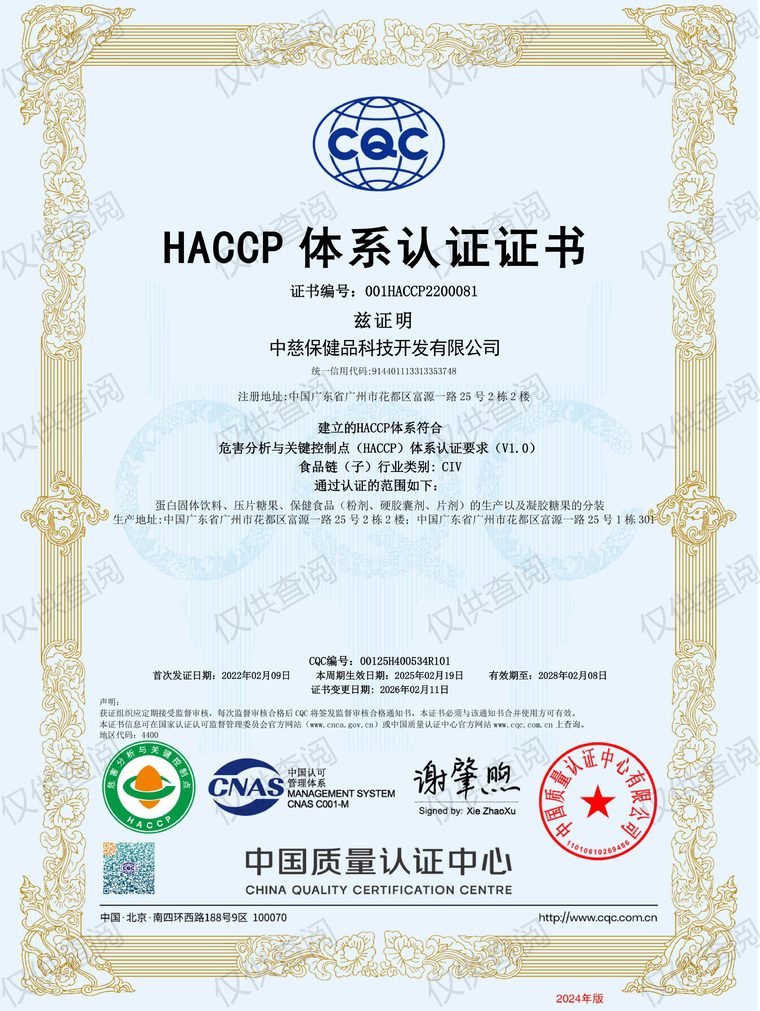
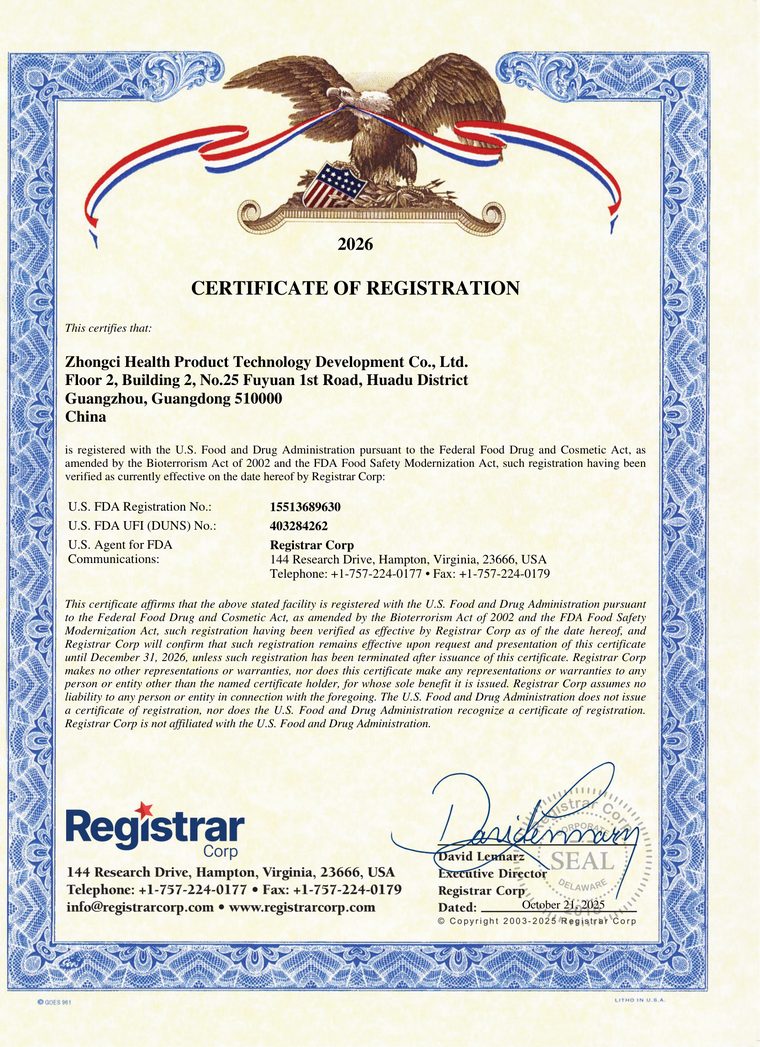
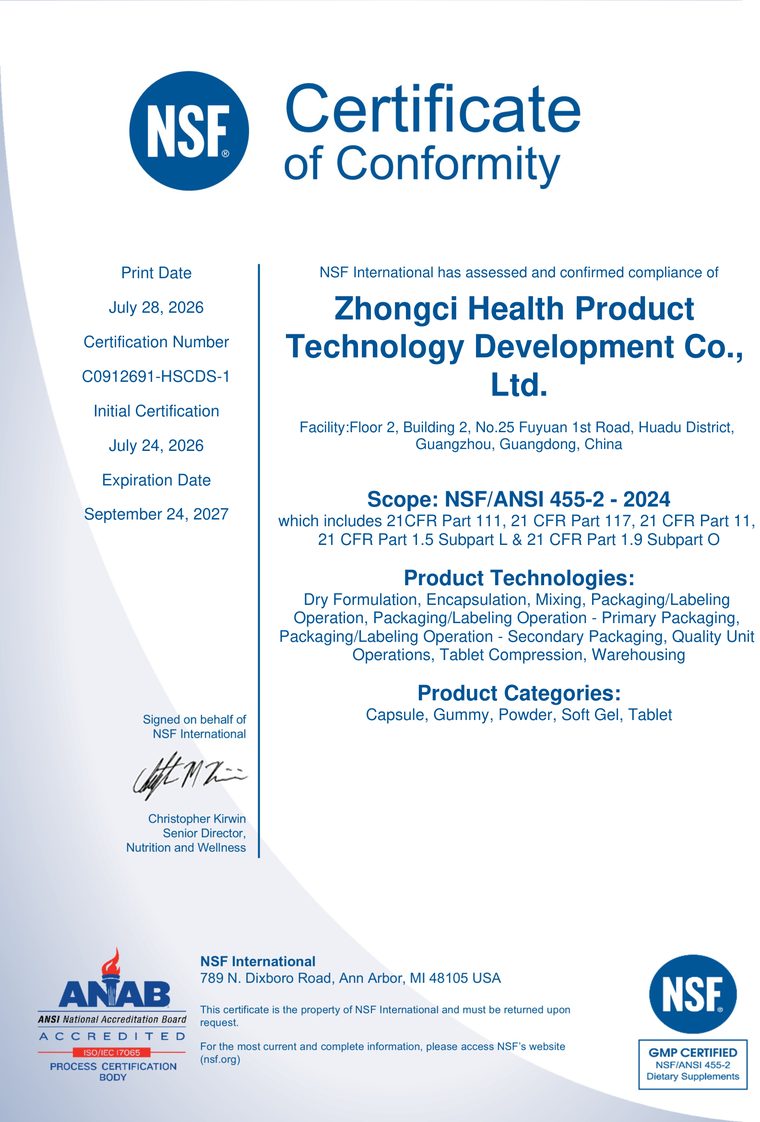
The certificates on this page are issued to Zhongci Health Products Technology Development Co., Ltd. (Business Registration No. 914401113313353748), Huadu District, Guangzhou, Guangdong, China — the manufacturer behind ZOOMSHEAL.
The U.S. Food and Drug Administration does not issue certificates of registration; this facility registration is verified by our U.S. agent, Registrar Corp.
What Each Certificate Actually Covers
Certificates are usually read as a single badge of quality, and they are not. GMP certifies the facility and the process — the building, the equipment, the documentation and the staff training — not any individual product. ISO 22000 certifies a food safety management system, which covers hazard analysis and traceability but says nothing about potency. HACCP is the hazard analysis method inside that system. ISO 9001 is quality management and is about consistency, not safety. NSF is different again: it can certify a facility or test a specific product against its label claim. A factory can hold GMP and still ship an under-potent batch if the finished-product testing is weak, which is why we show both the certificates and the release testing that happens per lot.
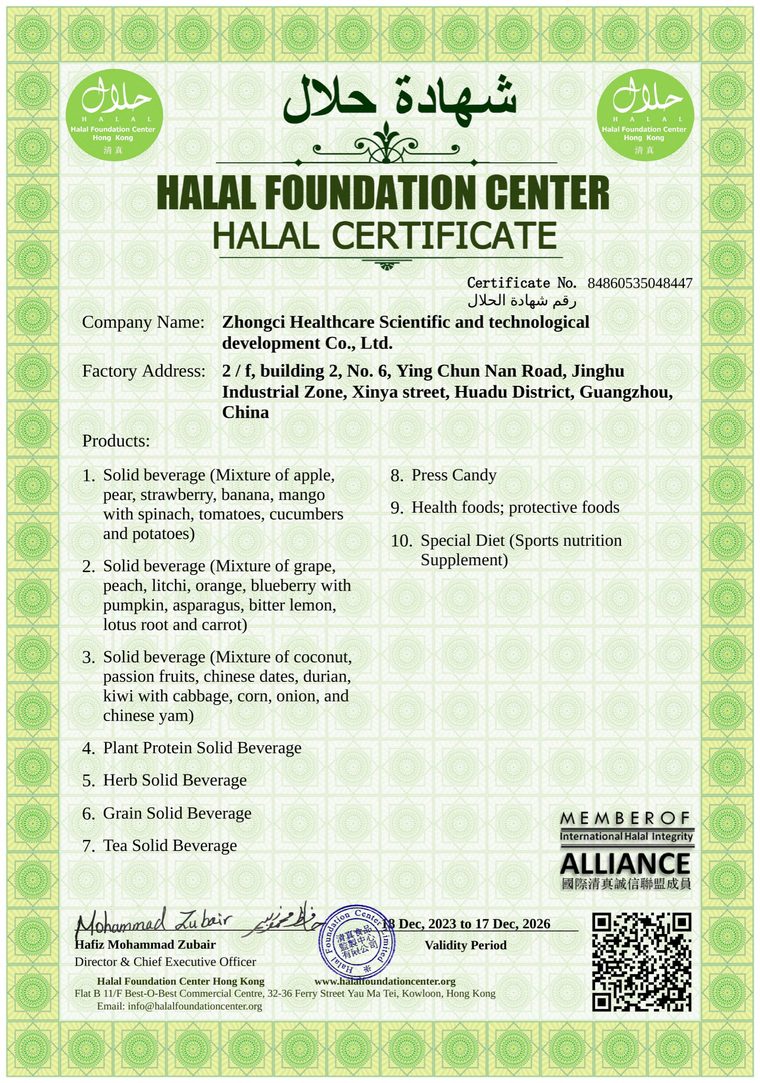
Two certificates cause the most confusion. FDA registration is not an approval: it means the facility has registered with the FDA and is subject to inspection, and no US authority has reviewed the formula. Halal certification is product- and line-specific — a plant can be Halal-certified for capsules and not for a gummy line that shares equipment with gelatin. If your market requires Halal, ask which lines and which products are in scope, not whether the company 'is Halal'.
How to Verify a Certificate Before You Pay a Deposit
Ask for the full PDF, not a cropped image of the front page, and check four things. First, the legal entity named on the certificate must match the entity on your contract and invoice — a trading company quoting with a factory's certificate is the most common problem in this industry. Second, check the scope wording: a certificate covering 'hard capsules' does not cover gummies or softgels. Third, check the expiry date and the surveillance audit date, because a certificate can be suspended between audits. Fourth, verify the certificate number directly with the issuer — Intertek, SGS, CQC and NSF all publish verification portals, and it takes two minutes.
For the US market, the FDA registration number can be checked in the FDA's own database, and the registered name should match the manufacturer, not the brand. For the EU, the relevant question is not a certificate at all but whether the ingredients are permitted in food supplements and whether any novel food authorisation applies. We send the certificate pack, the CoA template and the ingredient documentation together, so a buyer can verify the whole chain rather than one document.
Certification by Market
The documents a shipment needs depend on the destination, and a certificate that satisfies one market may be irrelevant in another. US-bound supplements need an FDA-registered facility, compliance with FSMA preventive controls, and a Supplement Facts panel in the correct format. The EU and UK need compliance with the Food Supplements Directive or its UK equivalent, permitted ingredient lists, and allergen labelling under FIC. The Gulf states usually ask for a health certificate, a Halal certificate and Arabic labelling, and Saudi Arabia additionally requires SFDA registration for some categories. Japan and Korea have their own notification systems and label formats.
We prepare the export document set per destination — certificate of origin, health certificate, CoA, MSDS where relevant, and the label artwork checked against that market's rules — because the certificate alone does not clear customs. If you are launching in several markets from one production run, tell us before artwork is approved: the label, the ingredient list and sometimes the formula itself need to differ, and reprinting after the fact costs more than planning for it.
Which Certificate Proves What
| Document | Issued By | What It Proves | What It Does Not Prove |
|---|---|---|---|
| GMP | Intertek | Facility, equipment and process meet good manufacturing practice | That a specific batch meets its label claim |
| ISO 9001:2015 | CQC | A quality management system is in place and audited | Product safety or ingredient compliance |
| ISO 22000:2018 | CQC | Food safety management system with hazard analysis and traceability | Potency, or that a formula is legal in your market |
| HACCP | CQC | Hazards are identified and controlled at defined critical points | Anything about labelling or claims |
| NSF | NSF International | Facility or product audited against NSF supplement standards | Compliance with EU or Gulf rules |
| FDA registration | US FDA (via US agent) | The facility is registered and subject to inspection | Approval of the product or the formula |
| Halal | Halal Foundation Center | The named lines and products are Halal-certified | That every product from the plant is Halal |
Certification Questions Buyers Ask
Is FDA registration the same as FDA approval?
No. FDA registration means the facility is registered with the FDA and subject to inspection. Dietary supplements do not require pre-market approval in the US, so no authority reviews the formula before it is sold. Compliance is the manufacturer's and the brand's responsibility.
Can you send the certificate PDFs before we place an order?
Yes. We send the full certificate pack, the CoA template and the ingredient documentation on request, with the certificate numbers visible so you can verify them with Intertek, CQC or NSF directly.
Does GMP certification cover every product you make?
It covers the facility and the processes within the certified scope, not each individual SKU. Product-level assurance comes from the batch record, the release testing and the CoA issued for that lot.
Is your Halal certificate valid for gummies and softgels?
Halal scope is line- and product-specific, and gelatin-based products need a Halal-certified gelatin source. We confirm which lines are in scope for your dosage form before quoting, rather than assuming the plant certificate covers it.
What do EU-bound shipments need that US shipments do not?
Compliance with the Food Supplements Directive, permitted ingredient lists, allergen labelling under FIC, and a food business operator established in the EU or UK for imports. Some ingredients also require novel food authorisation, which is a formula issue rather than a factory issue.
How often are the certificates renewed?
GMP, ISO 9001 and ISO 22000 run on three-year cycles with annual surveillance audits; Halal and NSF are renewed annually. We keep the current PDFs on this page and can provide the audit reports under NDA.