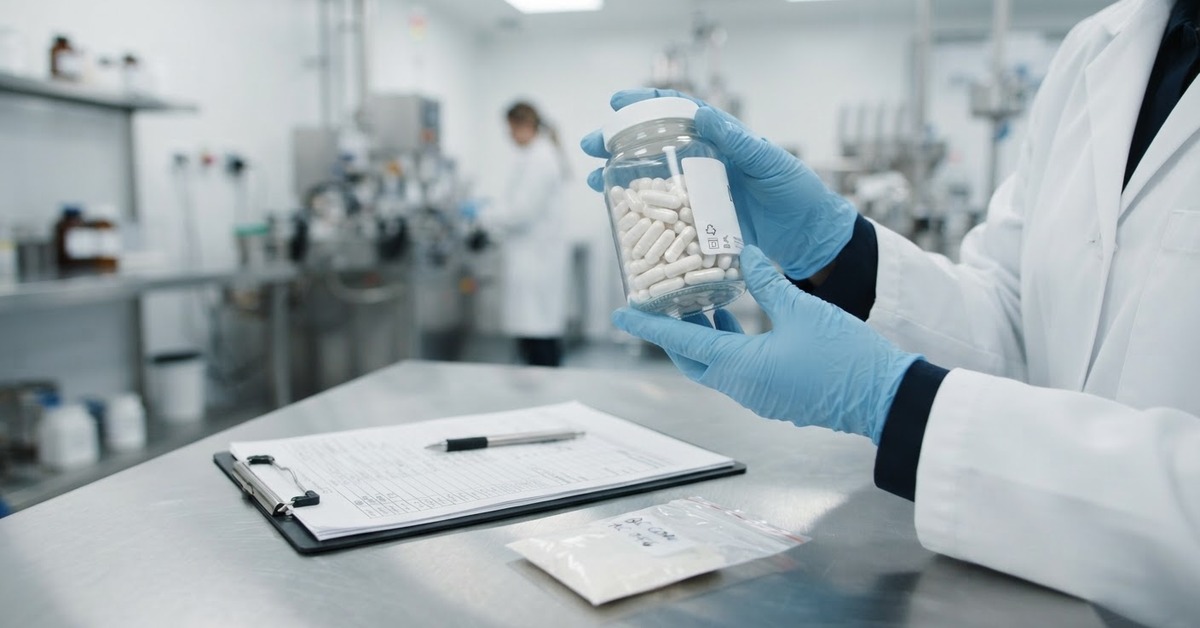

Third-party testing means sending your supplement batches to an independent, ISO 17025-accredited laboratory that verifies identity, potency, purity, and safety — then issues a Certificate of Analysis (COA). Every responsible brand should test every batch before products ship, and retailers increasingly require COAs before they will stock your products.
Dietary supplements are regulated as foods, not drugs, in most markets — which means they are not pre-approved by regulators before they reach store shelves. That places the burden of quality squarely on manufacturers and brands. Third-party testing is the single most powerful tool you have to prove your products contain what the label claims, at the stated dose, without harmful contaminants.
This guide explains what third-party testing is, what a COA actually tells you, which tests matter most, and how to build a testing program your brand — and your retailers — can trust.
1. What Is Third-Party Supplement Testing?
Third-party testing is laboratory analysis performed by an independent lab that has no financial interest in your product. "Third party" means the lab is separate from both you (the brand) and your manufacturer. This independence is what gives the results credibility.
A reputable testing lab holds ISO 17025 accreditation, which means its testing methods, equipment, and personnel have been audited against international quality standards.
2. Why Third-Party Testing Matters
Regulatory Reality
Under the FDA's Dietary Supplement Health and Education Act (DSHEA) framework, supplement manufacturers are responsible for ensuring their products are safe and properly labeled before marketing. The FDA does not approve supplements before sale — it can only act after problems are found. This makes proactive testing your first line of defense.
Retailer Requirements
Major retailers like Amazon, Walmart, and CVS increasingly require supplements to have third-party test results and COAs on file. Without them, your products simply will not get listed.
Consumer Trust
Consumers are more educated than ever. "Third-party tested" is now a trust signal that appears on the packaging of top-selling brands, and shoppers actively look for it.
3. The Certificate of Analysis (COA): What It Contains
A COA is the formal document a lab issues after testing a batch. A complete COA should include:
- Product name and batch/lot number — ties the COA to a specific production batch.
- Manufacturing date and test date.
- Test methods — e.g., HPLC, GC-MS, ICP-MS, or microbial enumeration.
- Specifications vs. results — the accepted range and the measured value for each test.
- Identity — confirmation the active ingredient is what the label claims.
- Potency/assay — the measured amount of each active ingredient, usually shown as a percentage of label claim.
- Purity — absence of undeclared substances.
- Heavy metals — lead, arsenic, cadmium, mercury levels.
- Microbial testing — total plate count, yeast, mold, E. coli, Salmonella.
- Residual solvents or pesticides — depending on the ingredient source.
- Lab accreditation number and sign-off — proof the lab itself is qualified.
4. The Four Core Test Categories Every Batch Needs
1) Identity Testing
Confirms the ingredient is actually what it claims to be. This is critical because herbal and botanical ingredients are the most commonly adulterated or substituted category in the supplement industry. Advanced methods include DNA barcoding, HPLC fingerprinting, and mass spectrometry.
2) Potency / Assay Testing
Measures how much of the active ingredient is present, compared to the label claim. Industry best practice is to allow a small tolerance (typically ±10% of label claim), but many brands now target tighter ranges. Potency testing also verifies stability — that the ingredient has not degraded during production or storage.
3) Purity / Contaminant Testing
Screens for heavy metals (lead, arsenic, cadmium, mercury), pesticides, residual solvents, and other unwanted substances. Botanical ingredients are especially at risk of heavy metal accumulation from soil, so every plant-based product should be tested.
4) Microbial Testing
Checks for harmful microorganisms: Salmonella, E. coli, Staphylococcus aureus, yeast, and mold. This is mandatory for any product consumed orally and is particularly important for gummies and liquids with higher water activity.
5. What About Potency Claims Like "Third-Party Verified"?
Be careful with terminology. "Third-party tested" simply means an independent lab ran tests. "Third-party verified" or "certified" usually implies a program with ongoing audits, such as:
- NSF International — certifies products against NSF/ANSI 173 (dietary supplements) and screens for over 200 contaminants.
- USP Verification Program — verifies ingredients, contaminants, and manufacturing practices against USP standards.
- ConsumerLab.com — independent testing and review program.
- Informed Sport / Informed Choice — anti-doping certification for athletes; tests for banned substances.
These programs go beyond a single batch test and provide ongoing, audited assurance. If your product targets athletes, Informed Sport is practically a requirement.
6. Batch Testing vs. One-Time Testing
One-time testing of a single batch proves nothing about the batches that follow. Raw materials vary by harvest season and supplier, and manufacturing processes can drift. Responsible brands test:
- Raw materials on receipt — before they enter production.
- Finished product per batch — before it ships.
- Periodic stability testing — to validate shelf life.
This is also what GMP regulations require. Under 21 CFR Part 111, supplement manufacturers must verify that every batch meets specifications — and third-party testing is the most credible way to demonstrate that compliance.
7. How to Read a COA Like a Pro
When you receive a COA, check these five things first:
- Is the batch number on the COA identical to the batch on your product label? Mismatched COAs are a major red flag.
- Is the lab ISO 17025 accredited? Look for the accreditation number.
- Are potency results within the stated specification? Results should typically be within ±10% of label claim.
- Are heavy metals below the limits? For example, California Prop 65 limits lead to 0.5 mcg/day — stricter than federal limits. Know your target market's limits.
- Is microbial testing within limits? Salmonella and E. coli should be absent; yeast and mold counts should be minimal.
8. Common Testing Red Flags
- A supplier that refuses to share COAs or only shares them after purchase.
- COAs that look identical across different batches (suggesting templates, not real tests).
- Labs without ISO 17025 accreditation or with expired accreditations.
- No heavy metal or microbial results on a botanical product.
- Potency results that are suspiciously "perfect" every single time.
9. How Much Does Third-Party Testing Cost?
Testing costs vary by scope, but typical ranges are:
| Test type | Typical cost (per batch) |
|---|---|
| Identity (HPLC/DNA) | $100 – $500 |
| Potency/assay | $150 – $600 |
| Heavy metals panel | $100 – $300 |
| Microbial panel | $100 – $250 |
| Full panel (all of the above) | $400 – $1,500 |
That is a small price compared to the cost of a recall, a retailer delisting, or a consumer lawsuit. Many brands build testing costs into their product COGS.
10. How to Choose a Testing Lab
- Verify ISO 17025 accreditation through the accreditation body's directory.
- Check the lab's experience with your ingredient type — botanical extracts, probiotics, and oils each require specialized methods.
- Ask for sample COAs and have your formulator review them.
- Confirm turnaround times — typically 5–15 business days per batch.
- Consider working with a manufacturer that already tests every batch — this saves you cost and time.
11. Working with a Manufacturer Who Takes Testing Seriously
The easiest way to build a bulletproof testing program is to partner with a contract manufacturer that treats quality control as a core competency. A GMP-certified manufacturer with an in-house quality lab will typically:
- Test raw materials on arrival.
- Conduct in-process checks during production.
- Test finished products per batch.
- Provide COAs for every batch you order.
- Maintain full traceability documentation for audits.
ZOOMSHEAL operates GMP-certified production facilities with rigorous incoming, in-process, and finished-product quality control, and provides batch COAs for every order. Learn more about our GMP-certified quality assurance process.
12. Frequently Asked Questions
Is third-party testing required by law?
Not explicitly as "third-party" testing. But GMP regulations (21 CFR Part 111 in the US) require manufacturers to verify batch quality, and third-party testing is the most widely accepted way to demonstrate it. Many retailers make it a de facto requirement.
What is the difference between a COA and third-party certification?
A COA documents the test results of one specific batch. Certification (like NSF or USP) is an ongoing program with audits, facility inspections, and continuous compliance requirements.
How often should supplements be tested?
Every batch of finished product should be tested. Raw materials should be tested on receipt, and stability testing should be done periodically throughout the product's shelf life.
Can I trust my manufacturer's in-house lab results?
In-house labs are valuable for daily quality control, but third-party testing adds independent verification. The strongest programs use both: in-house testing for speed and third-party testing for credibility.
Are gummies tested differently from capsules?
The test categories are the same (identity, potency, purity, microbial), but methods differ. Gummies require moisture-content testing and may need special preparation due to their sugar matrix. Microbial testing is especially important for gummies.
How long does third-party testing take?
Typically 5–15 business days per batch, depending on the test panel and the lab's workload. Plan your inventory and launch timeline accordingly.
13. Final Takeaways
Third-party testing is not a cost — it is an investment in your brand's credibility, retailer relationships, and consumer safety. In a market where trust is the ultimate differentiator, documented third-party test results are one of the strongest competitive advantages a supplement brand can have.
Choose your lab carefully, demand a COA for every batch, learn to read those COAs, and partner with a manufacturer whose quality systems make testing easy rather than optional.