
Quick answer: Choose capsules for fast release and easy swallowing, tablets for cost-effective high-dose formulas, softgels for fat-soluble vitamins and oils, gummies for consumer appeal and compliance, and powders for high-dose servings and customizable blends. Your choice should be driven by your active ingredients, target dosage, shelf-life requirements, and your end customer's preferences — not by what is cheapest to produce.
Choosing the right supplement format is one of the most important decisions you will make when developing a private label supplement brand. The format affects everything downstream: formulation stability, manufacturing cost, packaging design, consumer experience, and even your profit margin per bottle.
This guide breaks down the five most common supplement formats — hard-shell capsules, tablets, softgels, gummies, and powders — and gives you a practical framework for choosing the right one for your product.
1. Why Supplement Format Matters More Than You Think
Your supplement format is not just a delivery vehicle. It is a product decision that impacts:
- Bioavailability: Some ingredients absorb better in liquid or oil form than in compressed powder.
- Dosage ceiling: A single capsule holds roughly 400–800 mg of powder; a tablet can hold 500–1,000 mg; a powder sachet can hold several grams.
- Consumer compliance: Studies consistently show that people are more likely to take a supplement daily if it tastes good and is easy to swallow.
- Manufacturing cost: Softgels and gummies require more complex equipment and longer production cycles than tablets.
- Shelf life: Moisture-sensitive ingredients need formats with strong moisture barriers.
According to industry data, gummies and capsules are the fastest-growing formats in the dietary supplement market, while tablets remain the volume leader in unit sales. For a private label brand, understanding these trade-offs before you start formulation will save you months of rework.
2. Capsules (Hard-Shell)
What They Are
Hard-shell capsules consist of two pieces — a body and a cap — typically made from gelatin or vegetarian cellulose (HPMC). They are filled with powder, granules, or tiny pellets.
Key Advantages
- Fast disintegration — capsules break apart quickly in the stomach, typically within 10–15 minutes.
- No taste or smell — the shell masks unpleasant ingredients completely.
- Easy to formulate — most dry ingredients can be encapsulated without complex processing.
- Flexible dosing — capsule sizes range from 000 (largest) to 5 (smallest).
- Vegetarian option — HPMC capsules appeal to plant-based consumers.
Limitations
- Lower payload than tablets — usually 400–800 mg per capsule.
- Moisture-sensitive ingredients need careful handling.
- More expensive per unit than tablets at high volumes.
Best For
Herbal extracts, vitamin-mineral blends, probiotics (with enteric or delayed-release capsules), and any ingredient with an unpleasant taste.
3. Tablets
What They Are
Tablets are compressed powders formed under high pressure, often with binders, fillers, and disintegrants. They can be coated (film-coated or sugar-coated) or left uncoated.
Key Advantages
- Highest payload — tablets can carry 500–1,000+ mg per unit, ideal for high-dose minerals like magnesium or calcium.
- Lowest cost at scale — high-speed tablet presses produce tens of thousands of tablets per hour.
- Excellent stability — low moisture content gives long shelf life.
- Tamper-evident and easy to score — tablets can be split for flexible dosing.
Limitations
- Harder to swallow than capsules for some consumers.
- Compression can affect ingredient bioavailability.
- Requires more excipients (binders, fillers), which matters for "clean label" positioning.
Best For
High-dose minerals, multivitamins, and large-volume, cost-sensitive SKUs where price per serving matters most.
4. Softgels
What They Are
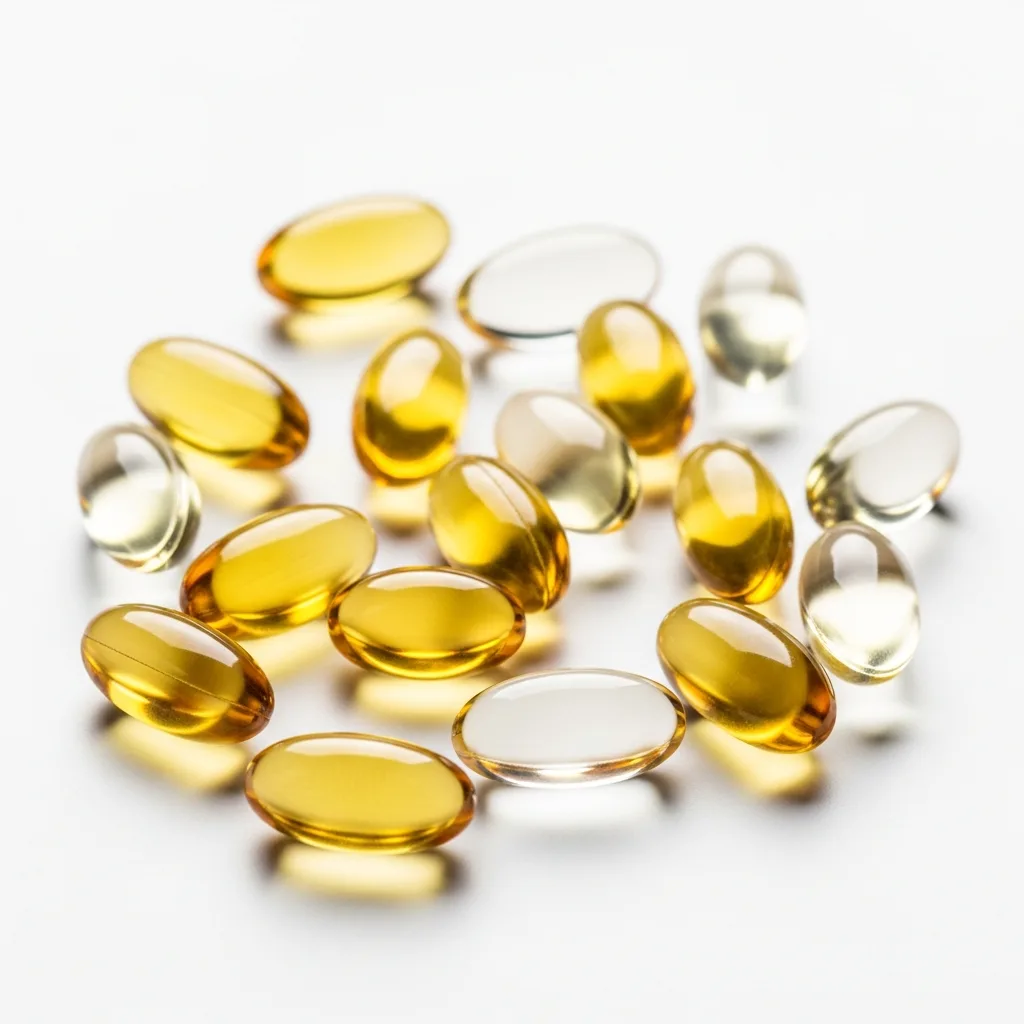
Softgels are one-piece gelatin (or vegetarian) shells filled with liquid or semi-liquid formulations — typically oils, oil suspensions, or lipid-soluble actives.
Key Advantages
- Superior for fat-soluble nutrients — vitamins A, D, E, K, omega-3s, CoQ10, and CBD isolates dissolve naturally in oil.
- High bioavailability — the liquid fill is absorbed directly, often faster than solid forms.
- Dose accuracy — each softgel contains a precisely measured liquid dose.
- Prevents oxidation — the airtight shell protects oxygen-sensitive oils.
Limitations
- Higher manufacturing cost and slower production than tablets.
- Gelatin softgels are not suitable for strict vegetarians (vegetarian softgel shells exist but are pricier).
- Heat-sensitive ingredients may degrade during the filling process.
Best For
Fish oil and omega-3s, vitamin D3, vitamin E, CoQ10, evening primrose oil, and any oil-soluble active.
5. Gummies
What They Are
Gummies are gelatin- or pectin-based chews infused with active ingredients, sugar or sugar substitutes, flavors, and colors.
Key Advantages
- Highest consumer appeal — gummies consistently outperform other formats in consumer preference surveys, especially among younger demographics and children.
- Great taste experience — flavors mask bitter actives like zinc, magnesium, and herbal extracts.
- Perceived as "treat-like" — higher daily compliance and repeat purchase.
- Premium pricing power — gummy products often command higher price points.
Limitations
- Low payload — typically 10–50 mg of active per gummy; high-dose ingredients require multiple gummies.
- Sugar and calories — sugar-free versions need careful sweetener selection (e.g., isomalt, maltitol, stevia).
- Stability challenges — moisture and heat can cause melting, sticking, or ingredient degradation.
- Higher production cost — longer drying cycles and specialized equipment.
Best For
Vitamins (C, D3, B-complex), minerals at moderate doses (zinc, magnesium), melatonin, collagen, and herbal extracts aimed at mass-market or child-friendly positioning.
6. Powders
What They Are
Powders are dry, loose formulations that consumers mix with water, juice, or food. They come in bulk jars, stick sachets, or single-serve packets.
Key Advantages
- Unlimited dose flexibility — you can deliver 5 g, 10 g, or more per serving, impossible in capsules or tablets.
- Ideal for large molecules — collagen peptides, protein, creatine, and fiber need gram-level doses.
- Customizable flavors — endless flavor and sweetener combinations.
- Cost-effective — no encapsulation or compression step; simple blending and packaging.
Limitations
- Requires mixing, which is a barrier for some consumers.
- Taste and texture must be carefully engineered.
- Moisture-sensitive actives need desiccants and strong packaging.
- Lower perceived convenience vs. a swallow-and-go format.
Best For
Protein and collagen peptides, creatine, greens blends, fiber, electrolytes, and any formula requiring gram-level doses.
7. Side-by-Side Comparison Table
| Factor | Capsules | Tablets | Softgels | Gummies | Powders |
|---|---|---|---|---|---|
| Max dose per unit | 400–800 mg | 500–1,000 mg | ~500 mg (liquid) | 10–50 mg | 1–10 g |
| Bioavailability | High | Moderate | Very high (lipids) | Moderate | High |
| Consumer appeal | High | Moderate | High | Very high | Moderate |
| Production cost | Medium | Low | High | High | Low |
| Unit cost at scale | $$ | $ | $$$ | $$$ | $ |
| Shelf life | Long | Longest | Medium | Medium | Medium–Long |
| Vegetarian option | Yes (HPMC) | Yes | Limited | Yes (pectin) | Yes |
| Ideal for | Extracts, probiotics | High-dose minerals | Oils, fat-soluble vitamins | Vitamins, melatonin | Protein, collagen, creatine |
8. How to Choose: A Practical Decision Framework
Work through these five questions in order:
- What is the active dose? If you need more than 1 g per serving, you are looking at powders or multi-unit formats.
- Is the active fat-soluble or oil-based? If yes, softgels are almost always the right call.
- Who is your target consumer? Kids and young adults? Gummies. Athletes? Powders or capsules. Seniors? Easy-to-swallow capsules or small tablets.
- What is your price point? Mass-market and value positioning favors tablets; premium lifestyle branding supports gummies and softgels.
- What are your stability requirements? Probiotics need protected formats; vitamin C and B-complex degrade with moisture, favoring dry formats.
9. Cost Considerations for Private Label Brands
Manufacturing cost per bottle is a major driver of your retail margin. As a general rule:
- Tablets are the cheapest format to produce at volume.
- Capsules add a small premium over tablets.
- Powders are cheap to blend but packaging (jars vs. sachets) drives cost.
- Softgels and gummies are the most expensive to produce and require the highest MOQs.
Working with an experienced tablet manufacturer, capsule manufacturer, softgel manufacturer, gummy manufacturer, or powder manufacturer with in-house R&D can help you optimize both formulation and cost before you commit to packaging.
10. Can You Mix Formats in One Brand?
Absolutely — and many successful brands do. A common strategy is to launch a hero product in one format (e.g., a daily multivitamin gummy) and expand the line with capsules or powders for higher-dose SKUs. Mixing formats lets you:
- Cover different consumer segments with one brand.
- Test a low-risk format before scaling into expensive ones.
- Spread manufacturing risk across different production lines.
Just be aware that each format you add increases your SKU count, inventory complexity, and regulatory labeling requirements.
11. Frequently Asked Questions
Are gummies less effective than capsules?
Not necessarily. Effectiveness depends on the dose and ingredient stability, not the format itself. However, gummies have a lower dose ceiling, so high-dose actives may require multiple gummies per day to match capsule doses.
Which supplement format is easiest to swallow?
Small capsules and mini-tablets are easiest to swallow. Softgels are also smooth and easy. Large tablets are the hardest for many people.
Are tablets cheaper to manufacture than capsules?
Yes, at scale. High-speed tablet presses produce more units per hour at lower per-unit cost, and tablets require less expensive shell materials.
Do softgels absorb better than tablets?
For fat-soluble nutrients like omega-3s, vitamin D3, and CoQ10, softgels generally offer better absorption because the active is already dissolved in oil. For water-soluble vitamins, capsules and tablets absorb similarly.
What is the shelf life of gummy supplements?
Typically 18–24 months when properly formulated with moisture barriers and stored in cool, dry conditions. Pectin-based gummies generally have better stability than gelatin-based ones in warm climates.
Can I make sugar-free gummies?
Yes. Sugar-free gummies use sweeteners like isomalt, maltitol, erythritol, or stevia. They require careful formulation because sugar alcohols affect texture and setting time.
12. Final Recommendations
There is no single "best" supplement format — only the best format for your specific product and audience. Start by defining your active ingredient and dose, then match it to the format that delivers it reliably, affordably, and enjoyably.
If you are developing a private label product and want expert guidance on formulation and format selection, contact Zoomsheal Health — a GMP-certified supplement contract manufacturer with in-house R&D, flexible MOQs, and full production capabilities across capsules, tablets, softgels, gummies, powders, and drops.