

Manufacturing capabilities at a glance
| Dosage forms | Powder blends, drink mixes, stick packs and sachets |
|---|---|
| Minimum order quantity | From 500 units per SKU for gummies, powders and liquids, and from 1,000 units for capsules, tablets and softgels, depending on formula and packaging |
| Lead time | 4–6 weeks after formula and artwork approval, excluding shipping |
| Custom formulation | Protein, probiotic and functional beverage blends, including taste and dosing |
| Certifications | GMP, ISO 22000 and HACCP; Halal and organic options available |
| Documentation | Certificate of analysis (CoA) for every batch, specification sheet, MSDS and export documents |
| Packaging & labelling | Bottles, jars, pouches and stick packs with private-label artwork; export-ready labelling |
Frequently Asked Questions
What is the minimum order quantity (MOQ) for powders?
Powder projects typically start from 500 units per SKU, depending on container type, fill weight and formula.
How long is the lead time?
Around 4-6 weeks after your formula and packaging artwork are approved, plus shipping time.
What powder formats do you offer?
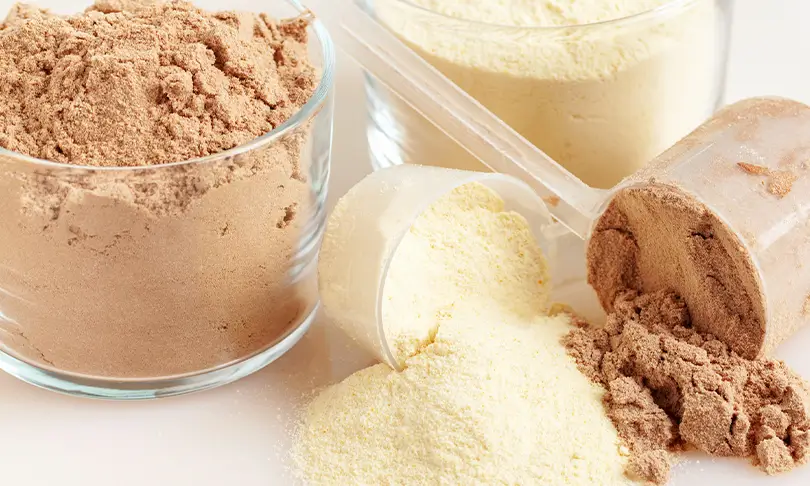
Protein, collagen, greens, pre-workout and custom blends in tubs and jars, as well as stick packs and sachets.
Is your factory certified?
Yes. Our Guangzhou factory is GMP-certified and operates to ISO 22000 and HACCP standards, with Halal options. Every batch is third-party tested and comes with a certificate of analysis (CoA).
Do you offer custom formulations and private label?
Yes. Our R&D team develops custom powder blends from your concept, and we provide full private-label (OEM) and ODM services, including packaging design and export-ready labelling.
Powder blends: where formulation meets flow
A powder looks like the simplest format in the catalogue and behaves like the most temperamental one. Uniformity, flow, taste and moisture all have to be solved at the same time, and a failure in any one of them shows up as a customer complaint rather than as a batch rejection. These are the four decisions that decide whether a powder sells again.
Blending: uniformity is the whole game
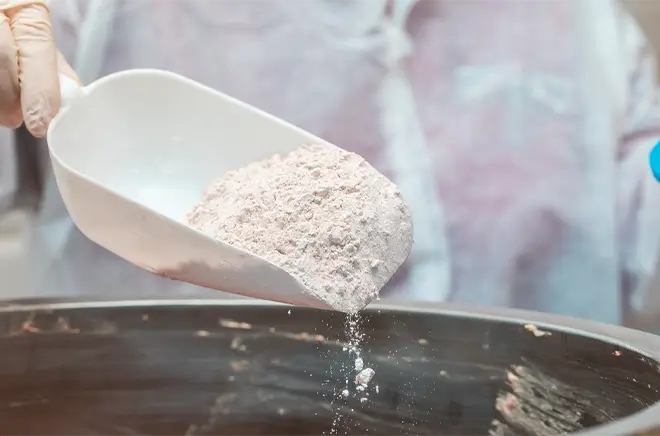
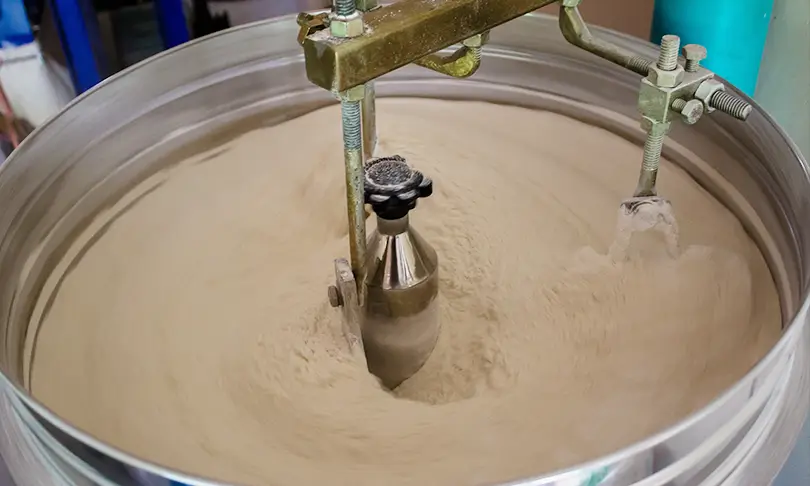
A powder is only as good as its worst-mixed scoop. Actives dosed at 5 mg in a 5 kg batch — vitamins, minerals, sweeteners, caffeine, probiotics — will not distribute evenly unless the blend is built in stages. In practice this means geometric dilution of the low-dose components into a carrier, a defined blending time validated by sampling, and sample points at the top, middle and bottom of the blender.
V-blenders suit free-flowing mixes, ribbon blenders handle denser and cohesive powders, and both need a validated loading order. If a supplier cannot tell you how they validated blend uniformity, the label claim is an average rather than a guarantee.
- Geometric dilution for actives below 1% of the batch
- Blend uniformity sampled at three heights, not from one tap point
- Segregation risk checked after filling, not only after blending
- Overages justified by stability data, never by habit
Flow, density and the filling machine
Bulk density decides how much powder fits in a scoop, in a stick pack and in a jar — and it changes with the same formula depending on granulation. A blend that flows well in a ribbon blender can bridge in a volumetric filler, which shows up as underweight sachets on the production line rather than as a formula problem.
Hygroscopic ingredients — some plant extracts, probiotics, certain salts — pull moisture from the air during filling and start to clump within days. Anti-caking agents, controlled room humidity and the right packaging film solve this; adding more anti-caking agent to a formula that is already at its limit does not.
Taste: the part that decides repurchase
Powder is the only supplement format the customer tastes in volume, so flavour is a formulation constraint rather than a marketing afterthought. Bitter actives, mineral salts with a metallic edge, and the acidity of vitamin C all have to be masked, and the masking system changes the sweetness, the mouthfeel and often the colour.
The practical limit is usually the active load, not the flavour. A 10 g serving can carry a real flavour system; a 3 g stick pack cannot hide 2 g of a bitter extract. Setting the serving size and the active dose before flavour development saves an expensive redesign later.
Shelf life, moisture and packaging
Powders fail in two ways: they cake, or they lose potency. Both are moisture stories. Water activity, headspace humidity and the moisture transmission rate of the packaging film determine whether a blend is still free-flowing at month eighteen.
Stick packs give the best barrier per serving but cost more per unit; jars are cheaper and risk repeated exposure to ambient air after opening, which is exactly where clumping starts. The right answer depends on the destination climate, so the packaging choice belongs in the stability plan rather than in the artwork file.
Documents and label claims
For a powder, the label carries two claims that are easy to get wrong: serving size and scoop accuracy. A scoop is a volumetric measure, so the gram weight per scoop has to be validated against the bulk density of the finished blend — and it will differ between flavours if the flavour system changes the density.
The rest of the dossier is standard: certificate of analysis per batch, heavy metals and microbiological results, allergen statement for the facility, and stability data covering the declared shelf life in the actual packaging.