

Mushroom Gummies Where the Beta-Glucan Is Actually Declared
Most mushroom gummy failures are sourcing failures: mycelium grown on grain arrives with 40-60% starch and almost no beta-glucan, and no amount of flavour masking fixes a label that cannot be substantiated. We ask for the extract specification first and build the base around it.
The Two Problems With Mushroom Gummies
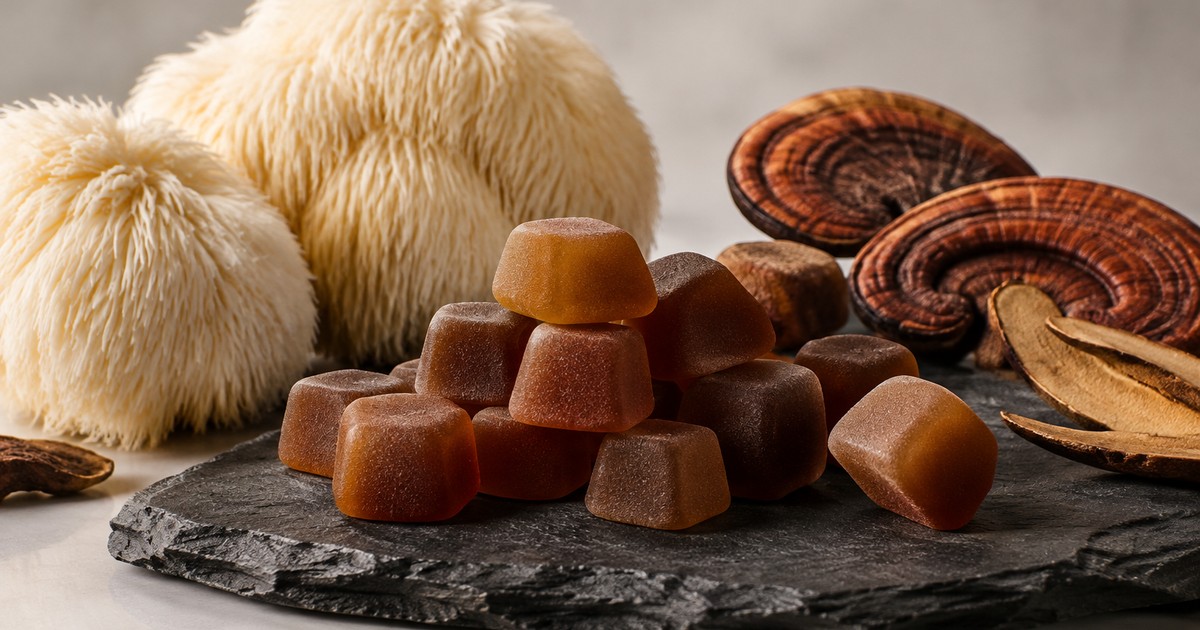
The first is identity. A 'lion's mane gummy' can legally contain mycelium-on-grain biomass with a beta-glucan content in the low single digits, alongside a starch load high enough to be detected as a filler. Buyers who test incoming material against a beta-glucan specification, and against alpha-glucan as a starch marker, avoid most of this. We work from your specification or help you set one before the first cook.
The second is taste. Reishi and chaga are bitter and astringent, lion's mane is savoury and slightly fishy when oxidised, and cordyceps reads as earthy. A 500-1,000 mg dose in a 3 g piece is a meaningful flavour load, so the system needs a strong acid profile (raspberry, sour cherry, yuzu) plus a masking agent, and often a pectin base because pectin carries bitterness better than gelatin.
Heat is the smaller issue. Beta-glucans are polysaccharides and survive the cook; the volatile aromatics that make mushroom powder smell like mushroom do not. Adding the extract late in the cook, below 70 °C, keeps more of the character and reduces the off-note the customer tastes on opening the bag.
What Our Mushroom Gummy Line Covers
Mushroom Gummy Capability
| Parameter | Range | Notes |
|---|---|---|
| Extract per piece | 250-500 mg | 500-1,000 mg per 2-piece serving |
| Beta-glucan | 10-30% in extract | Verified by third-party assay on incoming lots |
| Species | Lion's mane, reishi, chaga, cordyceps, turkey tail | Single or blended |
| Base | Pectin (standard), gelatin (on request) | Pectin carries bitterness better |
| Gummy weight | 3-4 g | Heavier piece for higher extract load |
| Batch size | 50,000-2,000,000 gummies | Pilot runs from 3,000 units |
From Brief to Finished Mushroom Gummy
Quality Control for Mushroom Gummies
Two assays carry the label: beta-glucan on the finished piece, and alpha-glucan as a marker that the extract was not cut with grain substrate. A finished gummy typically tests 5-10% lower than the input because of the base dilution, and we report the measured value rather than back-calculating from the formula.
The plant operates under GMP with ISO 9001, ISO 22000 and HACCP, is registered with the US FDA as a food facility, and is Halal certified. Third-party verification is available for beta-glucan, heavy metals and microbiologicals.
Mushroom Gummy FAQ
What beta-glucan level should the extract have?+
How much mushroom extract fits in one gummy?+
Does the heat destroy the actives?+
Can mushroom gummies be vegan?+
How do you mask the earthy taste?+
Do you test for starch adulteration?+
What is the minimum order?+
How long does production take?+
Send Your Mushroom Gummy Brief
Tell us the species, the beta-glucan range you need and the serving size you want. If you do not have a specification yet, we will send a template before quoting.