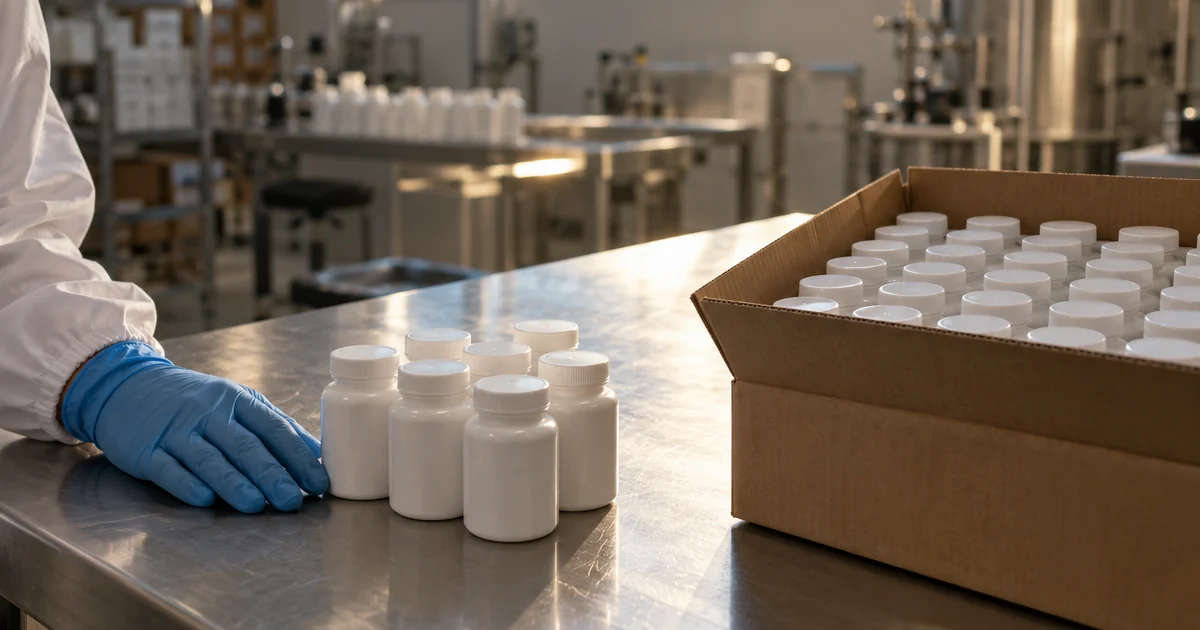
Every first-time buyer hits the same wall. You have a formula, a label concept and a budget for a test run of a few hundred units. Then the quote comes back: minimum order quantity 1,000 units. Sometimes 3,000. Occasionally 5,000.
It feels arbitrary, and sometimes it is. But most of the time the number is arithmetic, not attitude — and if you need a smaller first run, the practical route is a low MOQ supplement manufacturer rather than a discount. A contract manufacturer cannot buy 40 kg of a raw material that ships in 25 kg drums and sell you 300 capsules from it. They cannot print 300 labels when the printer's setup alone costs more than the labels. And they cannot justify an hour of line cleaning and a full QC release for a batch that fills for ten minutes.
Understanding where the number comes from is the difference between arguing about it and engineering it down.
The short answer
A supplement MOQ is the largest of four separate minimums, whichever binds first:
| Constraint | What sets it | Typical floor |
|---|---|---|
| Raw material purchase | Supplier drum/bag sizes, minimums on actives | 25–100 kg of a blend |
| Packaging components | Bottle, cap, label and carton print runs | 3,000–10,000 pcs |
| Machine setup and cleanout | Changeover time, first-article checks | 1,000–1,000 units |
| Batch size for testing | Lab sample needs, stability and assay | 500–1,000 units |
So when a supplier says "1,000 minimum", they are usually quoting the machine or component line, not the production line. Production itself is almost never the constraint — filling 1,000 capsules takes minutes.
Typical MOQs by dosage form
These are the ranges you will see from Chinese contract manufacturers for a custom private label run, single SKU, standard stock packaging:
| Dosage form | Common MOQ | What pushes it higher |
|---|---|---|
| Capsules | 1,000–3,000 | Custom capsule colours, enteric coating |
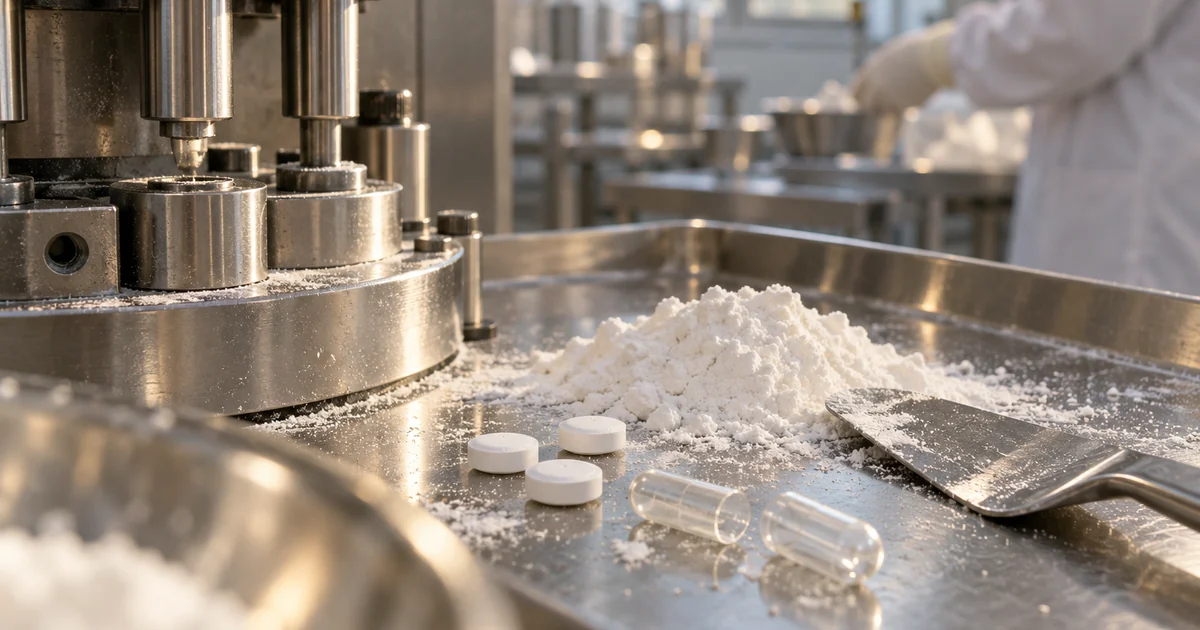
| Tablets | 3,000–5,000 | Compression tooling, film coating |
| Softgels | 3,000–5,000 | Custom die sets, gelatin vs veggie shell |
| Gummies | 1,000–5,000 | Starch trays, curing room time, custom shapes |
| Powders (jar) | 1,000 jars | Blend size, scoop tooling |
| Stick packs / sachets | 5,000–10,000 | Film print run, fill-seal setup |
| Liquids / shots | 1,000 bottles | Filling line minimum, bottle moulds |
Note that gummies and softgels have wider ranges than capsules. That is not inconsistency — both processes run on tooling (moulds, trays, dies) that only pays for itself across a certain run length. A custom gummy shape with a 5,000 minimum is not greed; the mould alone can cost more than the order.
Why 500 units costs more per bottle than 5,000
This is the part buyers underestimate. MOQ is not just a gate you pass; it sets your unit cost.
Take a capsule product with a fixed setup cost (line cleaning, first-article checks, artwork proofing, QC release, documentation) of roughly $600, and a variable cost of about $0.55 per unit at scale:
| Order size | Setup per unit | Variable per unit | Approx. unit cost |
|---|---|---|---|
| 500 | $1.20 | $0.62 | ~$1.82 |
| 1,000 | $0.60 | $0.58 | ~$1.18 |
| 3,000 | $0.20 | $0.56 | ~$0.76 |
| 5,000 | $0.12 | $0.55 | ~$0.67 |
The variable cost barely moves — it is the setup that halves every time you double the order. This is why a 500-unit run quoted at $4.00 a bottle is not a rip-off and a 5,000-unit run at $0.67 is not a bargain: they are two different products economically.
If your launch plan is 300 units to test the market, you are not buying a cheaper version of the 5,000-unit product. You are buying setup time.
The hidden binding constraint: packaging
Most buyers assume MOQ is about the formula. In practice, the bottle, cap, label and carton usually set the floor, and they are quoted by a different supplier with their own minimums.
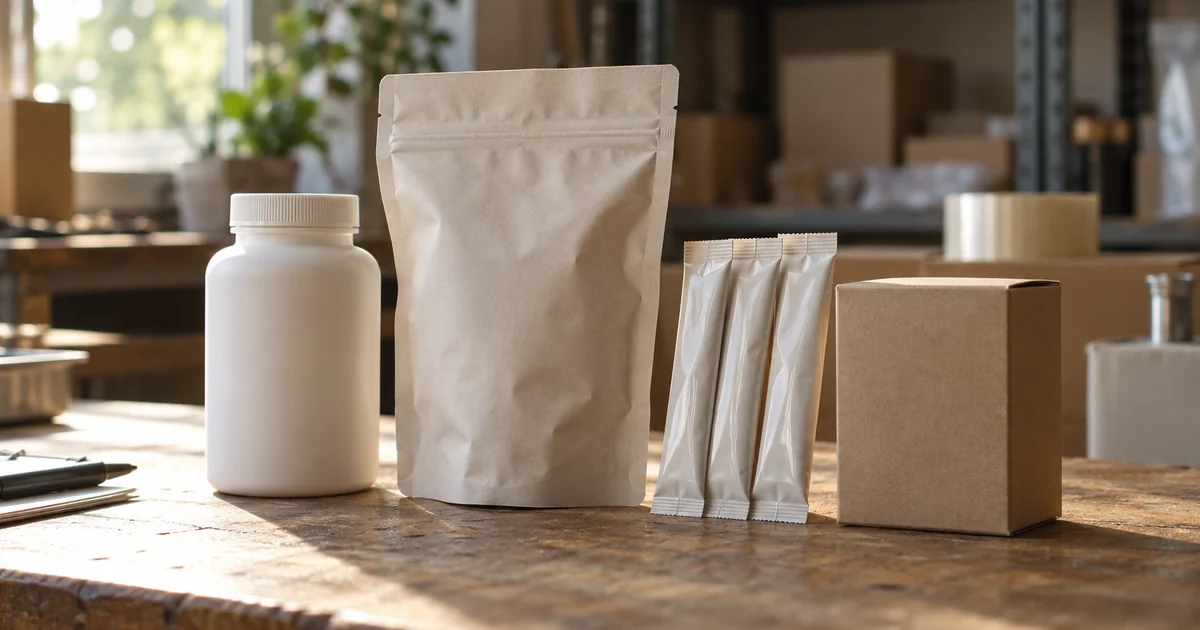
- Stock bottles and caps: often sold in cartons of 500–1,000, sometimes with no true minimum beyond the carton.
- Custom-coloured bottles: mould cost plus a run minimum that can start at 5,000–10,000 pcs.
- Printed labels: a digital run of 1,000 is fine, but the per-label price at 1,000 vs 10,000 can differ by 3–5x.
- Printed folding cartons: the die and plate charges dominate below ~3,000 pcs.
This is the single most useful lever you have. Ask what MOQ applies with stock packaging versus custom packaging. The gap is often 1,000 versus 5,000 — a five-fold difference in your first order, with no change to the product itself.
MOQ per SKU versus per order
A common and expensive mistake: assuming the minimum applies to your order. It usually applies to each SKU, because each SKU is a separate batch, a separate label, and a separate QC release.
Three flavours of the same capsule at a 1,000 MOQ is not a 1,000-unit order. It is three batches, and if any single flavour is below the batch minimum, the factory may still run it — and charge you for the full minimum anyway.
Two ways around it:
- Same base formula, different labels. If the only difference is the label, many factories will run one batch and apply multiple labels, provided the batch size covers the total.
- Ask for a "mixed batch" quote in writing. Confirm whether the minimum is per SKU or per order, and whether a 400/300/300 split is accepted at the 1,000 minimum. Get the answer before you design packaging for three variants.
Does a lower MOQ mean lower quality?
No, but it does change what you should check.
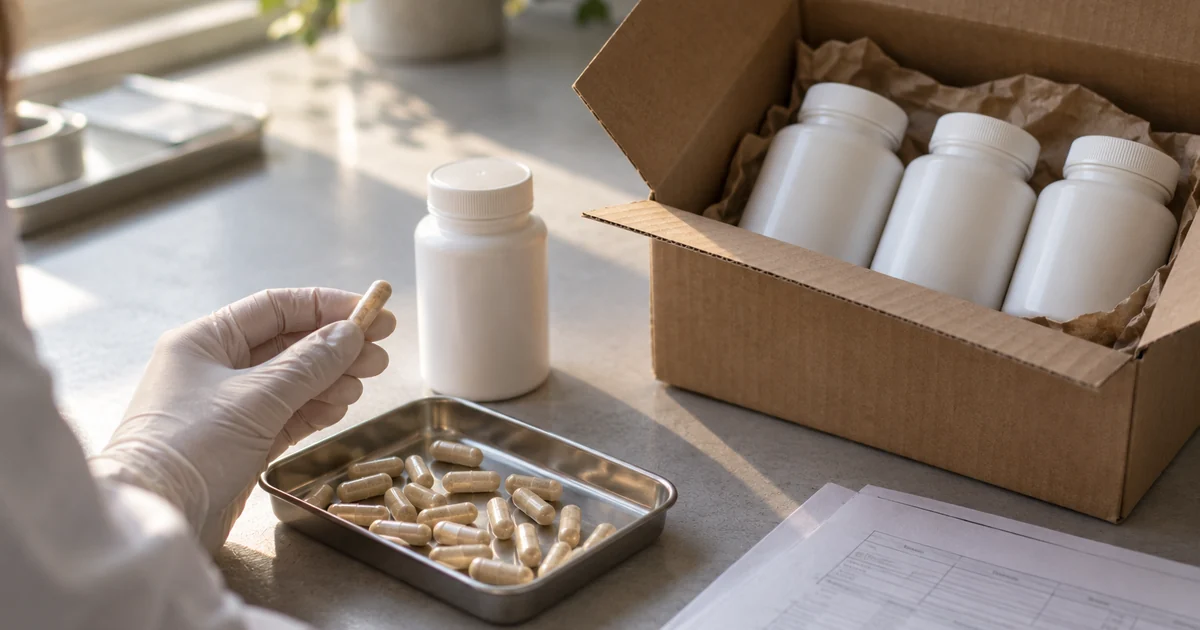
Low-MOQ runs are usually made on the same equipment as larger ones; the difference is scheduling. The batch may be run at the end of a shift, or the factory may group your order with a similar formula. What matters is not the size of the batch but whether it is a traceable, released batch with its own record, its own assay, and its own retention samples.
Three things to confirm when you buy small:
- A batch record exists for your order, not a shared "stock" batch number.
- Third-party testing is per batch, not per year. A COA dated before your production date is not your COA.
- Stability data covers your formula, not a similar one. A 500-unit custom run with no stability study is a product you cannot legitimately shelf-life.
If a supplier offers 100-unit minimums with no testing and no batch documentation, they are not offering you a smaller version of a real order. They are reselling something that already exists.
How to negotiate MOQ down (without asking for a discount)
The mistake is asking "can you lower the MOQ?" The productive question is "which of the four minimums is binding, and can we change it?"
- Switch to stock packaging. Usually the fastest 3–5x reduction, and it does not touch the formula.
- Accept a longer lead time. Small runs can fill gaps in the schedule. Ask to be slotted into an existing production window rather than booking a dedicated one.
- Pay the setup separately. If setup is what the MOQ is amortising, offer to pay it as a line item and buy fewer units. Some factories will agree; you get a higher unit price but a smaller cash commitment.
- Combine SKUs into one batch. Same formula, multiple labels, one batch record.
- Start from a stock formula. Existing formulas have already cleared stability and label review, which removes a fixed cost from your first order.
- Commit to a reorder. A written second order at 90 days is worth more than a verbal promise, and it is a legitimate reason for a supplier to take a smaller first run.
What not to do: ask for a MOQ below the component minimum and expect the price to hold. If a supplier agrees instantly to 200 units at the 1,000-unit price, one of two things is true — the quote is not real, or the product is not being made for you.
What to put in the contract
MOQ disputes are almost always about definitions, not numbers. Before you sign, make sure the quote states:
- MOQ basis: per SKU or per order.
- What counts toward MOQ: finished units, or units before overage and rejects. Ask for the fill overage and the reject allowance in writing.
- Reorder MOQ: usually lower than first-order MOQ, sometimes half. Get the number.
- MOQ validity: how long the quoted minimum holds, especially if packaging prices move.
- Change costs: what happens if you add a flavour after the PO is placed.
Frequently asked questions
Is 1,000 units a realistic minimum for a first supplement order?
For capsules with stock packaging, yes. For gummies, softgels, stick packs or custom bottles, 1,000 is usually below the component minimum, so expect 3,000–5,000 unless you accept stock components.
Can I order different flavours under one MOQ?
Sometimes. If the base formula is identical and only the label differs, a single batch with multiple labels can satisfy one minimum. If the flavour changes the formula, each becomes its own batch and its own minimum.
Why is my MOQ higher than the quote I saw online?
Online MOQs are usually quoted for stock formulas with stock packaging. Custom formula, custom capsule colour, custom bottle or custom carton each add a minimum of their own.
Do smaller orders cost more per unit?
Yes, and mostly because of setup, not materials. Doubling the order typically halves the setup contribution per unit while barely changing the variable cost.
Can I pay extra to go below the MOQ?
Often, yes — as a setup fee rather than a price increase. Ask for the setup to be itemised. If the supplier cannot explain what the extra money covers, the "low MOQ" is probably not being manufactured for you.
The takeaway
A supplement MOQ is a stack of minimums, and the number you are quoted is whichever one binds first. Before you argue about it, find out whether it is the raw material, the components, the machine, or the batch. Nine times out of ten it is the packaging — and packaging is the one part of the equation you can change without touching your product.
If you are planning a first run and want to know which minimum applies to your formula, our team quotes MOQ and unit cost together, with the component assumptions written down. For the other half of the schedule, see where supplement lead time actually goes.