

Probiotic Gummies Where the CFU Count Survives
Most Lactobacillus and Bifidobacterium strains die in a gummy: heat during cooking, then low water activity and low pH in storage. We build probiotic gummies around spore-forming strains that survive the process, and we test CFU at release and at end of shelf life.
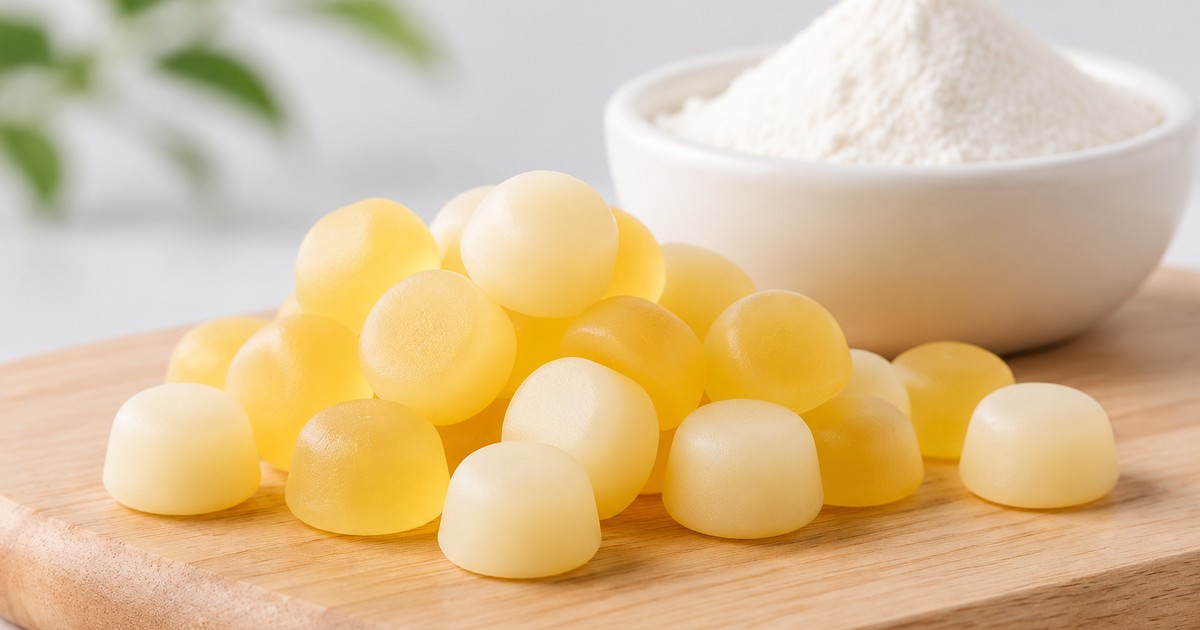
Why Most Probiotic Gummies Fail the CFU Claim
Vegetative probiotic cells, the Lactobacillus and Bifidobacterium you see in capsules, are fragile. They lose viability at the 80-90 °C of a gummy cook, then decline further in a low-moisture, low-pH matrix over months on a shelf. A 10 billion CFU input can test at a fraction of that by the time a consumer opens the bottle.
The strains that work in gummies are spore-forming, mainly Bacillus coagulans and Bacillus subtilis, plus some yeast-based products. Spores tolerate heat and desiccation, and they stay viable in a pectin or gelatin matrix without refrigeration. That durability is the reason most credible shelf-stable probiotic gummies on the market use spore strains.
We verify the claim rather than assume it: CFU is assayed on the finished gummy at release and again after accelerated and real-time storage. If the label needs 2 billion at end of shelf life, the overage is set from that data, not from a rule of thumb.
What Our Probiotic Gummy Line Covers
Probiotic Gummy Capability
| Parameter | Range | Notes |
|---|---|---|
| Potency | 1-5 billion CFU per gummy | At release, overage to end of life |
| Strains | Bacillus coagulans, B. subtilis | Spore-forming, shelf stable |
| Base | Pectin, gelatin, sugar-free | Low water activity required |
| Water activity | Below 0.6 aw | Verified after curing |
| Batch size | 50,000-1,000,000 gummies | Pilot runs from 3,000 units |
| Lead time | 4-6 weeks | After artwork and material approval |
From Strain Choice to Shelf-Stable Gummy
Quality Control for Probiotic Gummies
Probiotic gummies are only as good as the CFU test behind the label. We assay the finished gummy, keep stability samples at 25 °C and 40 °C, and re-test at the intervals your shelf life claim requires. Water activity is checked after curing because a soft, moist gummy will not hold spores or texture.
The plant operates under GMP with ISO 22000 and HACCP controls and is registered with the US FDA as a food facility. Microbiological testing covers the finished product, and third-party CFU verification is available if your retailer or distributor requires an independent laboratory.
Probiotic Gummy FAQ
Why do most probiotic gummies use spore-forming strains?+
Can you put Lactobacillus in a gummy?+
How is CFU verified?+
What potency can a gummy hold?+
Do probiotic gummies need refrigeration?+
Can you add prebiotic fibre?+
What is the minimum order?+
How long does production take?+
Send Your Probiotic Gummy Brief
Tell us the strain, target CFU per gummy and the shelf life you want to claim. We will confirm feasibility in a gummy matrix and quote with release and stability testing included.