

Energy Gummies Where the Caffeine Is Actually Uniform
Caffeine is bitter, hygroscopic and easy to dose unevenly. At 50-100 mg per gummy the difference between a good piece and a bad one is mixing validation, not flavour. We test content uniformity on the finished piece.
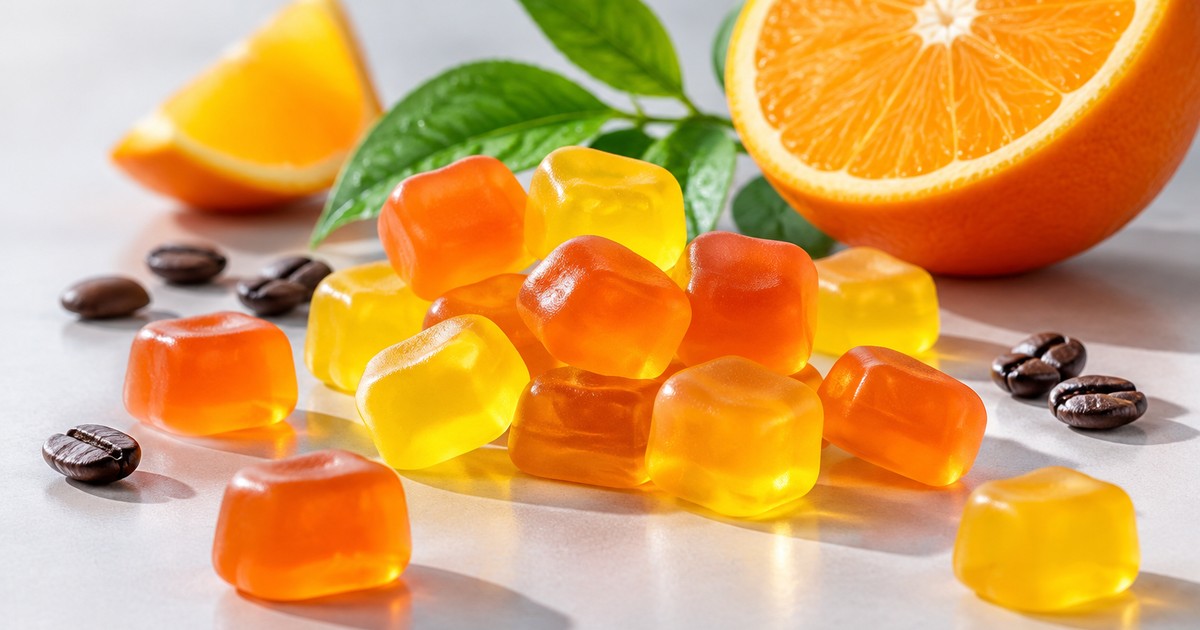
Dosing Caffeine in a Chew
A 60 mg caffeine gummy is roughly the caffeine of a small coffee, and it is the practical ceiling for a 4-5 g piece before the bitterness dominates. Higher doses usually mean two pieces per serving, which also spreads the dose more gently than a single 200 mg hit.
Caffeine is water-soluble, so it goes in with the water phase and stays there. The real risk is not solubility but uniformity: if the mixer does not distribute the powder fully before depositing, some gummies carry 40 mg and some carry 90 mg. We validate content uniformity across the batch, not just the average.
The supporting actives matter as much as the caffeine. Vitamin B12 and B6, taurine, L-tyrosine and ginseng are the usual companions; each adds taste, colour and assay work. Guarana and green tea extracts carry caffeine too, so the total caffeine load is calculated across all sources before the label is written.
Sugar is a formulation decision here, not a default. A sugar-free polyol base keeps the calorie claim clean but changes the set and the cooling effect, which is why we test the polyol system against the caffeine load rather than assuming a standard base will work.
What Our Energy Gummy Line Covers
Energy Gummy Capability
| Parameter | Range | Notes |
|---|---|---|
| Caffeine | 50-100 mg per gummy | 100-200 mg per 2-piece serving |
| Caffeine sources | Anhydrous, guarana, green tea | Total calculated across sources |
| Gummy weight | 4-5 g | Heavier piece masks bitterness better |
| Base | Pectin, gelatin, sugar-free polyol | Pectin for vegan and clean label |
| Uniformity | Tested per piece | Start, middle and end of run |
| Batch size | 50,000-2,000,000 gummies | Pilot runs from 3,000 units |
From Brief to Finished Energy Gummy
Quality Control for Energy Gummies
Caffeine content is assayed by HPLC on the finished gummy, and uniformity is checked across pieces rather than on a pooled sample. Colour is compared against a retained standard because B-vitamin blends fade unevenly under light.
The plant operates under GMP with ISO 9001, ISO 22000 and HACCP controls and is registered with the US FDA as a food facility. Caffeine is treated as a controlled input with weighed dispensing and reconciliation per batch.
Energy Gummy FAQ
How much caffeine fits in one gummy?+
How do you keep the caffeine dose even?+
Can energy gummies be sugar-free?+
Do you add B12 and taurine?+
Is guarana counted in the caffeine total?+
What labelling does caffeine require?+
What is the minimum order?+
How long does production take?+
Send Your Energy Gummy Brief
Tell us the caffeine dose per serving, the sources you want and the market you sell into. We will confirm the piece count, the uniformity testing scope and the labelling that applies.