

Glutathione Gummies: Sulphur Taste and a Short Half-Life
Reduced glutathione is a thiol, and thiols oxidise. The whole process is built around keeping the molecule reduced until it is inside the pack — and being honest that it is not liposomal.
Three Ways Glutathione Fails
Glutathione fails in a gummy for three reasons, and each one has a different fix. It oxidises from GSH to GSSG, it tastes of sulphur, and it is sold with an expectation of liposomal delivery that a chew cannot meet. The first two are process problems. The third is a labelling problem, and it is the one that most often goes unaddressed.
The oxidation chemistry is simple and unforgiving. Glutathione is a tripeptide with a free thiol group, and that thiol reacts with oxygen, with metal ions and with anything else that will accept an electron. In a warm, moist mass the reaction runs quickly. What you lose is not the peptide, it is the reduced form: assay by total glutathione still looks fine while the GSH fraction has collapsed into GSSG.
That is why the assay has to measure GSH and GSSG separately. A total glutathione figure can pass specification on a product that has lost most of its activity. We report both, and the specification is written against GSH, not against the sum.
Water activity is the main process lever. Every 0.05 aw of headroom above 0.55 roughly doubles the oxidation rate in a typical gummy base. Glutathione SKUs are run at 0.45-0.50 aw, which means a longer cure, a chewier texture and a higher solids load than a normal vitamin gummy.
Temperature is the second lever. GSH is added below 55 °C, after the gel has been cooked and partially cooled, and homogenised quickly. The addition point is the single biggest difference between a batch that retains 95% and one that retains 75% at release.
The third lever is oxygen. Where the line supports it, the mass is held under nitrogen from the addition point to the depositor, and the pack is flushed. This is not exotic equipment — a nitrogen blanket on the hopper and a flush before sealing are enough to change the loss curve measurably.
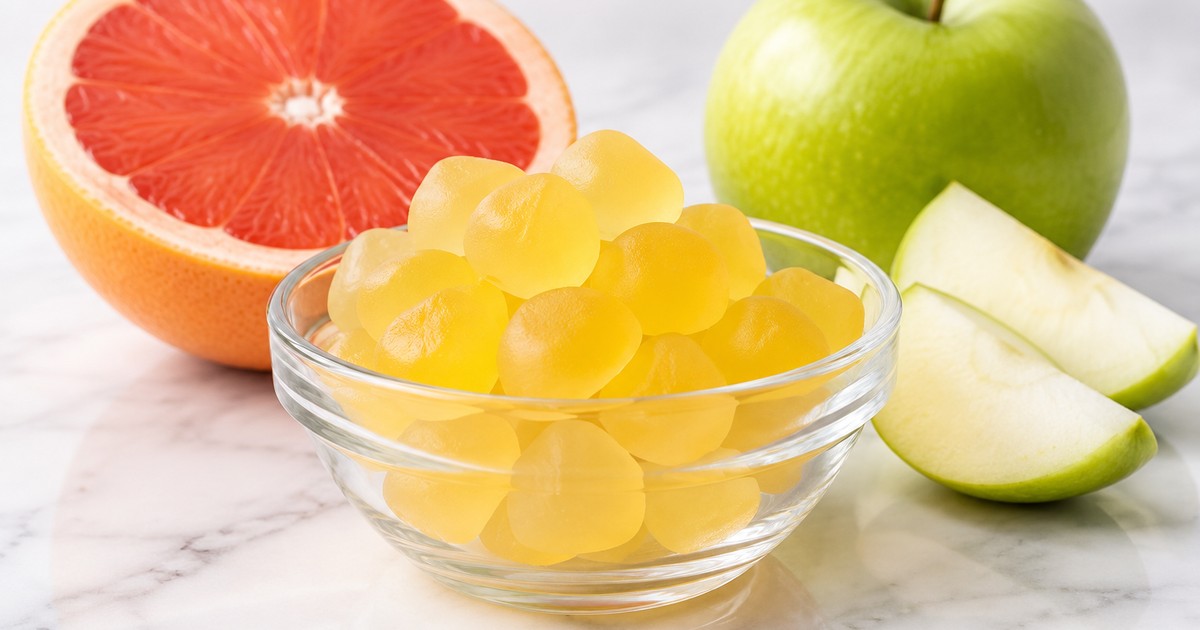
Taste is the fourth problem and it does not have a clean fix. Glutathione at 250-500 mg has a sulphurous, slightly yeasty note that intensifies with heat and with age. Acid forward flavours help; sweetness makes it worse. A citrus or green apple profile with a malate buffer at pH 3.3 is about as good as it gets, and it still tastes like a supplement.
Then there is the liposomal question. Liposomal glutathione is a specific delivery system: the molecule is encapsulated in a phospholipid vesicle, usually in a liquid or a softgel. A gummy cannot be liposomal in any meaningful sense, because the water activity and the gel network destroy the vesicle. A product can contain phospholipids and glutathione in the same piece, and some brands call that liposomal, but it is not the same structure. We do not use the word on a gummy.
What Our Glutathione Gummy Line Covers
Glutathione Gummy Capability
| Parameter | Target | Why it matters | Method |
|---|---|---|---|
| Reduced glutathione | 250-500 mg | Above 500 mg the sulphur taste dominates | HPLC, GSH and GSSG separately |
| Water activity | 0.45-0.50 aw | Each 0.05 above 0.55 roughly doubles oxidation | Per batch, 3 points |
| Addition temperature | Below 55 °C | Heat drives thiol loss before packing | In-line probe at addition |
| Headspace oxygen | Nitrogen blanket | Oxygen is the second cause of GSH loss | Pack flush where supported |
| NAC | 300-600 mg | Cysteine donor, supports the story | HPLC |
| Vitamin C | 100-250 mg | Reducing partner, protects GSH | HPLC |
| pH | 3.3-3.8 | Below 3.0 the gel weakens; above 4.5 taste worsens | Metered at deposit |
| Piece weight | 3.8-4.5 g | Needed to hold 500 mg plus a mask | Checked hourly |
| Batch size | 50,000-2,000,000 gummies | Pilot from 3,000 units | Longer cure than standard SKUs |
From Brief to Finished Glutathione Gummy
Quality Control for Glutathione Gummies
Reduced and oxidised glutathione are assayed separately by HPLC. A single total-glutathione number is not acceptable on this product, because the failure mode is oxidation rather than loss of peptide, and a total assay will not see it.
Water activity is checked at three points per batch and is a hard release criterion at 0.52 aw. A batch that is otherwise correct and above that figure is held, because the shelf life curve will not hold.
Colour is measured instrumentally. GSH oxidation is accompanied by a slow yellowing that is visible before the assay moves, and a colour drift of more than 3 units of b* in a month is treated as a stability failure.
The plant operates under GMP with ISO 9001, ISO 22000 and HACCP controls and is registered with the US FDA as a food facility. Heavy metals and microbiological testing run per batch, with third-party verification available.
Glutathione Gummy FAQ
How much glutathione fits in a gummy?+
Is a glutathione gummy liposomal?+
Why does the label need GSH and GSSG separately?+
How do you keep it reduced?+
Why does the gummy taste of sulphur?+
Can you combine glutathione with NAC?+
Is S-acetyl glutathione better?+
Can the gummy be sugar-free?+
What is the minimum order?+
How long does production take?+
Send Your Glutathione Gummy Brief
Tell us the dose, the form and the shelf life target. We will confirm the water activity, the overage and the assay scope, and we will tell you plainly if the claim you want belongs to a different format.