Quick answer: MCT oil is a fractionated triglyceride blend, usually caprylic acid (C8) and capric acid (C10), that absorbs into the portal vein and is oxidised by the liver rather than packaged into chylomicrons. A practical dose is 10 to 15 g daily with food. Start at 5 g; above roughly 30 g, loose stools and cramps outweigh any ketone benefit.
MCT oil has a real mechanism and a category full of inflated claims. The ketone effect is genuine but smaller than marketing suggests. The fat-loss effect is close to nil once calories are matched. And the gut tolerance ceiling is far lower than social media implies. This article separates the three.
What MCT oil actually is
Triglycerides are classified by carbon chain length. Long-chain triglycerides, which make up almost all dietary fat, are packaged into chylomicrons and travel through lymph and blood. Medium-chain triglycerides, defined as 6 to 12 carbons, are more water-soluble. They pass straight to the liver via the portal circulation and are oxidised quickly.
That shortcut is the entire premise. It means faster energy and, in a low-carbohydrate context, faster ketone production. It does not mean the fat is calorie-free or that it bypasses energy balance.
Commercial MCT oil is not a single molecule. It is a fractionated product, typically from coconut or palm kernel oil, in which the C8 and C10 fractions have been separated from the lauric acid (C12) that dominates the parent oil. The label percentage of C8 is the number that matters most.
| Chain | Name | Behaviour | Ketone conversion |
|---|---|---|---|
| C6 | Caproic acid | Sharp taste, poor tolerance | Fast |
| C8 | Caprylic acid | Best ketogenic response, mild taste | Highest |
| C10 | Capric acid | Slower ketone rise, better tolerated | Moderate |
| C12 | Lauric acid | Behaves more like a long-chain fat | Low |
What the evidence shows
Ketone availability. The strongest signal in the literature. Randomised crossover trials in healthy adults show that 15 to 20 g of C8 raises blood beta-hydroxybutyrate measurably within 30 to 60 minutes, with a larger and faster rise than an equal dose of C10. This is useful for people transitioning into ketosis or using ketones for cognitive or athletic reasons, but the rise is transient.
Energy expenditure and satiety. Short-term feeding studies report increased diet-induced thermogenesis and modest reductions in subsequent calorie intake, particularly with C8. The effect is small. It does not produce weight loss on its own, and most of these trials lasted hours to days, not months.
Fat loss. When calories are matched, MCT oil does not produce meaningful additional fat loss. The trials that show benefit typically replaced long-chain fats with MCTs while keeping calories constant, and the effect was a few hundred grams over several weeks. That is a real but marginal difference, and it is not a reason to add MCT oil on top of an unchanged diet.
Exercise performance. MCTs can spare glycogen in theory and improve time-to-exhaustion in some small studies, but the effect is inconsistent and no better than carbohydrate for most athletes. Evidence here is weak and mixed.
Cognitive effects. Small studies in people with impaired glucose metabolism suggest ketones can be used by the brain, but the evidence for MCT oil improving cognition in healthy adults is preliminary. Treat claims in this area with caution.
C8 vs C10: forms compared
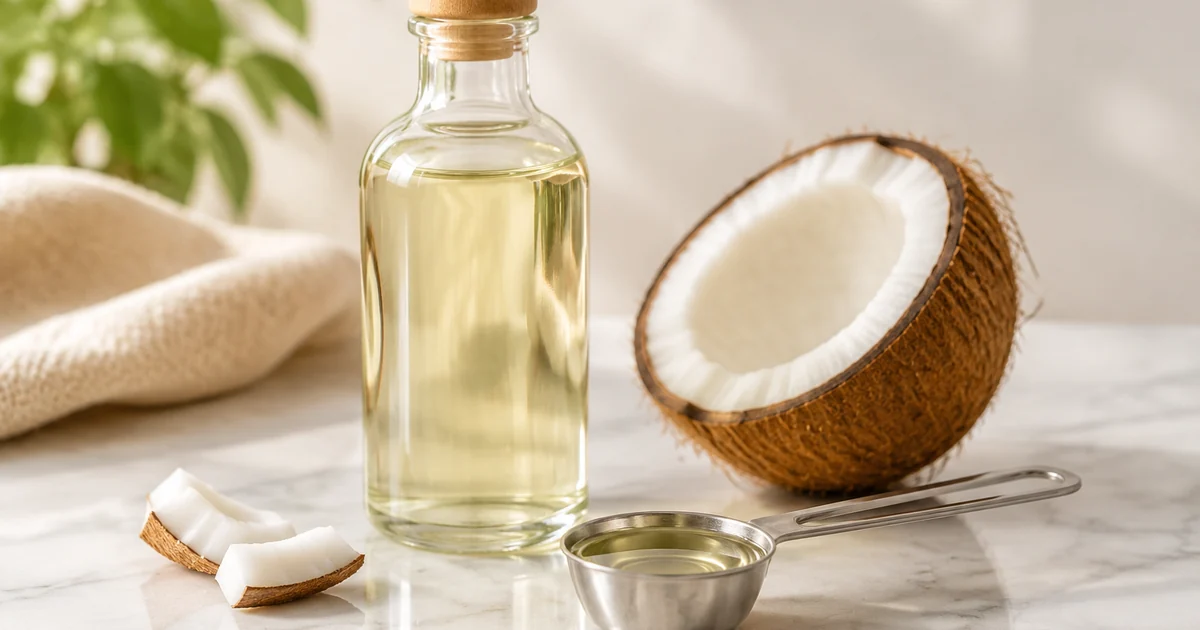
C8 is the most ketogenic fraction. C10 is cheaper, milder on the gut, and contributes very little to ketosis. This is why "100% C8" costs more than a C8/C10 blend, and why a product labelled simply "MCT oil" is usually 60/40 C8/C10 or a palm-derived 50/50. Coconut oil, for comparison, is only about 14% MCT of which most is C12, so it is a poor substitute despite what the internet says.
| Form | Typical C8/C10 ratio | Ketone response | Gut tolerance | Best use |
|---|---|---|---|---|
| 100% C8 | ~100/0 | Highest and fastest | Lowest; start at 5 g | Ketone boost, cognitive use |
| C8/C10 blend | 60/40 or 50/50 | Moderate | Moderate | Daily maintenance |
| Coconut-derived MCT | ~50/50, some C12 | Lower if C12 present | Good | General use, cost-sensitive SKUs |
| MCT powder (spray-dried) | Varies; check oil load | Depends on oil load | Good | Sachets, stick packs, RTD mixes |
Dosage and timing
The classic side effect is rapid intestinal transit. MCTs draw water into the small intestine when they are not fully absorbed, and a first dose of 20 g on an empty stomach reliably produces cramps and loose stools. Ramping over one to two weeks solves it for most people; some never tolerate more than 10 g.
| Population | Dose | Timing and notes |
|---|---|---|
| First-time user | 5 g | With a meal, once daily, for 3 to 7 days |
| Maintenance | 10–15 g | Split across 2 meals |
| Ketone boost before training | 15–20 g C8 | 30–45 min before |
| Low-carb dieter | 10–20 g | Replace other fats, not add to them |
| Practical upper limit | ~30 g | Above this, GI effects dominate |
Timing matters less than total intake. Taking MCT oil with food slows gastric emptying and improves tolerance. Taking it on an empty stomach is the fastest route to cramps.
Safety, side effects and interactions
MCT oil is generally well tolerated at doses under 30 g per day in healthy adults. The main adverse effects are gastrointestinal: loose stools, cramps, nausea and, at high doses, vomiting. These are dose-dependent and usually resolve with a slower ramp.
People who should be cautious include those with a history of pancreatitis, liver disease or fat malabsorption, because MCTs are metabolised in the liver and can worsen symptoms in some cases. Anyone with a diagnosed lipid disorder should discuss MCT oil with a clinician, since it can raise triglycerides in some individuals.
Drug interactions are limited but worth noting. MCT oil can slow gastric emptying, which may affect the absorption rate of some oral medications. It is not known to interact with common prescription drugs in a clinically significant way, but the evidence is sparse.
There is no established tolerable upper intake level for MCTs. The practical ceiling is set by gut tolerance, not toxicity.
How to read the label
Three numbers separate an honest MCT product from a commodity blend.
Fatty acid profile. Look for a GC (gas chromatography) profile on the lot. It should state C8, C10 and C12 percentages. A product that does not publish this is asking you to trust the front label.
Oil load in powders. A 70% powder delivers meaningfully more MCT per gram than a 50% powder, and the price difference usually reflects it. Check the carrier too: acacia fibre and tapioca maltodextrin are common, and the latter adds carbohydrate.
Third-party testing. Heavy metals, residual solvents and oxidation markers (peroxide value, anisidine value) should be available on request. Oxidation is the most common quality failure in oils, and it is invisible on the label.
| Label claim | What it means | What to verify |
|---|---|---|
| "100% C8" | Only caprylic acid | GC profile showing C8 >95% |
| "MCT oil" | Usually 60/40 C8/C10 | Actual ratio on CoA |
| "Coconut MCT" | Source, not purity | C12 content; some contain lauric |
| "MCT powder 70%" | 70% oil on carrier | Carrier type and oil load |
Making it: what changes in production
MCT oil is straightforward to handle in a contract manufacturing setting, but the dosage form dictates the process. Liquid drops and softgels are the simplest: the oil is filled directly, with softgels offering a clean unit dose and good oxidative protection. Hard capsules are feasible but limit the dose per capsule, so a 15 g serving becomes impractical.
Powder is where formulation decisions matter. Spray-drying MCT onto a carrier such as acacia fibre or tapioca maltodextrin turns it into a free-flowing powder at 50 to 70% oil load. This is the format that made MCT usable in sachets and stick packs, because liquid oil in a sachet is a leakage problem. Higher oil load means more MCT per gram but a harder powder to handle and a shorter shelf life.
Gummies are a poor fit for MCT oil at meaningful doses; the oil load needed for a ketogenic effect is incompatible with a stable gummy matrix. Effervescent tablets are also unsuitable, since oil and effervescent chemistry do not coexist well.
Stability is the main production risk. MCT oil oxidises, and oxidation shows up as off-flavour and rising peroxide values. Nitrogen flushing, opaque packaging and a shelf-life study are standard. Flavour masking is rarely needed because MCT oil is bland, but C6 residues from incomplete fractionation can produce a harsh taste that no flavour system fully hides.
Every batch should ship with a CoA. Third-party testing for heavy metals, microbiology and potency is available on request, and for a premium SKU the fatty acid profile by GC is the single most useful document to publish.
Buying checklist for brands
- Ask for the GC fatty acid profile per lot, not per product.
- Confirm the C8/C10 ratio and whether any C12 is present.
- Check the oxidation markers: peroxide value and anisidine value.
- For powders, confirm oil load percentage and carrier type.
- Confirm the dosage form can deliver the intended dose per serving.
- Request third-party heavy metals and microbiology testing.
- Verify the manufacturer holds GMP and ISO 22000 certification.
- Check lead time and MOQ against your launch plan before committing to artwork.
Frequently asked questions
Can I cook with MCT oil?
Not for high-heat frying. MCT oil oxidises and smokes earlier than olive or avocado oil, and heating accelerates oxidation. Use it cold or in warm drinks, smoothies and salad dressings. If you need a cooking fat, choose one with a higher smoke point and better oxidative stability.
Does MCT oil break a fast?
It contains calories and provokes a metabolic response, so a strict fast is broken. For a modified fast, such as a bulletproof coffee approach, it is usually acceptable because it does not raise blood glucose. The ketone response may even support the fasted state, but this is a personal decision rather than a rule.
Is coconut oil the same thing as MCT oil?
No. Coconut oil is mostly lauric acid (C12), which behaves more like a long-chain fat for ketone purposes. MCT oil is a fractionated product in which C8 and C10 have been concentrated. A tablespoon of coconut oil delivers far less C8 than a tablespoon of MCT oil, so they are not interchangeable.
Will MCT oil cause diarrhoea?
Only if the dose is too high too soon. Start at 5 g with food and increase weekly. Most people tolerate 10 to 15 g daily after a ramp. If loose stools persist, reduce the dose or split it across meals. Some people never tolerate more than 10 g, and that is normal.
How much C8 is in a typical MCT oil?
A product labelled simply "MCT oil" is usually 60% C8 and 40% C10, or a palm-derived 50/50 blend. Premium products state 100% C8 or a specific ratio. Always check the GC profile on the CoA, because the front label is a marketing claim and the CoA is the analytical result.
Can MCT oil help with weight loss?
When calories are matched, the effect is marginal. Some trials show a few hundred grams of additional fat loss over weeks when MCTs replace long-chain fats. MCT oil is not a weight-loss ingredient on its own. It is a tool for ketone support and energy, and it works best within a structured diet.
References
- NIH Office of Dietary Supplements: Dietary Supplements for Weight Loss
- PubMed search: medium-chain triglycerides and beta-hydroxybutyrate
- PubMed search: C8 vs C10 ketone response
- EFSA: Opinion on dietary reference values for fats
- FDA: Food Additive Status List
- PubMed search: MCT oil, satiety and energy expenditure
- WHO: Healthy diet fact sheet
- PubMed search: MCT oil gastrointestinal tolerance
Reviewed by the ZOOMSHEAL formulation team in Guangzhou (23 years of supplement contract manufacturing). Last updated: November 2025. This article is for education and does not replace medical advice.