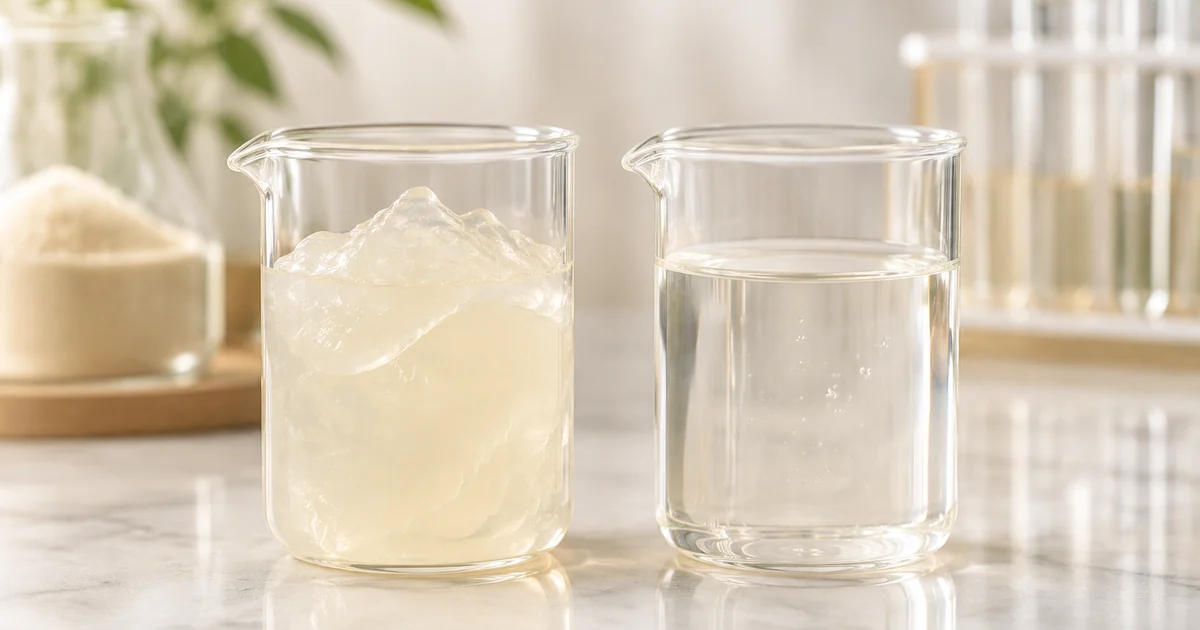

Quick answer: Psyllium husk is the seed coat of Plantago ovata, a soluble fibre that absorbs roughly ten times its weight in water and forms a gel. The effective dose is 5 g one to three times daily with at least 250 ml of water per dose, and 10 g per day is the dose with regulatory recognition for lowering LDL cholesterol.
It is one of the few fibres with hard clinical endpoints behind it, and also one of the easiest to get wrong. Most complaints about psyllium — bloating, cramping, the sensation of a brick in the stomach — trace back to too little water, too fast a ramp, or a fine powder grade that hydrates unevenly.
What psyllium actually is
Psyllium is not a grain fibre like oat beta-glucan or a synthetic like methylcellulose. The husk contains a highly branched arabinoxylan that is only partly fermented by gut bacteria, which is why it bulks stool rather than producing gas the way inulin or resistant starch can.
That low fermentability is the commercial advantage. It means psyllium works for both constipation and loose stools: it adds water-holding bulk when stool is hard, and absorbs excess liquid when it is loose.
| Property | Psyllium husk | Oat beta-glucan | Inulin |
|---|---|---|---|
| Water holding | Very high (~10x) | Moderate | Low |
| Fermentation | Low–moderate | Moderate | High (gas) |
| Bulk forming | Yes | Weak | No |
| LDL effect | Yes at 10 g/day | Yes at 3 g/day | Minimal |
What the evidence shows
The clinical literature on psyllium is unusually consistent for a dietary fibre. The strongest evidence is for cholesterol lowering and bowel regularity. Effects on blood glucose and IBS are real but smaller and more variable.
Cholesterol
This is the strongest claim. Meta-analyses of randomised controlled trials show psyllium lowers LDL cholesterol by roughly 5 to 10% at 10 g per day, through bile acid binding. The effect is dose-dependent and appears within 4 to 8 weeks. The FDA permits a health claim at 7 g per day from psyllium; EFSA recognises 10 g per day for maintenance of normal blood cholesterol.
Constipation
Effective and well established, typically at 5 to 10 g per day, with effect within 12 to 72 hours. It is one of the few fibres recommended in clinical guidance for chronic constipation because the evidence is consistent across trials in adults.
Irritable bowel syndrome
Soluble, gel-forming fibre is the type recommended in IBS guidance, and psyllium has the best trial record of the group, particularly for IBS with constipation. Bran-based insoluble fibres often make symptoms worse. The evidence is moderate quality; not every patient responds.
Blood glucose
Taking psyllium before a meal blunts postprandial glucose rise modestly by slowing gastric emptying. The effect is small — typically a 10 to 20% reduction in the glucose peak — and is not a treatment for diabetes. Evidence is weaker in people without diabetes.
Weight management
Psyllium may increase satiety and reduce energy intake modestly when taken before meals, but trials are short and results are mixed. It is not a weight-loss ingredient on its own.
Forms compared
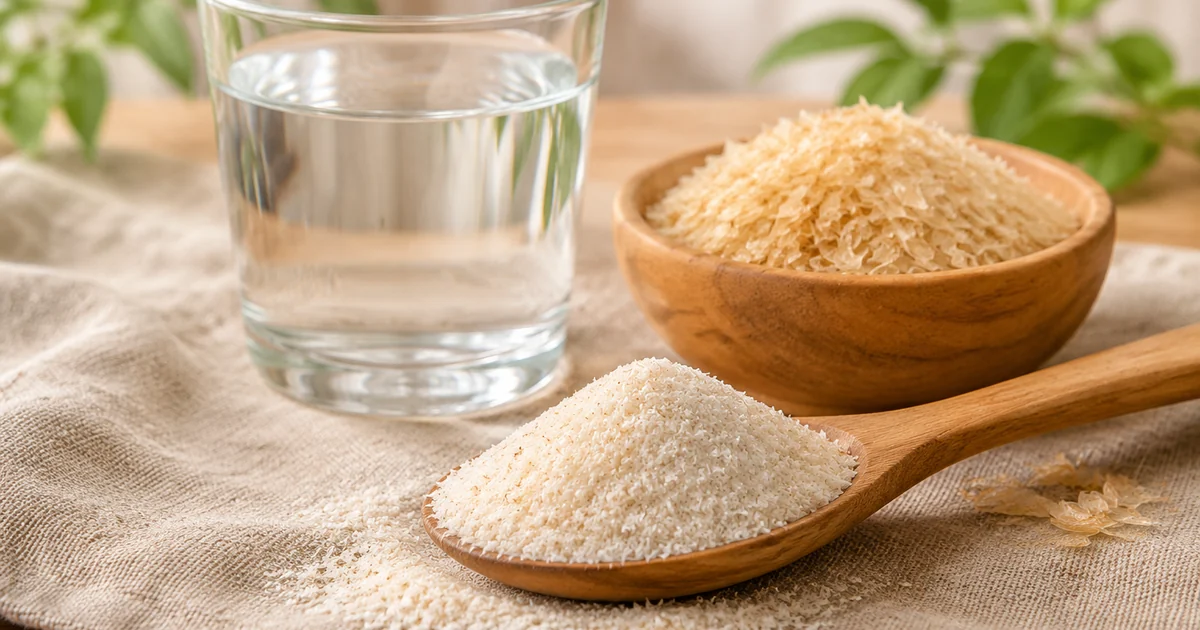
Psyllium is sold as whole husk, powder, capsules, and in baked goods. The form affects how easily it hydrates, how much you can take per dose, and whether it clumps.
| Form | Typical dose per serving | Water needed | Best for | Drawbacks |
|---|---|---|---|---|
| Whole husk | 5 g (1 rounded teaspoon) | 250 ml | Baking, bowel regularity | Gritty texture, slower hydration |
| Fine powder | 3–5 g | 250 ml | Drinks, stick packs, capsules | Gels fast, can clump with dry core |
| Capsules | 500–1000 mg per capsule; 4–8 capsules | 250 ml per 5 g | Convenience, travel | Large pill burden, higher cost per gram |
Dosage and timing
Dose depends on the goal. Start low and increase over one to two weeks. Always take with a full glass of water.
| Population / goal | Dose | Water per dose | Timing | Notes |
|---|---|---|---|---|
| Adults — bowel regularity | 5 g, 1–2×/day | 250 ml | With meals | Increase to 10 g/day if needed |
| Adults — LDL cholesterol | 5 g, 2×/day (10 g total) | 250 ml | Before meals | Take with statin? Separate by 2 h |
| Adults — IBS-C | 3–5 g, 1–2×/day | 250 ml | Start low, ramp over 2 weeks | May worsen bloating initially |
| Adults — glucose blunting | 5 g | 250 ml | 10–15 min before eating | Not a diabetes treatment |
| Children 6–12 years | 2.5–5 g/day | 150–250 ml | With meals | Only under medical advice |
Three rules prevent almost all the trouble:
- Water first, powder second. Stir into a full glass and drink it within a minute, before it sets. If it has already gelled, add more water rather than swallowing a paste.
- Ramp slowly. Start at 3 g for the first week. Doubling the dose on day one is the main cause of cramping.
- Never take it dry. Dry psyllium can swell in the throat and oesophagus. This is a real choking and obstruction risk and should be an explicit warning on pack.
Safety, side effects and interactions
Psyllium is generally well tolerated. The most common side effects are bloating, cramping, and increased gas during the first week. These usually settle as the gut adapts. Taking it with too little water is the main cause of discomfort.
Because it is a gel, psyllium can delay or reduce absorption of other drugs taken at the same time. The clinically relevant ones are levothyroxine, lithium, carbamazepine, digoxin and warfarin. The standard instruction is to separate by at least two hours, and to take other medicines either one hour before or four hours after psyllium.
Do not use psyllium in suspected bowel obstruction, or in people with difficulty swallowing without medical advice. People with diabetes should monitor blood glucose when starting psyllium, as it may lower postprandial glucose. Psyllium is not a treatment for any medical condition and should not replace prescribed therapy.
How to read the label
Labels on psyllium products vary widely. The key is to distinguish elemental fibre weight from compound weight, and to check for added ingredients that may undermine the benefit.
| Label term | What it means | What to check |
|---|---|---|
| Psyllium husk powder | Milled seed coat | Viscosity spec (cP) and mesh size |
| Psyllium husk (whole) | Flake form | Purity (no added seed or stem) |
| Soluble fibre per serving | Usually ~70% of husk weight | Actual psyllium weight vs fibre weight |
| Added sugar / flavour | Improves palatability | May add calories; check serving size |
| Third-party tested | Heavy metals, micro, potency | Certificate of analysis available? |
For a supplement, look for a product that states the psyllium dose in grams per serving, not just total fibre. Check that the product carries a batch-specific certificate of analysis (CoA) if you are buying in bulk. For food use, whole husk is preferred for texture.
Making it: what changes in production
Psyllium is a raw agricultural material with a natural bioburden that includes mould and, occasionally, Salmonella. Every serious supply chain uses a validated kill step, usually steam treatment or irradiation, and tests each lot. If a supplier cannot show a negative Salmonella result and a total aerobic count, the material is not ready for a supplement.
Viscosity is the real quality specification, not just mesh size. Viscosity depends on the ratio of soluble to insoluble fractions and on how the husk was milled, and two powders of identical appearance can behave completely differently in a glass of water. Buyers should ask for a viscosity specification in centipoise and run an in-house gel test on arrival.
In packaging, psyllium needs a moisture barrier. It picks up humidity and sets hard, and in a paper sachet it will do so within weeks in a humid climate. For stick packs and sachets, use a foil laminate. For capsules, choose a tight specification on powder flow to avoid bridging in the hopper.
At ZOOMSHEAL, we run psyllium powder and capsules on the same lines as other fibres. Our Guangzhou factory holds GMP (Intertek), ISO 9001:2015, ISO 22000:2018, HACCP, NSF audit, and Halal certification (line- and product-specific). Every batch ships with a CoA; third-party testing for heavy metals, micro, and potency is available on request. MOQ starts at 3,000 units for most forms; lead time is 4–6 weeks after formula and artwork approval, with sampling in 7–10 days.
Buying checklist for brands
- Ask for a viscosity specification in centipoise, not just mesh size.
- Request a batch-specific CoA showing Salmonella negative and total aerobic count.
- Confirm the kill step (steam or irradiation) and whether it is validated.
- Check that the supplier is the manufacturer, not a trading company.
- For gluten-free claims, ask for certification, not a statement.
- Test gel strength on arrival with an in-house water-holding test.
- Verify packaging has a moisture barrier for your climate.
Frequently asked questions
Can I take psyllium every day?
Yes. Daily use is standard and it is not habit forming, unlike stimulant laxatives. Most people can take psyllium indefinitely. Start with a low dose and increase gradually. If you take prescription medicines, separate them by at least two hours from psyllium. People with swallowing difficulties should avoid psyllium or use it only under medical advice.
Does psyllium cause gas?
Less than inulin or resistant starch, because it ferments slowly. Some initial bloating and gas in the first week is common and usually settles as the gut adapts. Taking it with plenty of water and starting at a low dose reduces the chance of discomfort. If symptoms persist beyond two weeks, reduce the dose or stop.
Is psyllium gluten free?
Psyllium itself is gluten free, but it is often milled on shared equipment. Coeliac buyers should ask for a gluten-free certification rather than a statement. Look for a product that is tested for gluten below 20 ppm. Whole husk and powder can both be contaminated during processing, so certification matters more than the raw material.
Whole husk or powder for constipation?
Either works. Powder is easier to drink and mixes more smoothly, but it gels quickly and can clump if not stirred well. Whole husk is harder to over-consume accidentally and is preferred for baking. For constipation, the key is the water ratio: 250 ml per 5 g dose, regardless of form.
Can psyllium lower cholesterol without statins?
Psyllium lowers LDL cholesterol by about 5 to 10% at 10 g per day, which is modest compared with statins but meaningful for people with mildly elevated cholesterol. It works through bile acid binding. It is not a replacement for prescribed medication. If you are on a statin, separate psyllium by at least two hours to avoid reduced absorption.
How much water should I take with psyllium?
At least 250 ml of water per 5 g dose. If you take 10 g, use 500 ml. Drink it immediately after mixing, before it sets. Taking psyllium with too little water is the main cause of bloating, cramping, and choking risk. Never take dry psyllium by the spoonful.
References
- NIH Office of Dietary Supplements — Dietary Supplements fact sheet
- PubMed search: psyllium cholesterol meta-analysis
- PubMed search: psyllium constipation randomized
- EFSA Journal — Scientific Opinion on the substantiation of health claims related to psyllium
- FDA — Authorized Health Claims
- PubMed search: psyllium irritable bowel syndrome
- PubMed search: psyllium glucose postprandial
- FDA — Food Additive Status List
Reviewed by the ZOOMSHEAL formulation team in Guangzhou (23 years of supplement contract manufacturing). Last updated: November 2025. This article is for education and does not replace medical advice.