

Amino Acid Gummies and the 5 g Problem
A scoop of BCAA is 5 g. A gummy is 4 g total, sweetener included. The format is not a smaller scoop — it is a different dose class, and pretending otherwise is how bad products get made.
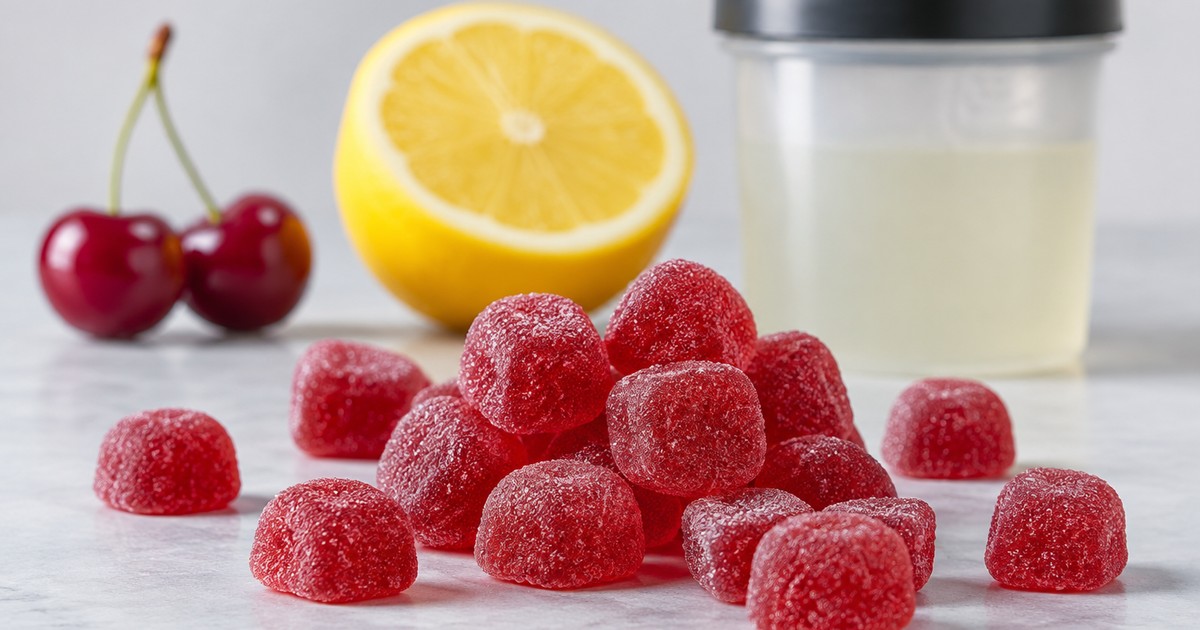
Where the Format Breaks
The first thing to settle in any amino acid gummy project is arithmetic, not chemistry. A 4 g finished piece contains roughly 3.2-3.6 g of solids once water is driven off to a water activity of 0.55-0.60. Sweetener, pectin or gelatine, acid, flavour and colour take 1.5-2.2 g of that. What is left for actives is 1.5-2.5 g per piece, or 3-5 g per two-piece serving at the absolute limit.
That ceiling is fine for taurine at 500-1,000 mg, glycine at 1 g, or L-carnitine at 500-1,000 mg. It is not fine for a 5 g BCAA serving at 2:1:1, and it is nowhere near a 10 g EAA serving. Any label that promises 5 g of BCAA per gummy is either selling a 12 g piece that nobody wants to chew, or it is not delivering the dose.
The second problem is chemistry. Free amino acids carry an amine group, and amine groups react with reducing sugars under heat. That is the Maillard reaction, and it turns a pale mass brown while producing cooked, savoury off-notes that no strawberry flavour can cover. A sucrose-glucose base is the worst possible partner for an amino acid load.
The answer is a polyol base with no reducing sugar: maltitol, sorbitol, isomalt or a blend, set with pectin or a modified starch. Pectin is usually the better fit because it gels at a lower solids level and gives a softer bite, which matters when the active itself is bitter and slightly drying.
The third problem is taste, and it is counter-intuitive. Amino acids are bitter and umami, and the instinct is to add sugar. That makes it worse: sweetness amplifies the savoury edge and the result tastes like salted caramel that has gone wrong. What works is acid. A citrate or malate buffer at pH 3.2-3.6, with a sour fruit profile, converts a bitter note into a sour one the tongue is willing to accept.
Leucine is the most bitter of the BCAAs and the one that sets the ceiling. Isoleucine and valine are milder. Taurine is sulfonic rather than amino and tastes clean at 1 g. Glycine is sweet, which sounds helpful until you realise it also plasticises the gel and softens the finished piece. L-carnitine tartrate is hygroscopic, picks up moisture in the pack and carries a fishy note that appears late.
Then there is the label side. A gummy at 2 g of amino acids is a supplement, not a protein substitute, and the claims need to reflect that. Muscle protein synthesis claims belong to 20-25 g of complete protein. What a gummy can honestly do is deliver a specific amino acid at a specific dose, and the honest marketing is about the dose, not the outcome.
We have run this category enough times to know where the failures are: browning from a sugar base, bitterness that was fought with sweetness, gel that went soft because glycine plasticised it, and a label that promised a scoop-sized dose in a chew-sized piece. All four are avoidable if they are decided at the brief.
What Our Amino Acid Gummy Line Covers
Amino Acid Gummy Capability
| Amino acid | Dose that fits | What breaks first | Workaround |
|---|---|---|---|
| BCAA 2:1:1 | 2-3 g per serving | Leucine bitterness, then gel softening | Acid buffer, pectin, 4.5 g piece |
| EAA blend | 2-3 g per serving | Combined bitterness, sulphur notes | Split across two pieces, sour profile |
| Taurine | 500-1,000 mg | Nothing at this dose | Straight addition, no masking needed |
| Glycine | 500-1,000 mg | Plasticises the gel, softens the bite | Reduce gelatine, raise pectin, check texture at 4 weeks |
| L-carnitine tartrate | 500-1,000 mg | Hygroscopic, fishy note after 2-3 weeks | Barrier pack, citrate pairing, low aw |
| Creatine monohydrate | 1-2 g per serving | Grittiness, poor solubility, settling | Micronised grade, suspension, texture check |
| Arginine / citrulline | 1-2 g per serving | Strong bitterness, high mass cost | Only at low dose, otherwise stick pack |
| Water activity | 0.55-0.60 aw | Above 0.65 the gel softens and browning accelerates | Cure 24-36 h at 20-25 °C, 35-45% RH |
| Batch size | 50,000-2,000,000 gummies | Pilot runs from 3,000 units | High-load SKUs run slower on the depositor |
From Brief to Finished Amino Gummy
Quality Control for Amino Acid Gummies
Each amino acid is assayed individually by HPLC on the finished gummy. A total nitrogen or total amino figure is not enough in this category, because a 2:1:1 BCAA claim is a claim about three separate numbers, and any one of them can drift.
Colour is measured as L*, a* and b* at release and at each stability pull. Browning is the earliest visible failure in an amino gummy, and it usually shows up before any assay result moves.
Texture is measured by compression at 1, 14 and 28 days. Amino acids at high load soften the gel over time, and a piece that is correct at day one can be unacceptable at day thirty.
The plant operates under GMP with ISO 9001, ISO 22000 and HACCP controls and is registered with the US FDA as a food facility. Heavy metals, microbiology and residual solvents are tested per batch.
Amino Acid Gummy FAQ
Can you fit 5 g of BCAA in a gummy?+
Why do amino gummies turn brown?+
How do you mask leucine?+
Can glycine be used in a gummy?+
Do creatine gummies work?+
Is carnitine stable in a gummy?+
Can the gummy be sugar-free?+
Should I make a gummy or a stick pack?+
What is the minimum order?+
How long does production take?+
Send Your Amino Acid Gummy Brief
Tell us the amino acids, the doses and the piece size you have in mind. We will come back with the dose that actually fits, the flavour direction that works, and a stick pack quote if the gummy cannot carry it.