

Detox Gummies: The Cofactors Fit, the Claim Does Not
There is no gummy that removes toxins, and no regulator will let you say there is. What a gummy can carry are the cofactors the liver actually uses in phase I and phase II metabolism, at doses that survive a 90 second cook.
Why We Formulate Cofactors Instead of Detox Claims
Detox is a marketing word with no regulatory definition. In the European Union the term implies a claim that a food removes toxins from the body, which is not an authorised health claim and in most member states is treated as a medicinal claim. In the United States the same word invites Federal Trade Commission attention unless it is carefully qualified. A brand that prints 'detoxifies your liver' on a gummy is buying a liability, not a benefit.
The technical reality is more interesting. The liver runs two enzyme systems, phase I cytochrome P450 oxidation and phase II conjugation with glutathione, glucuronic acid, sulphate and glycine. Those systems need cofactors: glutathione itself, N-acetylcysteine as its precursor, B vitamins as coenzymes, selenium for glutathione peroxidase, and choline for methylation and lipid export. Every one of those fits a gummy, and several of them are genuinely difficult to keep stable in one.
So the product we build is a cofactor product. The label says what the nutrients do in authorised language: riboflavin, niacin and vitamin B6 contribute to normal energy yielding metabolism; selenium and vitamin E contribute to the protection of cells from oxidative stress; choline contributes to normal liver function. What it does not say is that the piece detoxifies anything.
The hardest ingredient in this family is N-acetylcysteine. NAC is a thiol, it smells of sulphur, it tastes sour and rubbery at 300-600 mg, and it oxidises to cystine in the presence of oxygen and metal ions. In a water-based gummy at pH 4 that oxidation runs faster than in a capsule, and a piece that starts at 600 mg can be at 450 mg by the end of a nine month shelf life if the process is loose.
Reduced glutathione has the same problem in a more expensive form. GSH oxidises to GSSG, a dimer that has no biological equivalence for this purpose, and the conversion is accelerated by heat, oxygen, light and trace metals. We add it at the cool stage under nitrogen, chelate the water with a sequestrant, and assay GSH and GSSG separately so the label claim reflects the reduced form only.
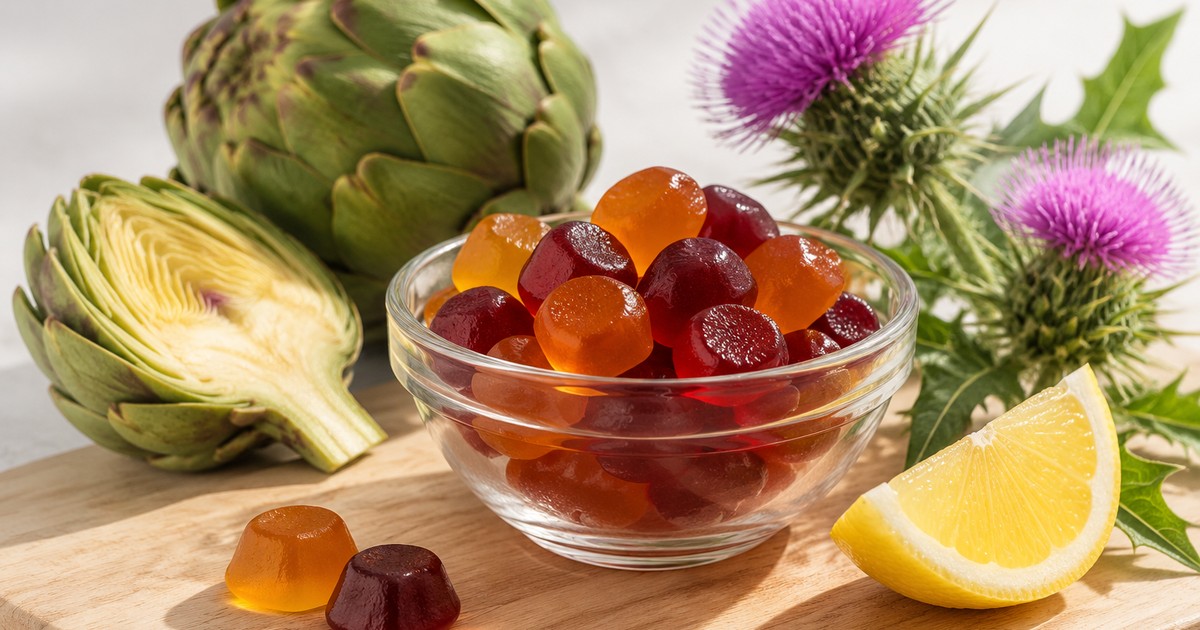
The botanicals bring a different failure mode: taste. Milk thistle extract at 150-300 mg is bitter and slightly gritty, artichoke leaf extract at 300-500 mg is more bitter still, and dandelion root adds an earthy note that reads as dirt to most tasters. A detox gummy that tastes like a hedgerow is not a commercial product, so the flavour system carries as much development time as the actives.
What Our Detox Gummy Line Covers
Detox Gummy Cofactor Table
| Cofactor | Role | Dose that fits | Stability issue | Label wording |
|---|---|---|---|---|
| N-acetylcysteine | Glutathione precursor | 300-600 mg | Thiol oxidation, sulphur taste | No EU claim |
| Reduced glutathione | Phase II conjugation | 250-500 mg | Oxidises to GSSG | No EU claim |
| Milk thistle (80% silymarin) | Phase I support | 150-300 mg | Bitterness, grit | No EU claim |
| Artichoke leaf extract | Bile flow | 300-500 mg | Intense bitterness | No EU claim |
| Choline | Methylation, lipid export | 200-300 mg | Fishy taste, hygroscopic | EU claim: liver function |
| Selenium | Glutathione peroxidase | 55-200 µg | Narrow therapeutic window | EU claim: cell protection |
| Riboflavin | Cofactor regeneration | 1.4-2.1 mg | Yellow colour, light | EU claim: energy metabolism |
| Niacinamide | NAD precursor | 14-18 mg | Flush if nicotinic acid | EU claim: energy metabolism |
| Vitamin B6 | Amino acid metabolism | 1.4-2 mg | None at this dose | EU claim: energy metabolism |
Detox Gummy Development Sequence
Quality Control for Detox Gummies
Glutathione is the release-critical assay. We measure reduced GSH and oxidised GSSG separately by HPLC, and the label claim is supported by the reduced figure alone. A total glutathione result can look healthy while most of the active has already converted to the dimer.
NAC is assayed as free N-acetylcysteine, with a sulphur-containing degradation check. The taste panel also scores sulphur, because a batch that assays within specification but smells of rotten eggs will come back from consumers regardless of the certificate.
Silymarin is assayed as the sum of the three main flavonolignans, silybin, silychristin and silydianin, on the finished piece. Input extract standardisation does not tell you what survived the cook and the shelf.
Colour is tracked instrumentally at release and at each stability pull. Thiol oxidation and silymarin degradation both show as a shift toward yellow-brown, and colour is often the first measurable sign that the headspace oxygen target was missed on a particular batch.
Detox Gummy FAQ
Does a detox gummy actually remove toxins?+
What can the label legally say in the EU?+
Why is glutathione so difficult in a gummy?+
How much NAC fits?+
Do you use liposomal glutathione?+
How bitter is the finished product?+
Can you combine detox with weight management actives?+
What is the shelf life?+
What is the minimum order and lead time?+
Send Your Detox Brief
Send us the cofactors, the doses and the market. We will return a formulation that fits a gummy, a stability plan for the thiols, and label wording that will survive a regulatory read without claiming the piece removes anything from the body.