

Liver Health Gummies Where Everything Tastes Bitter
Silymarin, TUDCA and NAC are three different taste problems in one piece. We build the base around the worst of them instead of adding flavour on top and hoping.
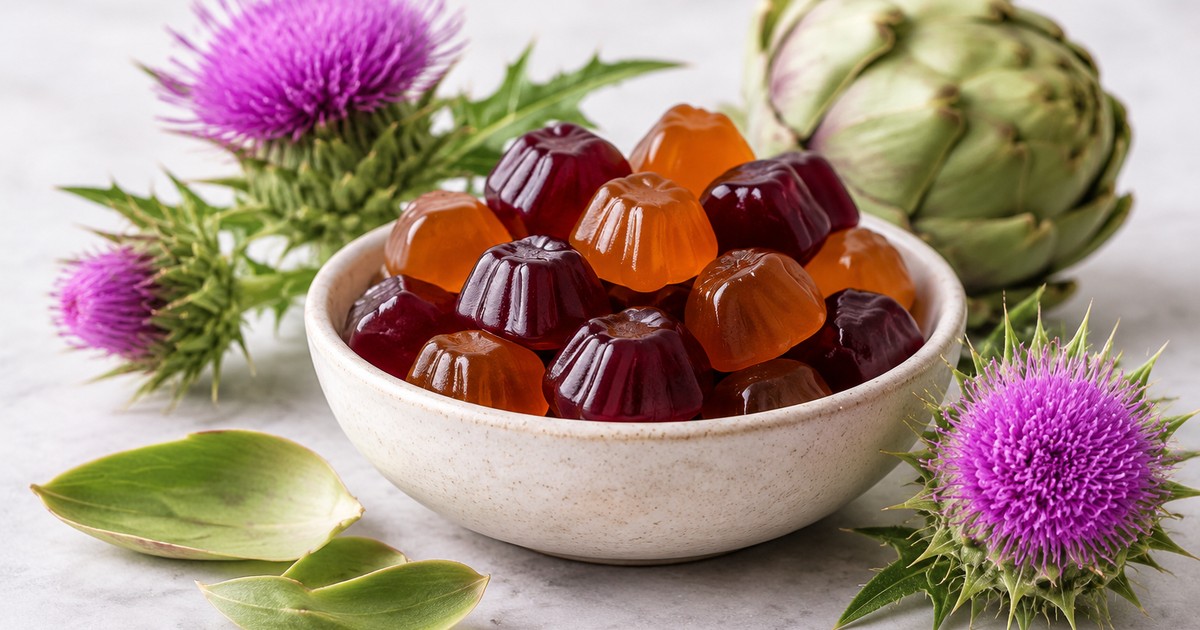
Four Actives, Four Different Failure Modes
Milk thistle extract is the anchor of almost every liver formula, and it is the reason the category tastes the way it does. Standardised extract at 80% silymarin carries 150-300 mg of actives in a normal serving, and silymarin is barely water-soluble. It does not dissolve into the cooked mass at all. It suspends.
That single fact decides the whole process. A suspended active has to stay suspended from the first tray to the last, which means the mass is kept under agitation right up to the depositor, and the assay is checked at the start, middle and end of the run rather than once at the end. If the silymarin settles, the first gummies are strong and the last gummies are decoration.
TUDCA is a different problem. It is a bile salt: water-soluble, surface-active, and bitter in a way that reads as soap rather than as herb. At 250-500 mg it foams during mixing, and foam in a depositing mass becomes air bubbles in the finished piece. It also prefers a pH away from the acid range that fruit flavours want, so the flavour system is chosen before the TUDCA level is fixed, not after.
NAC brings the third problem, which is sulphur. At 300-600 mg the mercaptan note is noticeable at the back of the throat and it gets worse with heat. NAC is also an amine source, and amines plus reducing sugars plus heat equals Maillard browning: the mass darkens, the flavour goes cooked, and nobody understands why the pilot batch came out the colour of cola.
The fix is a base, not a flavour. A polyol and pectin base removes the reducing sugar that Maillard needs, and it also carries bitterness more cleanly than a gelatine and sucrose base because there is no caramel note to fight. Where a sugar base is required for mouthfeel, the NAC is added late, below 65 °C, and the batch is run at a lower pH.
Artichoke and choline are the optional fourth and fifth actives, and both are worse than they look on paper. Artichoke extract at 300-500 mg is bitter in a green, lingering way that survives most masking systems. Choline bitartrate at 250-500 mg brings a fishy note that only shows up after two weeks in the pack, when the trimethylamine forms.
None of this makes a liver gummy impossible. It makes it a sequencing exercise: decide which actives are load-bearing, accept that the piece will be opaque and slightly bitter at the finish, and design the flavour to work with that rather than against it. A liver gummy that tastes like a strawberry candy and carries 300 mg of silymarin is not a better product. It is a product where the label and the piece disagree.
What Our Liver Health Gummy Line Covers
Liver Health Gummy Capability
| Active | Dose that fits | Behaviour in the mass | Handling |
|---|---|---|---|
| Silymarin (80% extract) | 150-300 mg | Insoluble, settles, slightly bitter | Suspension, continuous agitation, triple-point assay |
| TUDCA | 250-500 mg | Surface-active, foams, soap-bitter | Dissolve first, antifoam, pH 4.0-5.0 |
| NAC | 300-600 mg | Sulphur note, Maillard with reducing sugars | Add below 65 °C, polyol base |
| Artichoke extract | 300-500 mg | Green bitterness, lingers | Emulsifier in the flavour system |
| Choline bitartrate | 250-500 mg | Fishy note after 2 weeks | Encapsulate or pair with citrus terpenes |
| Water activity | 0.55-0.60 aw | Higher aw darkens the extract | Cure 24-48 h at 20-25 °C, 35-45% RH |
| Piece weight | 3.5-4.5 g | Below 3 g the dose will not fit | Deposit weight checked hourly |
| Batch size | 50,000-2,000,000 gummies | Pilot runs from 3,000 units | Scheduling depends on extract lead time |
| Shelf life target | 18-24 months | Silymarin assay drifts slowly, NAC faster | 25 °C and 40 °C stability at 0, 3 and 6 months |
From Brief to Finished Liver Gummy
Quality Control for Liver Health Gummies
Silymarin is assayed by HPLC on the finished gummy, expressed as silymarin content rather than as extract weight, because extract grades vary between 70% and 80% and a label built on input weight can be wrong by 15% before anything goes out of specification.
NAC is assayed separately and earlier in the stability programme than the rest of the panel. Free thiols oxidise, and the drop is not linear: a batch that reads 98% at release can be at 85% by month six in a clear pack under retail lighting.
Water activity is checked on every batch because it drives both microbial stability and browning rate. Liver formulas sit at 0.55-0.60 aw, and we do not accept a batch above 0.62 regardless of assay results.
The plant runs under GMP with ISO 9001, ISO 22000 and HACCP controls and is registered with the US FDA as a food facility. Heavy metals, microbiology and residual solvents are tested per batch, with third-party verification available on request.
Liver Health Gummy FAQ
How much silymarin actually fits in one gummy?+
Can TUDCA go into a gummy without ruining it?+
Why does NAC turn the batch brown?+
Does the gummy have to be opaque?+
Can you mask artichoke?+
Can the gummy be sugar-free?+
What claims can go on a liver gummy?+
Do you make hangover gummies?+
What is the minimum order?+
How long does production take?+
Send Your Liver Health Gummy Brief
Tell us the actives, the doses and whether TUDCA is in scope. We will confirm what the format carries, what the flavour ceiling is, and the assay scope before quoting.