

Heart Health Gummies: What Fits and What Does Not
CoQ10 at 200 mg fits inside an oil phase. Vitamin K2 fits at micrograms. Plant sterols at the 2 g cholesterol-lowering dose do not fit at all, and we will not pretend they do.
The Ingredient List Decides the Format
Heart health is the category where the gap between the evidence dose and the gummy dose is widest. CoQ10 has good data at 100-200 mg and the format carries it. Omega-3 has good data at 1-2 g of EPA plus DHA and the format carries 10-25% of that. Plant sterols have an authorised EU claim at 800 mg of plant stanols and the format carries a token amount. The label has to reflect which of those three situations applies to each ingredient.
CoQ10 is the anchor and the easiest win, because it is fat-soluble and the gummy already needs an oil phase. Ubiquinone at 100-200 mg disperses into that phase, colours the piece orange to amber, and needs an emulsifier for uniformity. Ubiquinol is the reduced form, less stable in processing, more expensive, and usually not worth the handling cost in a chew.
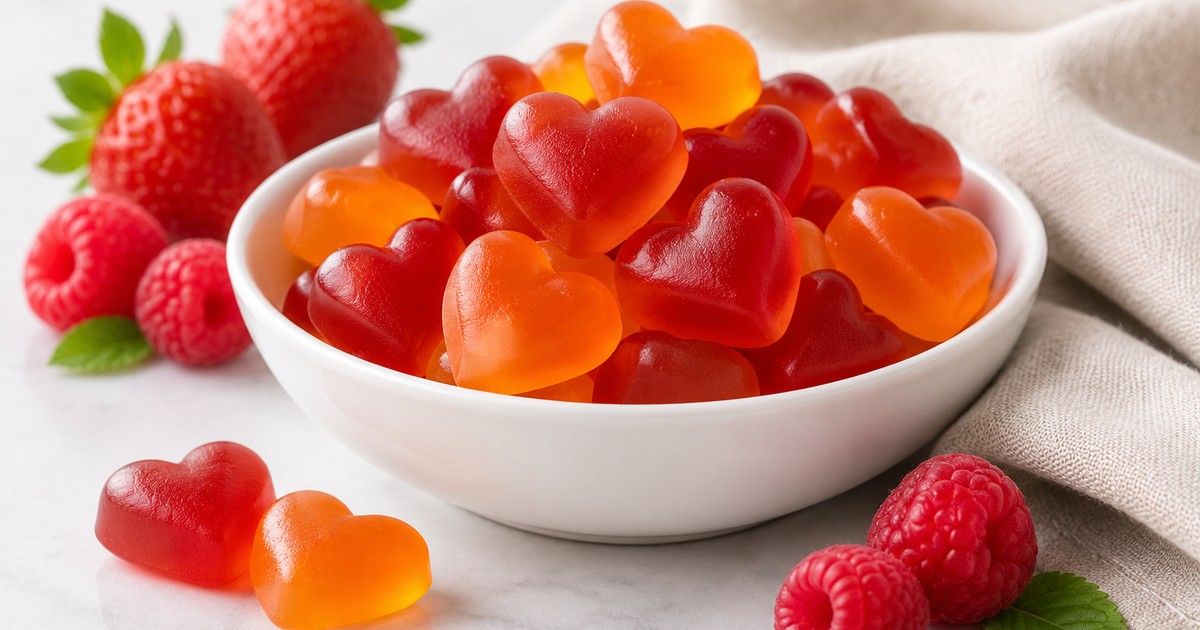
The piece becomes opaque and orange. That is not a defect, it is what 200 mg of CoQ10 looks like. Brands that insist on a clear, pale gummy end up at 30-50 mg of CoQ10, which is below the dose most of the published work uses.
Vitamin K2 as MK-7 is the opposite case: 45-90 µg is a mass rounding error and costs nothing to include. It also brings a real regulatory obligation. MK-7 interacts with warfarin and other vitamin K antagonists, so the label needs a warning in every market where the product is sold, and the warning is not optional marketing copy.
Omega-3 in a gummy is a supporting dose, not a therapeutic one. A 4 g piece can hold 100-250 mg of EPA plus DHA in an emulsified oil phase before the fish note and the oil load take over. That is enough to contribute to a label, not enough to replace a capsule at 1,000 mg. Selling it as equivalent is the most common misrepresentation in the category.
Plant sterols are the honest failure. The authorised EU claim for lowering blood cholesterol requires 1.5-3 g of plant sterols per day, and the standard product dose is 800 mg per serving of plant stanols. In a gummy, 400-800 mg is the practical maximum and even that is a chalky, waxy load. You cannot print the claim at a dose that fits, so the ingredient belongs in a functional food or a capsule, not a chew.
Citrus bergamot, beetroot and magnesium all sit in the middle. Bergamot extract at 500-1,000 mg is bitter and bulky; beetroot at 300-500 mg is a colour problem more than a taste problem; magnesium at 100-200 mg is straightforward and carries an authorised claim about normal muscle function rather than the heart specifically.
The product that works is usually CoQ10 plus K2 plus magnesium, with omega-3 as a supporting line item and no sterol claim. That combination is defensible at every dose on the label, which is worth more than a longer ingredient list that cannot be supported.
What Our Heart Health Gummy Line Covers
Heart Health Gummy Capability
| Active | Dose with evidence | Dose in a 4 g gummy | Label consequence |
|---|---|---|---|
| CoQ10 (ubiquinone) | 100-200 mg | 100-200 mg | Fits; piece is opaque orange |
| CoQ10 (ubiquinol) | 100-200 mg | 100 mg practical | Less stable, higher cost |
| Vitamin K2 (MK-7) | 45-90 µg | 45-90 µg | Fits; warfarin warning required |
| Omega-3 (EPA+DHA) | 1,000-2,000 mg | 100-250 mg | Supporting dose only, no equivalence claim |
| Plant sterols | 1,500-3,000 mg/day | 400-800 mg | Cannot print the cholesterol claim |
| Magnesium glycinate | 100-200 mg | 100-200 mg | Fits; muscle function claim applies |
| Citrus bergamot | 500-1,000 mg | 300-500 mg | Bitter, bulky, partial dose |
| Water activity | n/a | 0.55-0.60 aw | Protects the oil phase |
| Batch size | n/a | 50,000-2,000,000 gummies | Pilot from 3,000 units |
From Brief to Finished Heart Gummy
Quality Control for Heart Health Gummies
CoQ10 is assayed by HPLC on the finished gummy. The input figure is not used, because ubiquinone disperses unevenly in an oil phase and a formula that is correct on paper can be 15% low in the piece.
Peroxide value is tracked on the oil phase and on the finished product, since oxidised omega-3 is the defect a consumer notices immediately and the one an assay of total fat will miss.
Emulsion stability is checked at deposit, after curing and at two weeks. Surface oil on a CoQ10 piece is a reject because it predicts both a soft texture and a visible sheen on the pack.
The plant operates under GMP with ISO 9001, ISO 22000 and HACCP controls and is registered with the US FDA as a food facility. Heavy metals and microbiological testing run per batch.
Heart Health Gummy FAQ
How much CoQ10 fits in a gummy?+
Can you make an omega-3 gummy at 1,000 mg?+
Why will you not print a plant sterol cholesterol claim?+
Does vitamin K2 need a warning?+
Is ubiquinol better than ubiquinone in a gummy?+
Can I combine CoQ10 with magnesium?+
Will the gummy be orange?+
Can the gummy be sugar-free?+
What is the minimum order?+
How long does production take?+
Send Your Heart Health Gummy Brief
Tell us the actives and the claims you intend to print. We will tell you which doses the format carries, which claims the dose supports, and where a softgel or a stick pack is the honest answer.