

Hyaluronic Acid Gummies and the Moisture They Attract
HA is a humectant. Put 200 mg of it in a gummy and the piece will pull water out of the air, soften, and start to sweat in the pack. The packaging is part of the formula.
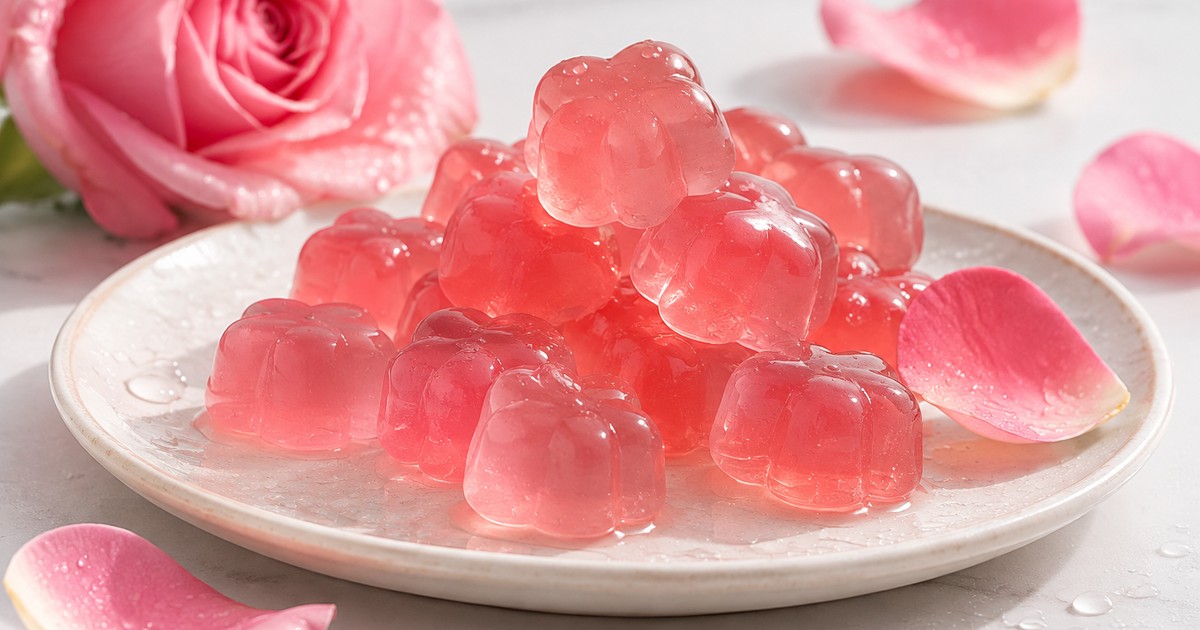
A Humectant Inside a Moisture-Sensitive Piece
Hyaluronic acid is the most hygroscopic active in the beauty category, and a gummy is a moisture-controlled system. Those two facts are in direct conflict, and the conflict is what makes this product harder than it looks.
Sodium hyaluronate binds up to 1,000 times its own weight in water. In a gummy at 120-200 mg per serving it holds water inside the piece, which is fine, until the piece meets a humid ambient and the gradient reverses. Then the HA keeps pulling water in from the headspace, the surface becomes tacky, and the gummies start to stick together and sweat.
The symptom shows up in the pack, not in the plant. A batch that leaves the line perfect can be a soft, glossy block by week six in a standard clear pouch. The fix is a combination of three things: a low water activity target, a high-barrier pack with a desiccant, and a molecular weight blend that does not sit entirely at the low end.
Molecular weight matters twice. Low molecular weight HA, roughly 50-200 kDa, is the fraction most often used in oral products and the one with the marketing story. It is also more hygroscopic and more mobile in the gel. High molecular weight HA, above 1,000 kDa, is more viscous and stays put but is harder to disperse evenly at dose.
The practical compromise is a blend: a majority at 50-200 kDa for the label story and the absorption argument, plus a fraction at 800-1,500 kDa to hold the piece together. The blend ratio is a processing decision as much as a marketing one, and we will say which ratio the piece actually needs.
Texture is the second consequence. HA at 200 mg adds a slippery, almost slick mouthfeel that works well in a pectin gel and badly in a gelatine one. Gelatine gives a springy chew where the HA reads as slime; pectin gives a shorter, cleaner bite that reads as a soft chew. For this category pectin is the better base, and it is also the one that tolerates the low water activity target.
The third issue is the claim. In the EU there is no authorised health claim for oral hyaluronic acid. Contributes to skin hydration is not an approved wording under Regulation 1924/2006, and the same applies to most wrinkle and elasticity language. What can be done is pair the HA with vitamin C, which has an authorised claim about collagen formation, and let the HA sit as a formula ingredient without a claim attached to it.
That is a real commercial constraint and it is worth naming before the artwork is designed. Brands that need a claim on the front of the pack usually go with vitamin C, collagen peptides, or both, and treat HA as the supporting ingredient. Brands that sell on the ingredient name alone are selling in markets where enforcement is lighter, and that is a decision for them, not for the factory.
None of this is a reason to skip the format. A well-built HA gummy is a pleasant product with a real dose, and the packaging cost is a few cents. It is a reason to plan the pack and the claim at the same time as the formula.
What Our Hyaluronic Acid Gummy Line Covers
Hyaluronic Acid Gummy Capability
| Parameter | Target | Why it matters | Note |
|---|---|---|---|
| Sodium hyaluronate | 120-200 mg | Matches oral market doses | Assayed as HA, not as salt weight |
| Molecular weight | 50-200 kDa + 800-1,500 kDa | Low MW for the story, high MW for structure | Blend ratio fixed by texture trial |
| Water activity | 0.45-0.55 aw | Humectant pulls moisture until gradient closes | Hard release criterion |
| Base | Pectin | Cleaner bite, better low-aw tolerance | Gelatine reads as slimy here |
| Vitamin C | 80-250 mg | Carries the authorised collagen claim | Ascorbic acid or sodium ascorbate |
| Pack | High-barrier film + desiccant | Prevents sweating and sticking | Costed into the quote |
| Piece weight | 3.5-4.2 g | Below 3 g the HA load is hard to disperse | Checked hourly |
| Batch size | 50,000-2,000,000 gummies | Pilot from 3,000 units | Longer cure on low-aw SKUs |
From Brief to Finished HA Gummy
Quality Control for Hyaluronic Acid Gummies
HA is assayed by HPLC on the finished gummy and expressed as hyaluronic acid rather than as sodium hyaluronate weight. The salt is about 10% heavier than the acid, so a label built on salt weight overstates the active by that margin.
Water activity is a hard release criterion. A batch above 0.55 aw is held even if every other result is in specification, because the pack trial data does not support shelf life at that figure.
Molecular weight distribution is verified on the incoming raw material by viscometry or GPC, since the blend ratio is what the texture and the claim both depend on.
The plant operates under GMP with ISO 9001, ISO 22000 and HACCP controls and is registered with the US FDA as a food facility. Heavy metals and microbiological testing run per batch.
Hyaluronic Acid Gummy FAQ
Why do HA gummies sweat in the pack?+
How much HA fits in one gummy?+
What molecular weight should I use?+
Is pectin or gelatine better for HA?+
Can I claim skin hydration in the EU?+
Does HA pair well with collagen?+
Can the gummy be sugar-free?+
How long does an HA gummy last?+
What is the minimum order?+
How long does production take?+
Send Your Hyaluronic Acid Gummy Brief
Tell us the dose, the molecular weight story and the pack format. We will confirm the water activity target, the film specification and the claim wording that the market will actually accept.