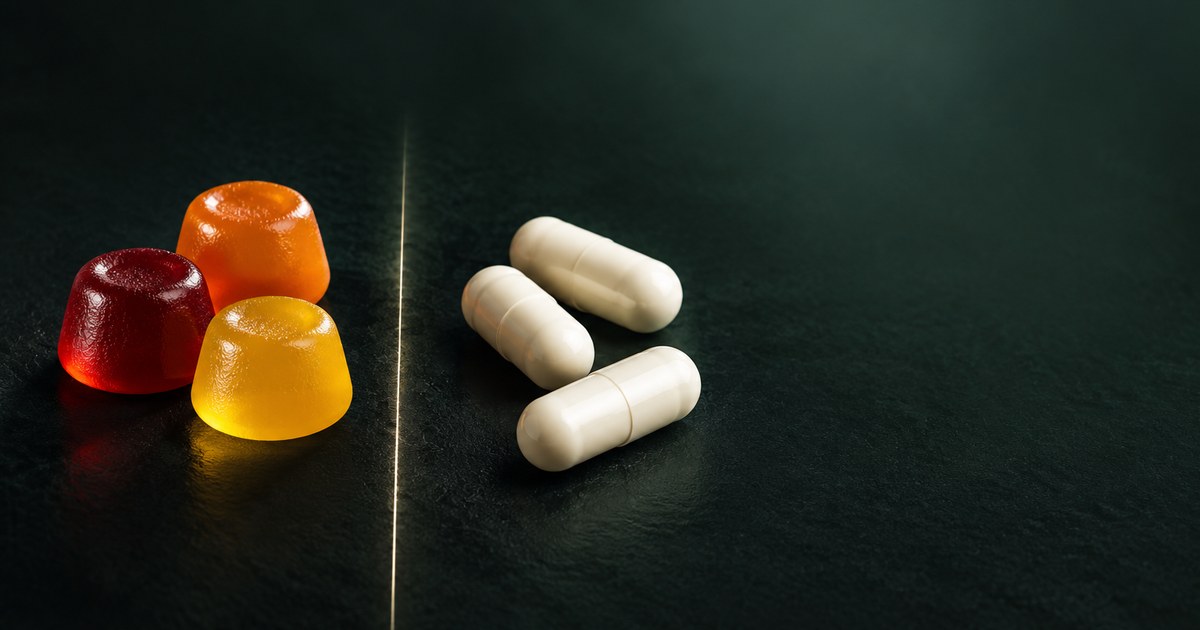

Vitamin gummies are sold on convenience and bought on taste. They are also, in many cases, a worse way to take the vitamin than a capsule — not because gummies are dishonest, but because the format imposes physical limits on what can go in, and those limits are rarely explained on the label.
This is the comparison most brands never see before they choose a format: what dose each vitamin actually needs, how much of it fits in a gummy, which vitamins degrade or taste unpalatable in a gummy matrix, and where a capsule or tablet is the better engineering answer.
The dose problem in one table
| Vitamin | Typical label dose | Practical gummy ceiling per piece | Pieces needed | Verdict |
|---|---|---|---|---|
| Vitamin D3 | 1,000–4,000 IU (25–100 µg) | 2,000 IU | 1–2 | Ideal gummy vitamin |
| Vitamin B12 | 100–1,000 µg | 500 µg (taste limits) | 1–2 | Good, but taste is a challenge |
| Vitamin C | 250–1,000 mg | 60–100 mg | 3–10 | Poor; use capsules or drink mix |
| Vitamin E | 15–400 IU | 30 IU in a fat-based gummy | 2–10 | Poor in water-based gummies |
| Vitamin A | 700–3,000 IU | 2,500 IU | 1–2 | Good |
| Vitamin K2 | 45–180 µg | 90 µg | 1–2 | Good |
| B-complex (full) | 10–100 mg each | Very limited | 3–5 | Poor; taste and bulk |
| Folate | 400–800 µg DFE | 400 µg | 1–2 | Good |
| Zinc | 10–30 mg | 5 mg (metallic taste) | 2–6 | Poor above 5 mg |
| Iron | 10–18 mg | Not practical | — | Off-flavour and oxidation; capsule or tablet |
The rule: below about 100 mg per serving, a gummy is fine. Above it, the gummy either needs a multi-piece serving or a smaller dose than the label claims to offer. A “1,000 mg vitamin C gummy” with a 2-gummy serving is delivering 500 mg per piece, which is possible only with a very large piece — and it will taste strongly of ascorbic acid.
What the format does to stability
| Vitamin | Failure mechanism in gummies | Typical loss at 12 months | Mitigation |
|---|---|---|---|
| Vitamin C | Oxidation, browning, Maillard with reducing sugars | 15–40 % | Overage, low aw, opaque packaging, non-reducing syrup |
| Vitamin B1 (thiamine) | Heat and pH degradation | 10–30 % | Add after cooling, overage |
| Vitamin B2 (riboflavin) | Photodegradation | 10–25 % | Opaque jar, colour masking |
| Folate | Light and heat sensitivity | 10–30 % | Overage, opaque packaging |
| Vitamin A | Oxidation; interacts with acid | 10–25 % | Encapsulated form, antioxidant |
| Vitamin D3 | Relatively stable in gummy matrix | 5–15 % | Overage, avoid prolonged heat |
| Vitamin E | Poor dispersion in aqueous matrix | 10–30 % | Emulsified or encapsulated tocopherol |
These are ranges from published stability work and supplier data; every matrix differs. What matters is the principle: gummies need more overage than capsules for the same claim, and the overage has to be measured, not guessed.
Sugar, calories and the thing nobody mentions
| Format | Sugar per serving | Calories per serving | Notes |
|---|---|---|---|
| Standard gummy (2 pieces) | 3–5 g | 12–20 kcal | Glucose syrup and sucrose |
| Sugar-free gummy (polyol) | 0 g | 6–12 kcal | Maltitol/sorbitol can cause GI discomfort |
| Allulose gummy | 0–1 g | 6–10 kcal | Better GI tolerance, higher cost |
| Capsule | 0 g | 0–2 kcal | — |
| Tablet | 0 g | 0–2 kcal | Excipients only |
For a children's multivitamin, 4 g of sugar per serving is a legitimate objection from a paediatrician. For an adult beauty gummy, it is a cost of doing business. Either way, the number belongs in the brief, and sugar-free is not a free switch — polyols change texture, aw and often tolerance.
Cost comparison at the same dose
| Line item | Gummy, 2-piece serving | Capsule, 1-piece serving | Tablet, 1-piece |
|---|---|---|---|
| Active | $0.031 | $0.031 | $0.028 |
| Overage for stability | $0.006 | $0.003 | $0.003 |
| Base / excipients | $0.028 | $0.009 | $0.007 |
| Shell or coating | — | $0.011 | $0.004 |
| Processing | $0.019 | $0.007 | $0.005 |
| Packaging per serving | $0.019 | $0.012 | $0.012 |
| Total per serving | $0.103 | $0.073 | $0.059 |
A gummy costs 40–75 % more per serving than a capsule at the same dose. That premium buys adherence — and adherence is worth more than the cost difference for a product people take daily. This is why gummies dominate DTC subscription channels and capsules dominate professional and clinical channels.
When each format is the right answer
| Scenario | Better format | Reason |
|---|---|---|
| Daily multivitamin for consumers who forget pills | Gummy | Adherence beats a marginal cost increase |
| High-dose vitamin C or B-complex | Capsule or tablet | Dose cannot fit; taste is unmanageable |
| Iron supplementation | Capsule / tablet | Off-flavour, oxidation, dose |
| Prenatal | Capsule or tablet | Iron and calcium load; no sugar desired |
| Kids' vitamins | Gummy | Swallowability; sugar-free options exist |
| Vitamin D, K2, B12 | Either | Micro-doses; gummy wins on marketing |
| Sports and clinical stacks | Capsule | Multiple actives, dose accuracy, no sugar |
| Beauty and hair | Gummy | Ritual product; dose fits |
Does the format change absorption?
This is where marketing and evidence part company. For most vitamins the molecule absorbed is identical, so a gummy and a capsule delivering the same dose produce comparable exposure. But the format changes three things that matter: the vehicle (chewed with saliva and a sugar load), the dissolution step (a gummy must dissolve or be chewed, not disintegrate in the stomach), and the timing of release.
| Vitamin | Absorption dependency | Gummy effect | Capsule effect |
|---|---|---|---|
| Fat-soluble (A, D, E, K) | Requires dietary fat and bile | Neutral to slightly negative — gummies are fat-free unless emulsified | Neutral; oil-filled capsules can help |
| Vitamin C | Dose-dependent saturation above ~200 mg | Low dose per piece means better fractional absorption but a lower total | Higher total dose, lower fractional absorption |
| B12 | Intrinsic factor, then passive diffusion | Chewing with saliva is fine | Fine; sublingual offers no proven advantage |
| Folate | Converted to the active form | Fine if the dose survives storage | Fine |
| Iron | Competes with calcium; needs an acidic environment | Poor fit — taste, oxidation, low dose | Standard |
The fat-soluble row is the one most often ignored. A vitamin D gummy with no fat in the matrix is absorbed less efficiently than a capsule taken with a meal containing fat. The fix is either an emulsified gummy or clear label guidance to take it with food — and the second costs nothing.
Three cases: kids, prenatal, clinical
| Case | Format | Why | Watch out for |
|---|---|---|---|
| Children 2–12 | Gummy, sugar-free where possible | Adherence and swallowability dominate | Accidental overdose — gummies look like sweets; child-resistant closures and iron-free formulas |
| Prenatal | Capsule or tablet | Iron, calcium and DHA load do not fit a gummy | Nausea — split dosing and non-fishy DHA forms help |
| Clinical / therapeutic | Capsule, tablet or sachet | Dose accuracy, documented potency, no sugar | Prescriber acceptance; sugar load in diabetic patients |
Notice the pattern: gummies win where the risk of not taking the product exceeds the risk of a slightly lower dose, and lose where the dose itself is the therapy. That is a marketing question dressed as a formulation question, and answering it wrongly is how brands end up selling a gummy prenatal that no pharmacist will recommend.
Label claims that behave differently
- “100 % of daily value” is easy in a capsule and hard in a gummy for anything above 100 mg.
- “Sugar-free” changes the texture story, not just the nutrition panel.
- “Vegan” is automatic with pectin, impossible with gelatin — and capsules need HPMC for the same claim.
- “No artificial colours” in a gummy usually means beetroot, beta-carotene and spirulina, which are less stable and drift in shade.
- “Clinically studied dose” is the claim most often broken by the format, because the studied dose may not fit in two gummies.
The overage you need to hold the claim at 12 months
| Vitamin | Measured loss, 12 months | Overage factor | Practical note |
|---|---|---|---|
| Vitamin D3, 1,000 IU | 5–15 % | 1.1–1.2× | Cheapest overage in the panel; no excuse for a short label |
| Vitamin B12, 500 µg | 10–20 % | 1.15–1.25× | Also check for taste contribution at higher levels |
| Folate, 400 µg DFE | 10–30 % | 1.15–1.45× | Light-sensitive: the jar, not the formula, does most of the work |
| Vitamin A, 2,500 IU | 10–25 % | 1.15–1.35× | Encapsulated forms cut loss but add cost |
| Vitamin C, 250 mg | 15–40 % | 1.2–1.7× | The overage contributes acid taste; this is where gummies stop making sense |
| B-complex, full panel | 10–30 % | 1.15–1.45× | Thiamine and riboflavin dominate the loss |
Two rules apply to every row. Overage is set on measured loss in your own matrix, plus the analytical variability of the method — usually 10–20 % on top. And overage is not free: at 40 % it changes taste, cost and sometimes colour, so a vitamin that needs 1.7× overage is usually the wrong vitamin for a gummy.
The brief that prevents a wrong-format launch
| Question | If the answer is… | Then |
|---|---|---|
| Is the dose per serving above 100 mg? | Yes | Capsule, tablet or drink mix — not a gummy |
| Does the label need to say “clinically studied dose”? | Yes, and it exceeds the gummy ceiling | Reduce the claim or change the format |
| Is the target audience diabetic or sugar-averse? | Yes | Sugar-free gummy or capsule; check polyol tolerance |
| Is the product for children? | Yes | Gummy, but keep sugar under 2 g per serving if possible |
| Does the brand depend on subscription adherence? | Yes | Gummy — the cost premium is justified by repeat purchase |
| Is the product sold through clinical or pharmacy channels? | Yes | Capsule; gummies read as confectionery to that buyer |
| Is iron in the formula? | Yes | Capsule or tablet; iron in a gummy is an oxidation and taste problem |
| Is the launch volume under 5,000 units? | Yes | Tablet or capsule; gummy MOQ and tooling dominate at this volume |
If you are weighing formats before you choose a supplier, our pages on vitamin manufacturing and capsule manufacturing set out the equipment, testing and minimum volumes behind each one. For the next decision in the sequence, read what actually fits in a collagen gummy.
Frequently asked questions
Are gummies as effective as capsules?
At the same delivered dose, yes — the vitamin is the same molecule. The difference is that gummies often carry a lower dose, need more overage, and add sugar; effectiveness depends on the dose actually delivered at expiry.
Why do gummy vitamins have less of the vitamin than capsules?
Physical bulk and taste. A 1,000 mg vitamin C dose would need a very large piece and would taste strongly acidic, so most gummies deliver 60–250 mg per serving.
Do gummies lose potency faster?
Generally yes, especially for vitamin C, B vitamins and folate, because of heat exposure during manufacture and higher water activity in the matrix. Overage and packaging can close most of the gap.
Is a sugar-free gummy better?
For calorie and dental reasons, yes. For GI tolerance, not always — maltitol and sorbitol cause discomfort in some people, and texture usually changes.
Can I put iron in a gummy?
You can, but it oxidises, tastes metallic, and needs a high dose. It is one of the few ingredients where a capsule is simply the better product.
What shelf life can a gummy vitamin claim?
18–24 months is achievable with measured overage and opaque, high-barrier packaging. Without stability data, the honest answer is 12 months.
Do gummies need a Supplement Facts panel?
In the US, yes — the same panel as a capsule, with the same serving-size rules, plus the sugar and calorie declaration that follows from the format.
Which is cheaper to launch?
Tablets and capsules, by a wide margin, because tooling and MOQ are lower. Gummies become competitive once volume supports a depositor batch and the brand can charge the adherence premium.
Sources and further reading
Regulatory and standards
- US FDA, 21 CFR Part 111; nutrition labelling and the dietary supplement framework.
- Directive 2002/46/EC via EUR-Lex; EU Register of nutrition and health claims at ec.europa.eu.
- Institute of Medicine / National Academies, Dietary Reference Intakes — the basis for %DV figures used in the table above.
Peer-reviewed research
- Disintegration and dissolution testing of green tea dietary supplements: application and evaluation of United States Pharmacopeial methods. J Pharm Sci. 2020. PMID 32081719 — why supplement performance testing differs from pharmaceuticals.
- Klayraung S, Viernstein H, Okonogi S. Development of tablets containing probiotics: effects of formulation and processing parameters on bacterial viability. Int J Pharm. 2009;370:54–60. PMID 19059323 — the same processing-loss logic that governs vitamin overage.
- Enhancing the dissolution stability of hard gelatin capsules using activated carbon as a packaging component. J Pharm Sci. 2018. PMID 30145210 — packaging as a stability variable, not an afterthought.
Standards and industry references
- ISO 22000; GFSI; US FDA HACCP principles.
- United States Pharmacopeia, general chapters <2021>, <711>, <232>.
Dose ceilings and stability losses are indicative ranges from formulation practice and supplier stability summaries; confirm with a bench trial and a stability study on your own matrix before setting a label claim.