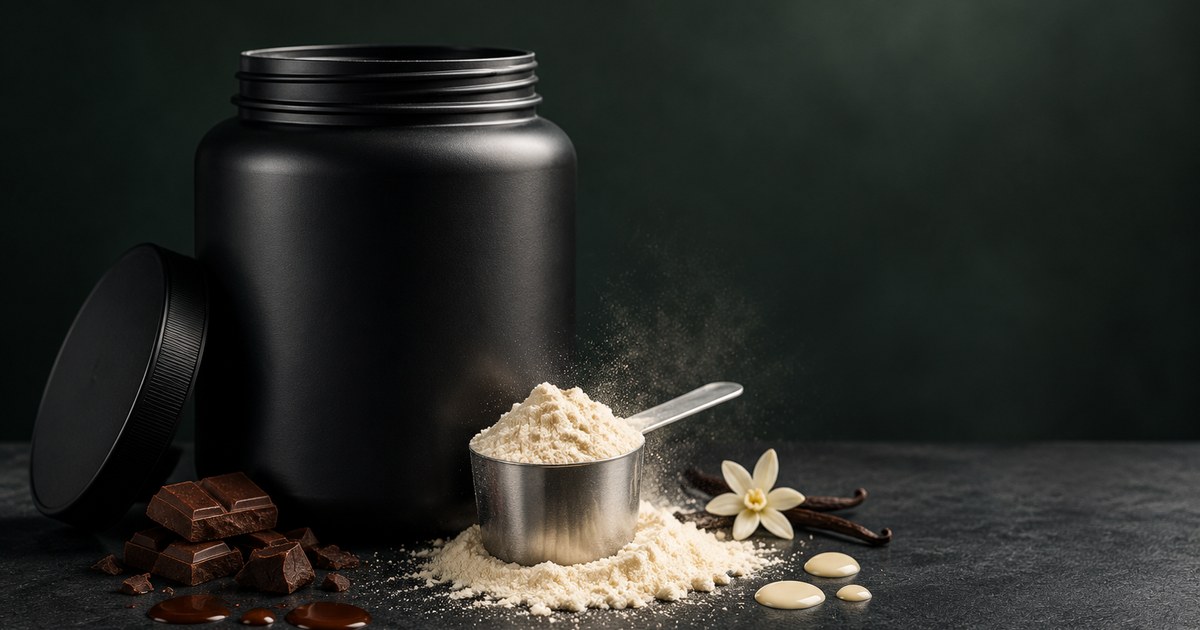

Protein powder looks like the simplest product in the supplement catalogue: three or four ingredients, a scoop, a tub. It is actually the most operationally difficult of the mainstream formats, because the active is cheap per kilo, the dose is large, the serving is tasted, and the powder has to flow through a high-speed filler without separating. Small mistakes in any of those three areas show up immediately — in taste complaints, in label-claim failures, or in a batch that will not fill to weight.
This guide covers what a contract manufacturer actually has to control to make protein powder well: protein source and assay, blending order, flavour and texture systems, fill accuracy, testing, MOQ economics and the cost build per serving. All figures are 2026 ex-works ranges from China-based contract manufacturers.
Protein source: what the label claim really costs
The single biggest driver of cost and quality is the protein source and its assay. A “25 g protein per serving” claim is a legal statement about measured protein, not about how much powder you put in the tub.
| Source | Protein content (dry) | Cost per kg protein (indicative) | Strength | Weakness |
|---|---|---|---|---|
| Whey protein concentrate 80 % | 80 % | $11–16 | Cheapest complete protein, good taste | Lactose 3–6 %; not dairy-free |
| Whey protein isolate 90 % | 90 % | $16–24 | Low lactose, clean flavour | Cost; harder to suspend |
| Whey hydrolysate | 80–90 % | $28–45 | Fast absorption claim | Bitter peptides; premium price |
| Milk protein concentrate | 70–85 % | $10–15 | Casein+whey blend, creamy mouthfeel | Slower solution; not clear in water |
| Pea protein isolate | 80–85 % | $9–14 | Vegan, low allergen | Gritty, beany off-note, low methionine |
| Rice protein | 75–80 % | $9–13 | Hypoallergenic, complements pea | Chalky; needs 2:1 pea:rice to close the amino profile |
| Soy protein isolate | 90 % | $7–11 | Cheapest complete plant protein | Allergen labelling; taste; consumer perception |
| Collagen peptides | 90–97 % | $17–26 | Beauty and joint positioning | Not a complete protein — cannot carry a “complete protein” claim |
Two consequences. First, a plant-based product at the same 25 g claim costs more than whey concentrate unless you accept soy, and it will taste worse unless you spend on flavour and texture. Second, if a quote for “whey isolate, 25 g protein, 2 lb tub” comes in far below this table, one of three things is true: the assay is lower than stated, the serving size is larger than the label implies, or the protein is a blend with concentrate and the “isolate” is a small fraction.
Assay: the number you must test, not assume
| Test | Method | Why it matters | Typical spec |
|---|---|---|---|
| Crude protein | Kjeldahl or Dumas | Backs the label claim; nitrogen-based, so it can be inflated by non-protein nitrogen | ±5 % of label |
| Amino acid profile | HPLC | Catches adulteration (glycine, taurine, melamine) that Kjeldahl misses | Match declared profile |
| Moisture | Loss on drying | Drives caking and shelf life | ≤5 % |
| Heavy metals | ICP-MS | Plant proteins carry soil-derived load | Per Prop 65 / EFSA limits |
| Microbiology | USP / ISO methods | Powders are not sterile | TAMC <104, no pathogens |
| Bulk density and flow | Tapped density, angle of repose | Determines whether the filler can hit weight | Set per formula |
| Solubility / dispersibility | In-house method | The complaint driver | ≥95 % dispersed in 30 s |
| Allergen cross-contact | ELISA swabs | Required for dairy-free and vegan claims | <LOD after cleaning |
The amino-acid profile is the test that separates a serious buyer from a naive one. Protein adulteration with glycine or taurine is cheap, raises Kjeldahl nitrogen, and is invisible on a certificate that only reports “protein 80.2 %”. Ask for the profile, and compare it against the reference for that source.
Blending: order, time and the separation problem
A protein powder is a mixture of particles with different sizes and densities. Whey isolate is fine and light; cocoa is fine and light; lecithin is coarse and sticky; salt and sweetener are crystalline and dense. Put them together badly and the tub separates in transit — the first serving is over-flavoured and the last is under-flavoured, and the protein varies by several grams.
| Step | What happens | Control point |
|---|---|---|
| 1. Pre-blend micro-ingredients | Sweetener, flavour, colour, salt, vitamins diluted into a carrier at 1:10 | Geometric dilution to avoid hot spots |
| 2. Load base protein | 50 % of the protein into the ribbon or V-blender | Weigh-in tolerance ±0.2 % |
| 3. Add pre-blend and actives | Layered between protein portions | No ingredient added last on top of the mass |
| 4. Add texture and flow agents | Lecithin, xanthan, silicon dioxide | Lecithin must be dry-blended, not wetted |
| 5. Blend | 8–15 min ribbon, 10–20 min V-blender | Over-blending causes heat and static, under-blending causes variation |
| 6. Discharge and sieve | Through 20–30 mesh | Catches lumps and foreign matter |
| 7. Metal detection | Ferrous, non-ferrous, stainless | Before the filler, not after |
Ask a factory two questions here: what blender type and working volume they use for your batch size, and how they validate blend uniformity. A 500 L ribbon blender run at 100 kg is not the same machine as one run at 400 kg, and uniformity data from the full load does not transfer to a half load.
Flavour, texture and the ingredients nobody budgets for
| Function | Typical ingredient | Use level | Cost effect per kg |
|---|---|---|---|
| Sweetener | Sucralose, stevia (Reb M), monk fruit, allulose | 0.1–8 % | $0.4–6.0 |
| Flavour | Spray-dried natural/artificial, 2–4 % | 2–4 % | $0.6–3.5 |
| Masking | Masking flavour, salt, cocoa | 0.3–2 % | $0.3–2.0 |
| Texture | Xanthan, guar, cellulose gum | 0.1–0.5 % | $0.1–0.8 |
| Emulsifier | Sunflower or soy lecithin | 0.2–1.0 % | $0.1–0.6 |
| Flow agent | Silicon dioxide | 0.2–0.5 % | $0.1–0.4 |
| Colour | Beetroot, beta-carotene, caramel | 0.05–0.5 % | $0.1–1.2 |
| Probiotic / enzyme | Bacillus coagulans, protease | Per CFU or unit | $1.5–12.0 |
The flavour system is where a cheap formula and a good formula diverge most. A vanilla built on one spray-dried flavour plus sucralose tastes thin and chemical at 25 g in 300 ml; a vanilla built on a flavour blend, a masking agent, salt at 0.2 %, and a little monk fruit tastes like a product. The difference is roughly $0.8–2.2 per kg of finished powder — about 3–6 US cents per serving, which is almost nothing against a $35 tub.
A word on plant proteins: pea and rice carry green, beany, earthy notes that no single flavour covers. The workable approach is a two-protein base (typically 70:30 pea to rice), a bitter blocker, a creamy mouthfeel agent, and a flavour that leans into the base rather than fighting it — chocolate, vanilla-caramel and coffee all mask better than berry or citrus.
Filling: where weight accuracy lives
| Filler type | Accuracy (typical) | Speed | Best for |
|---|---|---|---|
| Auger / screw filler | ±2–4 % | 20–40 tubs/min | Large fills, 500 g–5 kg |
| Net-weight auger with load cell | ±1–2 % | 15–30 tubs/min | High-value blends where overfill matters |
| Servo volumetric | ±3–5 % | 40–60 tubs/min | High-volume commodity powders |
| Stick / sachet vertical form-fill-seal | ±2–3 % | 40–80 strokes/min per lane | Single-serve, 15–40 g |
Three practical rules. First, fill weight is set at the mean, not the label: if you declare 907 g and the machine runs ±1.5 %, target 915 g or plan for rejects. Second, bulk density varies between lots of the same protein, so the machine needs a density check at line start, not just a weight check. Third, overfill is a real cost: a 1 % systematic overfill on 20,000 tubs of a $12-per-kg blend is about $2,200 of free product per run.
Cost build per serving
| Line item | 20 g serving, whey blend | 30 g serving, plant blend |
|---|---|---|
| Protein | $0.42 | $0.55 |
| Flavour, sweetener, texture | $0.06 | $0.09 |
| Actives (vitamins, enzymes) | $0.02 | $0.06 |
| Blending and filling | $0.07 | $0.08 |
| Tub, lid, scoop, seal, label | $0.31 | $0.31 |
| Testing amortised | $0.02 | $0.02 |
| Ex-works cost per serving | $0.90 | $1.11 |
| Retail price at $39.99 / 30 servings | $1.33 | — |
The packaging line is the surprise for most first-time buyers: a tub, lid, scoop, induction seal and printed label land between $0.28 and $0.38 regardless of what is inside. At the low end of the protein market you are selling a container with powder in it, and the container is a third of the cost.
Yield and loss: the 2–6 % that decides your margin
Every protein quote assumes a yield. Nobody puts it on the quotation, and it is the single easiest number to leave vague — because a factory that quotes 98 % yield and delivers 94 % has just taken four points of your margin without changing the price per kilogram.
| Loss point | Typical loss | Cause | How to control it |
|---|---|---|---|
| Bag emptying and dust | 0.3–1.0 % | Residual powder in sacks, airborne fines | Specify a bag-emptying protocol and weigh returns |
| Blender hold-up | 0.5–2.0 % | Product left in the ribbon, cones and discharge | Fixed rinse-out mass charged to the batch; larger batches amortise it |
| Filling overshoot | 0.5–2.5 % | Target weight set above label to protect the claim | Cap the overfill at mean +1.5 SD and monitor by check-weighing |
| Start-up and shutdown scrap | 0.5–1.5 % | First containers off-spec, tails at the end of the run | Agree a scrap allowance in writing, per SKU |
| Rejected containers | 0.2–1.0 % | Seal failures, label misregistration, weight outliers | Inline check-weigher and seal inspection |
| QC retention samples | 0.1–0.3 % | Required retain and stability pulls | Expected, not a surprise — but it should be visible |
A well-run powder line lands at 96–98 % yield on a 500 kg batch. At 4 % loss on a $14/kg blend, you are paying $0.56 per kilogram for nothing, which on a 2 lb tub is roughly $0.03 per unit — small per unit, decisive across a container.
Two clauses prevent the argument. First, ask for the yield assumption in writing at quotation stage, expressed as kilos of finished product per kilo of blend. Second, agree that losses above the stated figure are reconciled by weight, not by goodwill — most factories will accept this when the number is on the quote, and almost none will accept it afterwards.
MOQ and lead time
| Order size | Blend batch | Unit cost index | Lead time (first order) |
|---|---|---|---|
| 500 tubs | Custom blend, small batch | 145 | 5–7 weeks |
| 2,000 tubs | 500 kg batch | 115 | 4–6 weeks |
| 5,000 tubs | 1,000–1,500 kg batch | 100 | 4–5 weeks |
| 20,000 tubs | 3–4 tonnes | 92 | 5–6 weeks (scheduling) |
Lead time is dominated by three things: raw material availability (protein lots move), artwork and label approval, and stability testing if you need a shelf-life claim before launch. A factory that quotes three weeks for a first order is either using stock formula and stock packaging or is not planning to test.
Failure modes you will see in the first year
- Separation in the tub. Under-blending or mismatched particle size. Fix: pre-blend, sieve, validate uniformity at the actual batch size.
- Caking after two months. Moisture above 5 % plus a hygroscopic active, or a liner that is not foil. Fix: moisture spec, desiccant where needed, seal integrity test.
- “It used to mix better.” A new lot of protein with different bulk density changes dispersion. Fix: density and dispersibility spec per lot, not per supplier.
- Flavour fade. Spray-dried flavours oxidise; a 24-month shelf life needs an antioxidant strategy or a shorter date code.
- Label claim failure. Protein measured below claim because overage was set on the raw material assay rather than the finished product, and blending losses were ignored.
- Allergen cross-contact. A dairy-free run after a whey run without validated cleaning. Fix: ELISA swab verification, allergen matrix, dedicated scheduling.
What to put in the brief
- Protein source and assay, with the amino-acid profile you will accept.
- Protein grams per serving and servings per tub — and the overage policy.
- Full ingredient list including flavour system, sweetener and texture agents.
- Flavour profile target, with a commercial reference product named.
- Packaging: tub size, material, scoop size, seal type, label supply.
- Markets and claims: which claims, which countries, which certification.
- Testing: release panel, amino profile, heavy metals, allergen swabs, stability scope.
- Volume: first order, 12-month forecast, and whether the formula is expected to change.
If you are weighing formats before you choose a supplier, our pages on protein powder manufacturing capabilities and sports nutrition production set out the equipment, testing and minimum volumes behind each one. For the next decision in the sequence, read what a first order actually costs.
Frequently asked questions
How much protein powder can a factory actually make in a day?
A single ribbon blender and one auger filler typically produce 8,000–20,000 tubs per shift depending on fill weight and pack format. The constraint is usually filling and capping, not blending.
Is a “25 g protein” claim checked on the finished product?
It should be. A serious factory tests finished-product protein, not just incoming raw material, because blending losses and overage errors only appear at the end of the line.
Can I use the same formula for a tub and a stick pack?
Usually not without changes. Sticks need better flow, no sticky lecithin at high levels, and a finer, faster-dispersing powder; the flavour level often rises because the powder-to-water ratio is different.
Why does my chocolate taste different from the sample?
Three usual causes: a different cocoa lot, a change in the flavour supplier's carrier, or a different blend time. Ask for a retained sample from each batch and compare blind.
Do I need a stability study before launch?
You need at least accelerated data (40 °C/75 % RH, 3 months) to defend a shelf-life claim, and real-time data to keep it. Launching with zero stability data means the first complaint defines your shelf life.
What is the minimum order for a custom flavour?
Flavour houses typically have a 25–100 kg minimum for a custom blend, which equates to roughly 1–4 tonnes of finished powder. Stock flavours have no such constraint and cost less.
How do I know the protein is not adulterated?
Test the amino-acid profile against the reference for the declared source, and check for glycine, taurine and melamine. A certificate that only reports crude protein cannot detect the most common adulterants.
Can the factory handle organic and non-GMO claims?
Only with certified organic protein and a documented organic handling plan; most protein isolates are not available as certified organic at scale, so confirm before you promise the claim on packaging.
Sources and further reading
Regulatory and standards
- US FDA, 21 CFR Part 111 — cGMP for dietary supplements, including component and finished-product testing.
- US FDA, FALCPA allergen labelling; EU Regulation 1169/2011 via EUR-Lex.
- Codex Alimentarius, General Standard for the Labelling of Prepackaged Foods.
Peer-reviewed research
- Morton RW et al. A systematic review, meta-analysis and meta-regression of the effect of protein supplementation on resistance training-induced gains in muscle mass and strength. Br J Sports Med. 2018;52:376–384. PMID 28698222 — the basis for the 1.6 g/kg dosing used in most product briefs.
- Jäger R et al. International Society of Sports Nutrition Position Stand: protein and exercise. J Int Soc Sports Nutr. 2017;14:20. PMID 28642676.
- Gorissen SHM et al. Protein content and amino acid composition of commercially available plant-based protein isolates. Amino Acids. 2018;50:1685–1695. PMID 30167963 — why pea and rice are blended rather than used alone.
Standards and industry references
- ISO 22000, GFSI benchmarked schemes, and US FDA HACCP principles.
- United States Pharmacopeia, general chapters <2021>, <232>, <905> for microbiological limits, elemental impurities and uniformity of dosage units.
Prices are 2026 ex-works ranges from China-based contract manufacturers and move with protein commodity cycles; re-quote against your specification, volume and destination.