

Vitamin E Gummies: An Oil in a Water Matrix
Tocopherol is a fat-soluble oil, and a gummy is 15% water. Getting one into the other is an emulsification job, and the piece will never be clear afterwards.
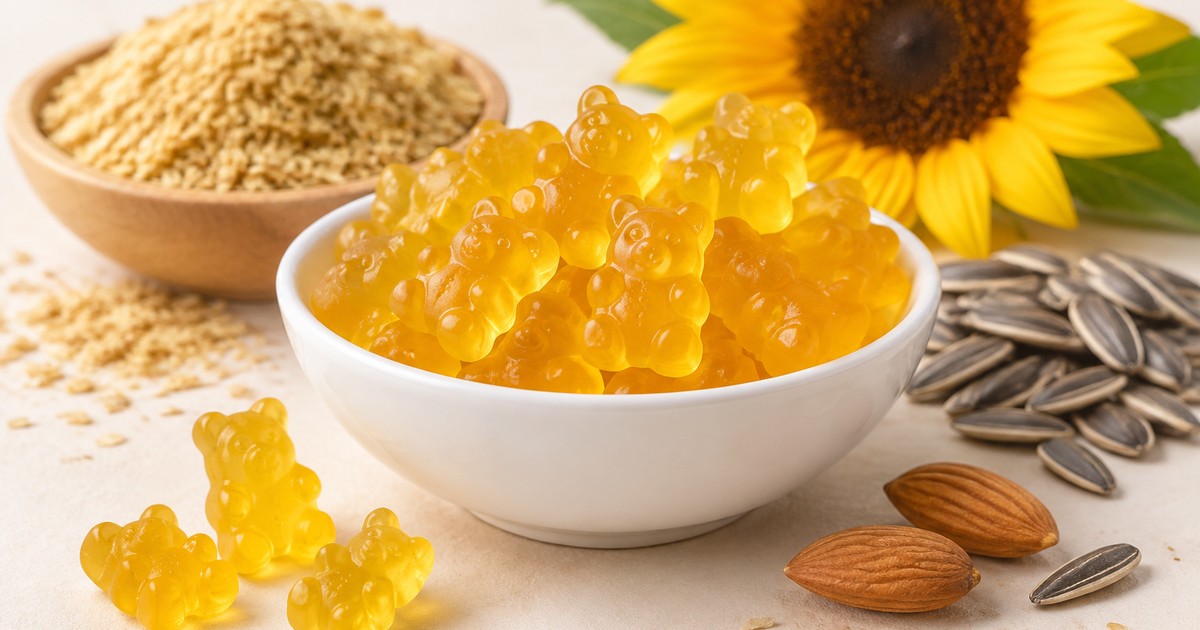
Oil, Emulsion and the Opaque Piece
Vitamin E is the clearest example of a vitamin that does not want to be in a gummy. The natural form, d-alpha-tocopherol, is a viscous oil that is insoluble in water. The acetate form, tocopheryl acetate, is also an oil, slightly more stable and slightly less bioavailable before hydrolysis. Neither dissolves in a gummy mass, and neither can be hidden in a clear piece.
The route that works is an oil-in-water emulsion. The tocopherol is dispersed into the oil phase of the base with a high-HLB emulsifier, homogenised, and then stabilised so it does not cream or coalesce during curing. A stable emulsion gives a uniform, opaque, slightly creamy piece. An unstable one gives oil droplets on the surface and a soft, greasy texture after a few weeks.
Vitamin E is also an antioxidant, which is useful and inconvenient at the same time. It scavenges free radicals in the base, protecting flavours and colours, and in doing so it is consumed. That consumption is why vitamin E overages are higher than for most vitamins: 20-30% is normal, and a formula built on a 10% overage can be out of specification before the end of shelf life.
The choice between tocopherol and tocopheryl acetate is a choice about heat and shelf life. Tocopherol is the more biologically active form and the more heat-sensitive one. Acetate is more resistant to oxidation and to the depositing temperature, which makes it the safer choice for a long shelf life in a clear pack. The label consequence is that the IU conversion differs between the two.
That conversion is where labels go wrong. One milligram of natural d-alpha-tocopherol is 1.49 IU. One milligram of synthetic dl-alpha-tocopheryl acetate is 1.0 IU. A 15 mg dose is 22.4 IU as natural tocopherol but 15 IU as the synthetic acetate. The EU label uses mg alpha-tocopherol equivalent and a reference intake of 12 mg; the US label uses IU. Both can be correct and still disagree with each other if the form is not stated.
Ascorbyl palmitate is the usual partner. It is a fat-soluble form of vitamin C that regenerates oxidised tocopherol and slows the loss of both. At 100-200 mg per serving it also gives the formula a second antioxidant claim, which is often what the brand actually wants to market.
The physical consequences are worth stating plainly. The piece is opaque, usually off-white to pale yellow, because the emulsion scatters light. It has a slightly creamy mouthfeel that most consumers read as premium in a soft chew and as odd in a jelly. And it is sensitive to oxygen during processing, so the mass is held under nitrogen where the equipment allows.
None of this is a reason to avoid the format. It is a reason to design the piece around the oil rather than trying to make a clear gummy and failing at the stability stage. Vitamin E gummies that look like a milky soft chew are honest about what they are. Ones that look like a clear fruit jelly and taste of nothing usually contain a token dose.
What Our Vitamin E Gummy Line Covers
Vitamin E Gummy Capability
| Form | Potency | Dose that fits | Behaviour in the mass | Label note |
|---|---|---|---|---|
| d-alpha-tocopherol | 1,000-1,300 IU/g | 15-30 mg | Oil, heat-sensitive, emulsifies well | 1 mg = 1.49 IU |
| Tocopheryl acetate (natural) | 700-1,000 IU/g | 15-30 mg | More heat-stable, slower release | Convert by form, not by habit |
| dl-alpha-tocopheryl acetate | 1,000 IU/g | 15-30 mg | Most stable, synthetic | 1 mg = 1.0 IU |
| Mixed tocopherols | 400-800 IU/g | 20-40 mg | Darker, stronger taste | Declare the tocopherol profile |
| Ascorbyl palmitate | n/a | 100-200 mg | Fat-soluble, regenerates tocopherol | Second antioxidant claim |
| Water activity | n/a | 0.55-0.60 aw | Higher aw destabilises the emulsion | Per batch |
| Piece weight | n/a | 3.5-4.5 g | Below 3 g the emulsion is hard to stabilise | Checked hourly |
| Batch size | n/a | 50,000-2,000,000 gummies | Pilot from 3,000 units | n/a |
From Brief to Finished Vitamin E Gummy
Quality Control for Vitamin E Gummies
Tocopherol is assayed by HPLC on the finished gummy and expressed in the same unit as the label, so an IU claim and an mg-ATE claim are both traceable to a measured number rather than to a calculation from the input oil.
Peroxide value is measured on the oil phase at receipt and on the finished gummy at each stability pull. A rising peroxide value is the earliest signal that the emulsion is failing, and it usually appears before the assay drops.
Emulsion stability is checked visually and by droplet size at deposit and after curing. Surface oil at two weeks is a reject, because it predicts a soft, sweating piece by month three.
The plant operates under GMP with ISO 9001, ISO 22000 and HACCP controls and is registered with the US FDA as a food facility. Heavy metals and microbiological testing run per batch.
Vitamin E Gummy FAQ
Why is a vitamin E gummy never clear?+
Tocopherol or tocopheryl acetate?+
How do I convert mg to IU?+
How much vitamin E fits in one gummy?+
Why is the overage higher than for other vitamins?+
Does vitamin E gummy need a special pack?+
Can it be combined with vitamin C?+
Can the gummy be sugar-free?+
What is the minimum order?+
How long does production take?+
Send Your Vitamin E Gummy Brief
Tell us the form, the dose and whether the label is in IU or mg ATE. We will confirm the emulsion route, the overage and the pack type that holds the assay.