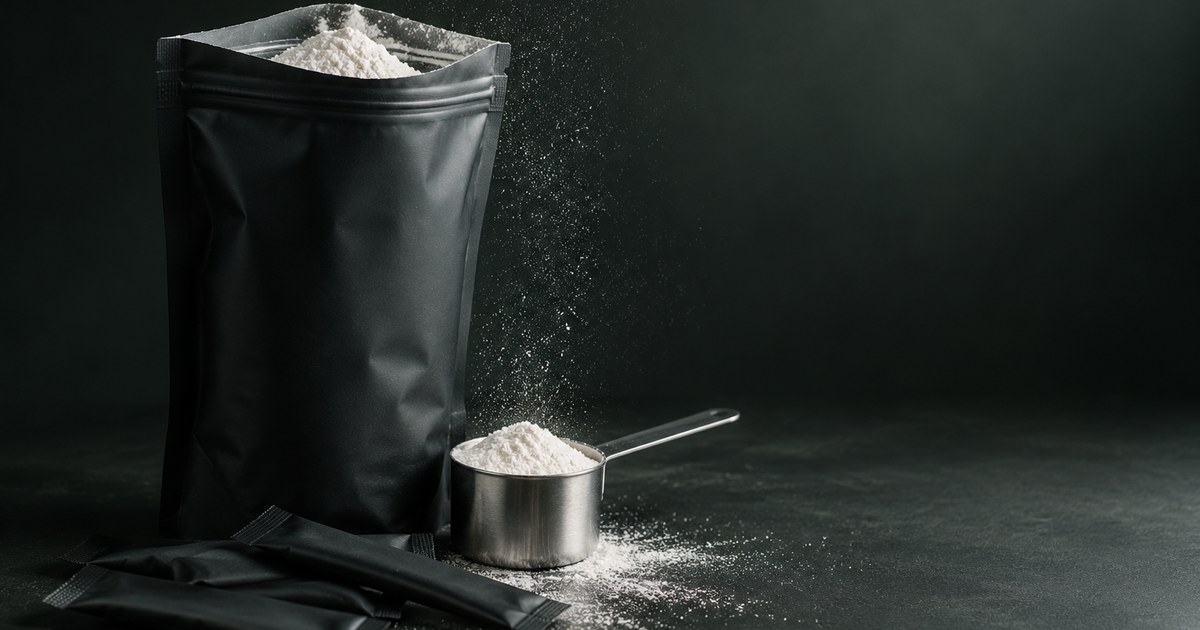
Creatine is the supplement category where the format debate is loudest. Powder is cheap and clinically boring; stick packs and single-serve sachets are the format that converts on TikTok, travels in a gym bag, and lets a brand charge four times the per-serving price of a tub. Both can be made on the same production floor, but they are not the same project.
This guide covers what changes when you move creatine from a tub into a stick pack or sachet: powder specifications, fill accuracy, film structure, testing, MOQ, cost per serving and the timeline from brief to pallet.
Three powder formats, three different economics
| Format | Typical fill | Servings per unit | Indicative MOQ | Unit cost (ex-works) | Best for |
|---|---|---|---|---|---|
| Round tub / jar | 300 g–1 kg | 30–200 | 3,000 units | $2.10–6.80 | Value, subscription, bulk buyers |
| Single-serve stick pack | 5 g–12 g | 1 | 30,000 sticks (or 3,000 cartons of 10) | $0.045–0.11 per stick | Sampling, travel, gym, retail cartons |
| Multi-serve sachet / pouch | 30 g–150 g | 6–30 | 5,000 pouches | $0.22–0.75 | Starter SKUs, bundles, subscription trials |
The stick pack looks cheap per unit and is expensive per gram of creatine: you are paying for film, forming, sealing and cartoning on every 5 g dose. A tub delivers the same creatine at roughly a third of the packaging cost per serving. Where the stick pack wins is basket size: a 30-stick carton at $29.90 is an easier first purchase than a $54 tub, and it converts trial customers who will later buy the tub.
Powder specification: what to write into the brief
- Particle size. 200 mesh (74 µm) or finer for stick packs. Coarser monohydrate bridges in the hopper and gives inconsistent fills; it also feels gritty in a 150 ml shaker.
- Bulk density. Specify a range, typically 0.55–0.75 g/ml for micronised monohydrate. Bulk density drives the fill auger setting and therefore the volumetric fill accuracy.
- Flowability and caking. Insist on a 90-day caking test at 40 °C/75% RH. If the powder cakes, the stick will not empty cleanly and you will get the one-star reviews.
- Anti-caking agent. Silicon dioxide at 0.5–1.0% is standard and label-friendly. Tricalcium phosphate is an alternative but adds a chalk note.
- Flavour system. Dry-blend flavours and acidulants (citric, malic) at 3–8%, plus a high-intensity sweetener. Test in the actual sachet volume of water, not in a beaker — 5 g in 150 ml tastes very different from 5 g in 400 ml.
- Instant / agglomerated grade. If you want the powder to dissolve without a shaker ball, specify an instantised grade. It costs 15–25% more and needs a different fill setting because it is less dense.
Stick pack engineering
A stick pack is a vertical form-fill-seal operation: film is formed into a tube, sealed longitudinally, filled, then sealed and cut. Three things determine quality:
| Parameter | Specification to demand | Why it matters |
|---|---|---|
| Fill weight accuracy | ±2% on 5 g (i.e. 4.9–5.1 g), verified by check-weigher on 100% of units | Legal metrology, and under-fill is a refund claim waiting to happen |
| Film structure | PET/ALU/PE or PET/metallised-PET/PE, 90–120 µm | Moisture and oxygen barrier; aluminium is 5–10× better than metallised for 12-month shelf life |
| Seal strength | ≥25 N/15 mm peel strength, no channel leaks | Creatine picks up moisture through any leak and hardens into a brick |
| Headspace | Minimised; optional nitrogen flush | Oxygen accelerates flavour degradation, not creatine itself |
| Cut and tear notch | Clean tear without scissors | This is the single most common consumer complaint on stick packs |
Ask for the film specification sheet and the seal-strength test report with your first production batch. Factories that run stick packs properly have both on file; factories that outsource the format will not.
Testing and release
- Identity and assay of incoming creatine monohydrate (HPLC, plus IR identity), with lot traceability.
- Blend uniformity on the finished powder: sample from the top, middle and bottom of the blender, and from three points along the filler run. Coefficient of variation should be under 5% for the active.
- Fill weight by check-weigher plus a manual 20-unit audit per shift.
- Seal integrity by dye penetration or burst test on a sample per 10,000 units.
- Microbiology (aerobic plate count, yeast and mould, E. coli, Salmonella) per lot.
- Stability at 0, 3, 6, 12 months for assay, moisture, colour and sensory, plus a 3-month accelerated arm.
Cost breakdown: what you are actually paying for
At 30,000 sticks of a 5 g creatine monohydrate stick pack, delivered in 10-count cartons:
| Cost element | Share of unit cost | Comment |
|---|---|---|
| Creatine monohydrate | 22–30% | The only line that scales with dose |
| Flavour, acid, sweetener | 6–10% | Cheap to upgrade; the biggest sensory lever |
| Film | 14–22% | Aluminium vs metallised is the swing factor |
| Forming, filling, sealing | 15–20% | Line speed, not labour |
| Carton and print | 10–16% | 10-count cartons cost more than the sticks inside them |
| Testing and QC | 4–6% | Do not let a supplier cut this |
Timeline
Four to five weeks for a repeat formula in existing film; six to eight weeks if the film needs printing, which it usually does. Add two weeks if you want an instantised grade, because the fill settings and the caking data both change.
FAQ
Can one stick hold 10 g of creatine?
Yes, but the stick gets long and the fill accuracy degrades. Most 10 g products use a wider sachet rather than a longer stick, and expect ±3% fill tolerance instead of ±2%.
Is a stick pack cheaper than a tub per serving?
No. Per gram of creatine a stick pack costs 2.5–3.5× more than a tub. It earns its place through trial conversion and travel convenience, not unit economics.
Do stick packs need a desiccant?
Not with an aluminium-containing film and a proper seal. With metallised film in a humid climate, a small desiccant in the carton is cheap insurance.
Can you fill creatine blends with other actives?
Yes — beta-alanine, citrulline, electrolytes, taurine and caffeine all fill on the same line. Check compatibility of the acidulants with the film and confirm the blend does not become hygroscopic.
What about compostable film?
Available, but barrier performance is 3–6 months at best for creatine. Treat it as a limited-shelf-life SKU, not a like-for-like replacement.
Can you produce both tubs and sticks from one order?
Yes, and it is the cheapest way to build a range: one blend, two packaging formats, one set of release tests. MOQ applies per format, so budget for 1,000 tubs plus 30,000 sticks.
If you are choosing between formats, the fastest route is a cost-per-serving model built on your target retail price rather than a per-unit quote. Our stick pack, powder and creatine teams can price both formats against the same blend, and the packaging page covers film and carton options in more detail.
Powder grade, particle size and why your scoop weighs wrong
Creatine monohydrate is sold in three grades that behave very differently on a filling line. The differences are invisible in a COA but visible in your fill weights and in the customer's shaker.
| Grade | Typical particle size | Bulk density | Flow | Cost index | Where it fits |
|---|---|---|---|---|---|
| Regular monohydrate | 80–200 mesh (75–180 µm) | 0.50–0.65 g/ml | Free-flowing, some dust | 1.00 | Tubs, high-volume blends |
| Micronised | 20–50 µm mean | 0.35–0.50 g/ml | Poorer — tends to fluidise and bridge | 1.10–1.30 | Stick packs, premix drinks, claims about mixing |
| Instantised (agglomerated) | 150–400 µm agglomerates | 0.55–0.70 g/ml | Excellent | 1.15–1.35 | Tubs sold on “dissolves without clumps” |
| Creatine HCl | Fine crystalline | 0.6–0.8 g/ml | Good but hygroscopic | 6–10 | Premium positioning only — the dose is 1–1.5 g |
Bulk density is the number that decides your scoop. A 5 g serving of micronised material occupies roughly 11–14 ml; the same 5 g of instantised occupies 7–9 ml. If you print “one scoop = 5 g” and then switch grade between batches without changing the scoop, you ship a product that is 20 % under or over label — and volumetric scooping is never more accurate than ±5 % in the consumer's kitchen anyway. The professional answer is a graduated scoop with a fill line plus a stated “one level scoop” instruction, and a net-weight declaration that matches the worst-case fill.
Caking, humidity and the 0.3 % rule
Creatine monohydrate is hygroscopic enough that a tub left open in a bathroom will turn into a brick within weeks. Three defences, all cheap:
- Silicon dioxide at 0.5–1.0 % (or tricalcium phosphate at 1–2 %) as a glidant and anti-caking agent. Below 0.3 % you are not really protected; above 2 % the powder feels chalky in the shaker.
- Water vapour transmission rate of the container. A standard HDPE tub with a foil induction seal runs 0.1–0.3 g/day/m². A cheap tub with a screw cap and no liner can be ten times worse.
- Fill and seal in a controlled room at <45 % RH. Filling in a monsoon-season warehouse at 80 % RH puts the moisture inside the pack on day one, and no desiccant will recover it.
For stick packs the numbers tighten further: the film's WVTR dominates, and a 3 g stick has a very high surface-area-to-mass ratio. Ask for the film specification and the supplier's moisture pick-up data over 12 weeks at 40 °C/75 % RH — if they cannot produce it, they have not run the study.
Blending: where homogeneity is won or lost
A 5 g dose in a 500 kg batch means your active is 1 % of the mass. At that ratio, a ribbon blender run for the wrong time will give you zones that assay at 0.6 % and zones at 1.4 %.
| Parameter | Practical target | Why |
|---|---|---|
| Blender type | V-blender or double-cone for <200 kg; ribbon or ploughshare for larger | Tumble blenders avoid the dead zones a ribbon leaves at the ends |
| Blend time | 10–15 min at 60–70 % fill | Over-blending causes segregation by density, not better mixing |
| Premix step | Active pre-blended with 3–5× its weight of a carrier | Dilution before the main blend is the single biggest homogeneity lever |
| Sampling | 10 locations, assay each, RSD <5 % | One grab sample proves nothing |
| Order of addition | Coarse and dense first, fine and light last | Reduces dusting and stratification during discharge |
Ask for the homogeneity validation report on a comparable formula, not a promise. A real report shows ten sample points, individual assays, and the calculated RSD.
Stick pack lines: film, seal and the four parameters that decide leaks
A stick pack is a vertical form-fill-seal sachet, usually 3–12 g, filled on a multi-lane machine running 8–12 lanes at 40–80 strokes per minute. Everything about quality is decided by four machine parameters and one material choice.
| Element | Typical specification | Failure if wrong |
|---|---|---|
| Film structure | PET 12 µm / ALU 7–9 µm / PE 60–80 µm | Metallised OPP instead of foil: WVTR up 5–20×, flavour scalping, short shelf life |
| Seal temperature | 150–175 °C on the PE side | Too low: channel leaks. Too high: film thinning and pinholes |
| Seal pressure | 0.3–0.5 MPa | Low pressure leaves product in the seal area — the classic “powder in seam” leak |
| Dwell time | 0.3–0.6 s | Too short: incomplete polymer fusion |
| Fill accuracy | ±2 % at 3–5 g, ±1.5 % at 10 g | Auger drift shows up as underweight sticks in the last 20 % of a run |
| Leak test | Dye penetration or vacuum decay on 30 sticks/shift | Skipping it means you find leaks in the market, not the factory |
Two production realities worth knowing before you specify a stick. First, powder in the seal is the number one defect: good lines use a mechanical squeeze or a burst of air before sealing, and they run the auger at a fill profile that stops 50 ms before the seal closes. Second, the machine's tolerance for fine, dusty powder is limited — micronised creatine at 20 µm will coat the seal area far more than a 150 µm regular grade, which is why stick-pack specifications often choose a coarser or instantised grade even though the marketing story prefers micronised.
Flavour systems for a 5 g powder serve
Powder flavour is not the same discipline as gummy flavour. The active has a bitter, slightly sour note, and there is no gel matrix to hide behind.
- Acid level 0.8–1.5 % (citric, malic or a blend) is what makes a 300 ml serve taste like a drink rather than water with powder in it.
- Sweetener system: 0.02–0.04 % sucralose, or a stevia/erythritol blend at 1–3 % for a “natural” claim. Erythritol adds mouthfeel but also bulk, which changes your scoop volume.
- Masking: a bitter-blocker (usually a sodium salt or a specific flavour chemical) at 0.1–0.3 % does more work than adding more sweetener.
- Colour: many stick-pack creatines are uncoloured, which is honest but looks pale; beetroot or beta-carotene at low levels reads better in photos.
Budget 2–4 flavour iterations, each about 2 kg of sample and 5–10 days of turnaround. Skipping iterations is how brands end up with a product that reviews as “tastes like chemicals” — the single most damaging review pattern for a consumable.
What the two formats cost, line by line
| Cost element | 1 kg tub (200 servings) | 30 × 5 g sticks |
|---|---|---|
| Creatine (5 g serve) | $0.045/serve | $0.045/serve |
| Flavour, acid, sweetener, glidant | $0.006/serve | $0.008/serve |
| Primary pack | $0.90–1.60/tub | $0.035–0.06/stick |
| Secondary pack | $0.25 carton | $0.45–0.70 carton of 30 |
| Filling and labour | $0.30–0.50/tub | $0.010–0.020/stick |
| Ex-works per serve | $0.055–0.065 | $0.075–0.095 |
| Retail price per serve | $0.28–0.45 | $0.55–1.20 |
The stick pack costs roughly 40 % more per serve to make and sells for two to three times as much per serve. That is the entire commercial logic of the format: you are not selling creatine, you are selling a portion-controlled, no-scoop, portable ritual.
Release testing: the panel to insist on
| Test | Method | Specification | Frequency |
|---|---|---|---|
| Assay (creatine) | HPLC | 95–105 % of label, incl. overage | Every batch |
| Creatinine | HPLC | <1 % of creatine content | Every batch |
| Moisture | Karl Fischer or loss on drying | <1.0 % (powder), aw <0.4 | Every batch |
| Uniformity of mass | 10 units, individual weights | ±2 % for sticks | Every batch |
| Microbiology | USP <2021> | TAMC <103 cfu/g, absence of pathogens | Every batch |
| Heavy metals | ICP-MS | Per USP <232> / regional limits | Quarterly or per raw lot |
| Seal integrity | Dye penetration / vacuum decay | Zero failures in 30 | Per shift |
| Stability | 25 °C/60 % and 40 °C/75 % RH | Assay within spec at 0/3/6/12/24 months | Per formula |
Failure modes and fixes
| Symptom | Likely cause | Fix |
|---|---|---|
| Powder bricks in the tub | Moisture ingress, no glidant, HDPE without liner | Foil induction seal, 0.5–1 % SiO2, fill room <45 % RH |
| “Doesn't dissolve” reviews | Regular grade, no instantising, wrong scoop instruction | Switch to instantised, add “shake 20 s, drink within 10 min” |
| Flavour fades by month 6 | Metallised film, volatile top notes | ALU-containing film, flavour fixed on a carrier |
| Underweight sticks at end of run | Auger wear, hopper bridging | Auger calibration each shift, vibratory hopper assist |
| Leaking sticks in transit | Powder in seal, low pressure | Air knife before sealing, raise pressure to 0.4 MPa, leak test per shift |
| Assay drops in storage | Moisture + heat, no overage | 3–5 % overage, foil film, controlled warehouse |
Sources and further reading
Peer-reviewed research
- Kreider RB et al. ISSN position stand: safety and efficacy of creatine supplementation. J Int Soc Sports Nutr. 2017;14:18. PMID 28615996
- Effect of water activity and temperature on the stability of creatine during storage. PMID 19635041
- Multi-analytical characterization of creatine degradation for dietary supplement safety assessment. PMID 41214971
- Plasma creatine kinetics after ingestion of microencapsulated creatine monohydrate. PMID 28121472
Regulatory and standards
- US FDA, Dietary Supplements and 21 CFR Part 111 (cGMP).
- Directive 2002/46/EC, EUR-Lex; Regulation (EC) 1924/2006 and the EU health claims register.
- ISO 22000 and GFSI schemes; US FDA HACCP principles.
- United States Pharmacopeia, monographs <2021>, <232> and uniformity methods used in the release panel above.
Prices are 2026 ex-works ranges from supplier quotes and move with creatine raw-material cycles; re-quote for your specification, volume and destination.