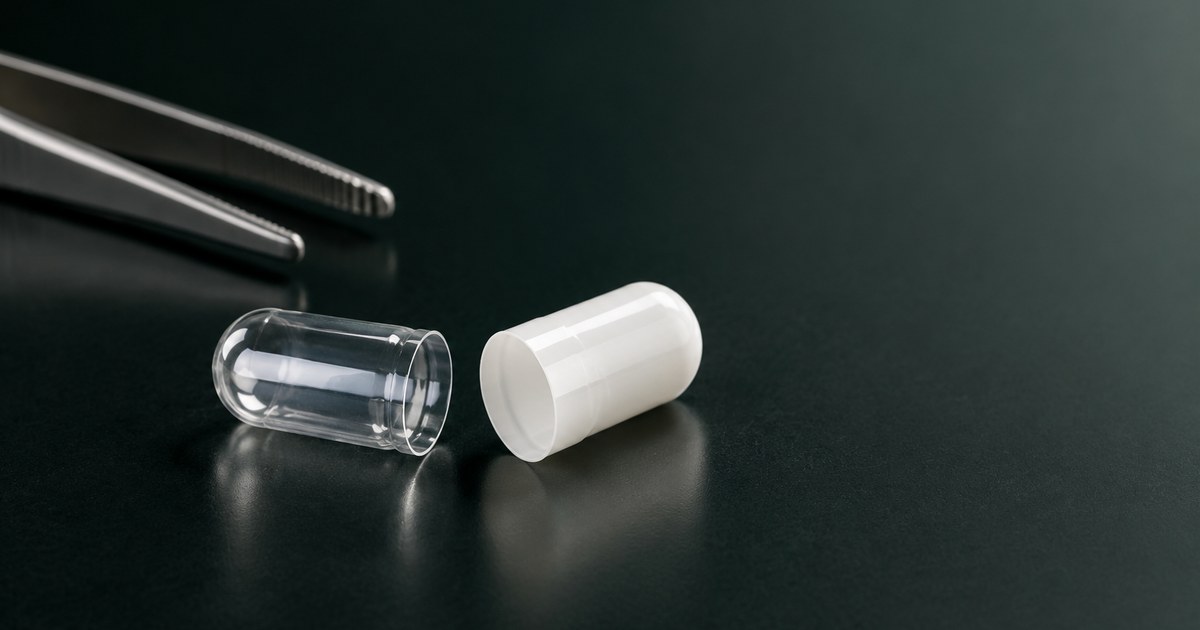
Empty capsule shells are one of the few supply decisions that changes your label, your certification stack, your shelf life and your unit cost at the same time. The choice between HPMC (hydroxypropyl methylcellulose, plant-based) and gelatin is not a marketing preference — it decides whether you can claim vegan, whether you can sell into the Middle East, how the capsule behaves in humid climates, and how much the shell costs.
This guide covers the technical and commercial differences, the moisture and cross-linking behaviour that causes most capsule failures, and how to specify shells so your fill line does not reject 4% of every batch.
The comparison, in one table
| Property | HPMC (plant cellulose) | Gelatin (bovine / porcine) |
|---|---|---|
| Source | Synthetic cellulose from wood pulp or cotton linter | Animal collagen, mostly bovine bone/skin or porcine skin |
| Vegan / halal / | Yes, inherently | No; requires certified halal gelatin, which is scarcer and dearer |
| Moisture content of shell | 4–6% | 13–16% |
| Behaviour in low humidity | Stable, but can become brittle below 30% RH | Brittle and prone to cracking below 35% RH |
| Behaviour in high humidity | Absorbs water, softens above 65% RH | Absorbs water, can stick and deform above 60% RH |
| Cross-linking risk | None (no aldehydes to react with) | Real, with reducing sugars and aldehydes; causes slowed dissolution |
| Dissolution | Slightly slower at body temperature; typically 8–12 min | Faster, typically 3–6 min |
| Relative shell cost | 1.4–2.2× gelatin | Baseline |
| Typical use | Vegan, halal, hygroscopic actives, probiotic blends | High-volume, cost-driven, fast-dissolving |
Why moisture is the real issue
A gelatin shell carries 13–16% water; an HPMC shell carries 4–6%. That difference matters three ways.
- Hygroscopic actives. A probiotic blend, a deliquescent salt, or a highly hygroscopic herbal extract will pull moisture out of a gelatin shell and go soft or clump. HPMC's lower water content makes it the safer shell for those fills.
- Humid markets. In a warehouse at 70% RH, gelatin capsules stick together in the bottle. HPMC holds shape better but softens; neither is a substitute for a proper induction seal and a desiccant where the climate demands it.
- Cross-linking. Gelatin reacts with aldehydes (from some actives, or from lipid oxidation) to form a film that slows or blocks dissolution. If your product contains a reducing sugar, an aldehyde-bearing flavour, or an oil that can oxidise, expect a dissolution failure at 6 or 12 months unless the formula is designed around it. HPMC has no such reaction.
Where gelatin still wins
- Cost. At 25,000+ units the shell difference is $0.08–0.14 per bottle — on a $1.47 product that is 6–10% of ex-works cost.
- Dissolution speed. For a fast-acting claim, gelatin's quicker opening is measurable.
- Fill-line behaviour. Gelatin shells are more forgiving on older encapsulators: better elastic recovery, fewer splits at the joint during closing.
- Softgels. If your product is a softgel, the shell is gelatin by definition — plant-based softgels exist but are a different process and cost 2–3× more.
Where HPMC is worth the premium
- Any vegan claim, which is now table stakes for DTC brands and Amazon's grocery categories.
- Halal markets where certified gelatin supply is a bottleneck.
- Probiotics, enzymes and other moisture-sensitive actives.
- Products with reducing sugars or oxidisable oils where cross-linking would show up in a stability study.
- Long shelf life in hot climates — 24–36 months in Southeast Asia or the Gulf.
Specifying shells so the line does not reject them
| Specification | What to ask for |
|---|---|
| Size and fill volume | Size 0 (0.68 ml), 1 (0.50 ml), 2 (0.37 ml), 3 (0.30 ml); confirm the powder density so the fill weight matches the volume |
| Tolerance | Wall thickness and cap length within ±0.05 mm; ask for the incoming inspection report |
| Colour and opacity | Opaque shells hide fill variation and protect light-sensitive actives; titanium dioxide is the standard opacifier — confirm it is permitted in your market |
| Printing | Axial or radial print, food-grade ink, and a sample of the printed band before the run |
| Certification | Halal/ certificates for gelatin, non-GMO and vegan statements for HPMC, plus the shell maker's GMP certificate |
| Storage of empty shells | 15–25 °C, 35–55% RH. Shells stored badly fail on the line, not in the lab |
Cost impact, worked through
A 60-count bottle of 500 mg capsules:
| Item | Gelatin | HPMC |
|---|---|---|
| Shell cost per bottle (60 shells) | $0.09 | $0.18 |
| Encapsulation cost | $0.24 | $0.26 |
| Extra stability work (cross-linking arm) | Sometimes required | Not required |
| Total delta on a $1.98 product | — | +$0.11 (+5.6%) |
Five to six percent is the honest number. If a supplier quotes you a 25% premium for HPMC, you are being charged for a claim, not a shell.
FAQ
Are HPMC capsules vegan certified?
The shell material is plant-derived and inherently vegan, but ask for the certificate — the lubricants and printing inks used on the line must also be vegan, and that is a separate declaration.
Do HPMC capsules dissolve as fast as gelatin?
Usually 2–6 minutes slower in USP dissolution. For most supplements this is irrelevant; for a fast-onset claim it is not.
Can I switch shells on an existing product?
Yes, but it is a formulation change: re-run dissolution and stability, and update the label. Budget 6–8 weeks and one stability start.
Which shell for probiotics?
HPMC, and preferably a DR-caps or acid-resistant grade if you are claiming survival through the stomach. Standard HPMC gives no enteric protection.
Is titanium dioxide still allowed?
It is banned as a food additive in the EU but permitted in capsules in most markets, including the US. If you sell into the EU, specify a TiO2-free opaque shell using calcium carbonate or rice starch.
What causes a capsule to crack in the bottle?
Almost always low humidity during storage or transport, combined with a shell that was dried too far. Specify incoming moisture and store shells within 35–55% RH.
If you are choosing a shell for a new SKU, the decision usually comes down to whether the vegan/halal claim is part of the business model and whether the active is moisture-sensitive. Our capsule manufacturing team runs both shell types on the same line, and the vegan and halal pages cover the certification side.
What "cross-linking" actually is, and why it ruins dissolution
Gelatin is a protein. Its capsule shell is held together by hydrogen bonds and a small amount of residual moisture (13–16 %). When the shell is exposed to heat, humidity, or aldehydes — from the fill, from a packaging component, or from the environment — new covalent bonds form between lysine residues. The shell stops being soluble in gastric fluid. The capsule arrives intact at the colon, and the active is largely not absorbed.
The clinical signature is unmistakable: a product that passed release testing, then failed dissolution at 3 or 6 months, with an assay that is perfectly fine. Assay measures how much active is in the capsule. Dissolution measures whether the patient gets it.
| Factor | Effect on gelatin | Effect on HPMC |
|---|---|---|
| Residual moisture in shell | 13–16 % — a reactant | 3–6 % — essentially inert |
| Aldehydes (from excipients or packaging) | Direct cross-linker | No reactive amine backbone |
| Heat >30 °C in storage | Accelerates cross-linking | Stable; risk shifts to brittleness |
| Reducing sugars (Maillard browning) | Reacts with lysine | Not applicable |
| Low humidity <30 % RH | Shell becomes brittle | Also brittle, but less so |
| Pellicle formation | Common in stressed gelatin | Rare |
The dissolution test that catches it
A single time point is not enough. Specify two-stage testing, because a cross-linked gelatin capsule often looks acceptable at 45 minutes and fails at 90.
| Parameter | Gelatin capsule | HPMC capsule | Why it matters |
|---|---|---|---|
| Medium, stage 1 | 0.1 N HCl, 900 ml, 37 °C | Same | Simulates fasting gastric conditions |
| Apparatus | USP Apparatus 1 (basket) or 2 (paddle) | Same | Basket is harsher on shells; use the method in your dossier |
| Time points | 15, 30, 45, 60, 90 min | Same | Cross-linking shows as a plateau |
| Typical acceptance | Q = 75 % at 45 min | Q = 80 % at 45 min | Match the spec to the reference product |
| Enzyme stage (if failed) | Add pepsin, continue 60 min | Usually unnecessary | Distinguishes cross-linking from a formulation problem |
| Frequency | Release, 3, 6, 12, 24 months | Same | Failure is time-dependent, not batch-dependent |
If a supplier cannot show you dissolution data at 6 and 12 months on a comparable product, you are buying a risk you cannot see. This is the single most valuable question to ask a capsule supplier.
Shell specification: the details that change the price
| Specification | Standard | Cost effect | When to pay for it |
|---|---|---|---|
| Colour, opaque | TiO2 or iron oxide | +0–3 % | Light-sensitive actives, brand differentiation |
| Colour, transparent | No opacifier | Baseline | When the fill looks good |
| Printing (logo/text) | Printing on shell | +8–20 %, plus $300–900 plates | Premium SKUs, tamper evidence |
| Band sealing | Gelatin band at the joint | +5–12 % | Liquids, hygroscopic fills, high-value products |
| Enteric coating | HPMC-phthalate or acrylic | +20–40 % | Actives destroyed by stomach acid |
| Size reduction | Size 2 or 3 instead of 0 | −5–10 % | Low-dose actives; improves swallowability |
| Low-moisture HPMC | <4 % shell moisture | +3–8 % | Moisture-sensitive fill, probiotics |
Powder fill versus pellet fill
HPMC capsules are often chosen together with a change of fill, and the two decisions interact.
- Powder fill is the default: fastest, cheapest, works with both shells. It exposes the shell to the fill's moisture and to any reactive excipient.
- Pellet or bead fill costs 15–35 % more but protects both directions: the shell sees a low-surface-area, low-moisture fill, and the active is protected from gastric acid if the beads are enteric-coated.
- Liquid fill requires band sealing on gelatin and is generally avoided with HPMC unless the fill is anhydrous.
What the price difference really is, per bottle
| Scenario | Gelatin size 0 | HPMC size 0 | Delta |
|---|---|---|---|
| Shell cost per 1,000 (empty) | $6–9 | $11–16 | +$5–7 |
| Shell cost per 60-count bottle | $0.42–0.54 | $0.66–0.96 | +$0.24–0.42 |
| Filling cost (same machine) | Baseline | +3–8 % (slower runs, humidity control) | +$0.03–0.06 |
| Extra stability testing | — | Same protocol | $0 |
| Total delta per bottle | +$0.27–0.48 | ||
| Retail uplift available for vegan claim | — | $2–6 per bottle in most markets | +400–1,000 % on the delta |
That last line is the whole argument. The cost delta is around 30–40 US cents. The vegan claim supports a retail premium several times larger, and it removes an objection that kills conversion on Amazon listings where “vegan” is a filter.
When gelatin still wins
- Oil-based fills and softgels — gelatin dominates the softgel category for good technical reasons, and HPMC softgels are a small, more expensive niche.
- Cheapest possible cost at high volume — a 25,000-bottle run with no vegan positioning is still cheaper in gelatin.
- Markets where “gelatin” is expected — some Asian traditonal-medicine formats and some contract specs still assume it.
- Short shelf life, fast turnover — cross-linking is a time-and-stress phenomenon; a product sold within 9 months rarely shows it.
A supplier question set that separates the two
- Which shell supplier do you buy from, and what is the shell's specified moisture range?
- Show me 12-month dissolution data, not just release, on a comparable fill.
- Do you band-seal, and is it standard or optional?
- What is your filling-room humidity specification, and is it logged?
- Have you had a dissolution failure in the last 24 months? What was the root cause?
- If we move to HPMC, does the fill need to change (glidant, lubricant, moisture)?
- Which excipients in your standard formula contain aldehydes or reducing sugars?
Questions 1, 2 and 5 are the ones that produce different answers from a real capsule factory versus a broker.
Sources and further reading
Peer-reviewed research
- Enhancing the dissolution stability of hard gelatin capsules using activated carbon as a packaging component. PMID 30145210 — formaldehyde-induced cross-linking and how packaging scavengers mitigate it.
- Challenges of dissolution method development for soft gelatin capsules. PMID 33557167 — method design for shell-based dosage forms.
- Disintegration and dissolution testing of dietary supplements. PMID 32081719 — why supplement dissolution is not automatically pharmaceutical dissolution.
Regulatory and standards
- US FDA, 21 CFR Part 111 — cGMP including the requirement for specifications and testing of components.
- United States Pharmacopeia, general chapters <711> dissolution, <701> disintegration, <2021> microbiology.
- Directive 2002/46/EC, EUR-Lex — EU food supplement framework; national rules govern which excipients are permitted in capsules.
Standards and industry references
Cost figures are 2026 ex-works ranges and depend on shell supplier, fill weight and volume; dissolution acceptance criteria must be set against your own reference product and market requirements.