

Astaxanthin Gummies: A Red Oil That Wants to Leak
Astaxanthin is a carotenoid, not a vitamin. It arrives as a dark red oleoresin, it oxidises on contact with air and light, and it migrates through a gel matrix. A gummy that carries it has to be built as an emulsion with an opaque pack.
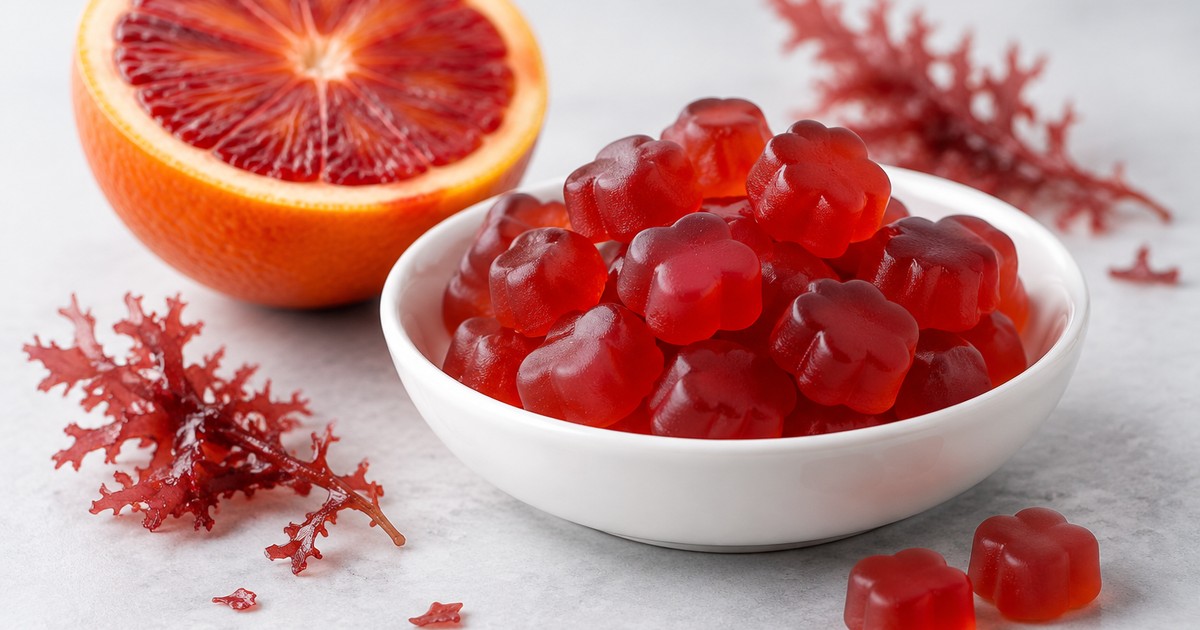
Carotenoid Chemistry in a Sugar Matrix
Astaxanthin is one of the most oxidation-prone carotenoids used in supplements. It has eleven conjugated double bonds, which is what gives it the deep red colour and also what makes it react readily with oxygen, light and heat. In a capsule the powder sits in an anhydrous environment with almost no oxygen mobility. In a gummy it is surrounded by water, headspace air and a translucent matrix that lets light through.
The commercial form is usually a Haematococcus pluvialis oleoresin, standardised to 2-10 percent astaxanthin and often esterified, or a fermentation-derived beadlet. Both are oils or oil-dispersible powders, not water-soluble actives. That means every astaxanthin gummy is an oil-in-water emulsion, and the quality of that emulsion decides the shelf life.
Dose is small: 4-12 mg per serving covers the range used in human work, with 12 mg at the top end. Twelve milligrams of a 5 percent oleoresin is 240 mg of oil, which is a real but manageable oil load in a 4 g piece. The difficulty is not the mass. It is keeping the carotenoid dissolved, dispersed and unoxidised from the cook through to month twelve.
Colour migration is the second constraint. Carotenoids are lipophilic and will partition into any fat phase in the system, including flavour oils and the surface film of the piece. A gummy that looks evenly red on day one can show a darker rim at month three as the pigment migrates to the surface, and a paler core. This is why astaxanthin gummies are usually opaque: opacity hides the migration and also blocks the light that drives oxidation.
Then there is the label question. Astaxanthin has no authorised health claim in the European Union and is subject to a novel food assessment for some sources. In the United States it is a dietary ingredient with structure and function claims available. The 4-12 mg dose is the range most buyers expect, and it is the range we will formulate to rather than stretching to 20 mg for a marketing number.
The result is a product that costs more in process than in ingredients: an emulsion stage, a nitrogen blanket, an opaque piece and an HPLC assay that separates astaxanthin from its esters and from the oxidised forms.
There is also a practical limit on how much of the oil a 4 g piece will hold before the surface turns glossy. Above roughly 250 mg of oleoresin the piece reads as oily in the hand even when the emulsion is intact, which is one more reason the 12 mg dose is the sensible top end for this format.
Astaxanthin Gummy Capability
Astaxanthin Gummy Parameters
| Parameter | Target | Why it matters | Method |
|---|---|---|---|
| Astaxanthin dose | 4-12 mg per serving | Human evidence range | HPLC at 474 nm |
| Oleoresin load | 80-240 mg of 5% oleoresin | Oil phase sizing | Formulation record |
| Emulsion droplet size | 1-3 µm | Stability against creaming | Laser diffraction |
| Antioxidant | 200-500 ppm ascorbyl palmitate | Interfacial protection | Formulation record |
| Water activity | 0.55-0.60 | Colour and texture stability | Aw meter |
| Piece opacity | Opaque, L* > 85 | Light blocking | Colorimeter |
| Headspace oxygen | <2 % at pack | Oxidation rate | Headspace analyser |
| Colour drift | ΔE < 3 at 8 weeks | Consumer perception | Colorimeter at 40/75 |
| Assay retention | >90 % at 12 months | Label claim | HPLC stability pull |
Astaxanthin Gummy Development Sequence
Quality Control for Astaxanthin Gummies
Astaxanthin is assayed by HPLC at 474 nm on the finished gummy, with the extraction designed to release the carotenoid from the emulsified oil completely. An incomplete extraction reads low and looks like a process loss when it is actually an analytical artefact.
Colour is measured as L*, a* and b* at release and at every stability pull. A drop in a* with a rise in L* is the signature of carotenoid bleaching, and it appears before the assay moves enough to fail a specification.
Droplet size distribution is checked on the emulsion before deposit. A mean above 5 microns or a wide distribution predicts creaming within weeks, and at that point the batch is better reworked than packed.
Headspace oxygen is measured on the first filled unit and again at the end of the run. A rise across the run usually means a purge fault rather than a formula problem, and it is the least expensive early warning available in this category.
Microbiological testing follows the standard panel, but the pack format matters more here than in most categories: an opaque jar with a desiccant keeps both moisture and light away from a carotenoid that is sensitive to each, and the same gummy in a clear pouch will fail the twelve month colour specification even when the assay holds.
Astaxanthin Gummy FAQ
How much astaxanthin fits in a gummy?+
Why are astaxanthin gummies always opaque?+
Does the astaxanthin survive the cook?+
What is the difference between esterified and free astaxanthin?+
Is astaxanthin legal as a food ingredient in the EU?+
Can you make a clear astaxanthin gummy?+
What does the assay look like at twelve months?+
Can astaxanthin be combined with other carotenoids?+
What is the minimum order and lead time?+
Send Your Astaxanthin Brief
Tell us the dose, the source and the pack format you have in mind. We will come back with an emulsion design, an opacity and headspace plan, and a realistic shelf life for the packaging you intend to use.