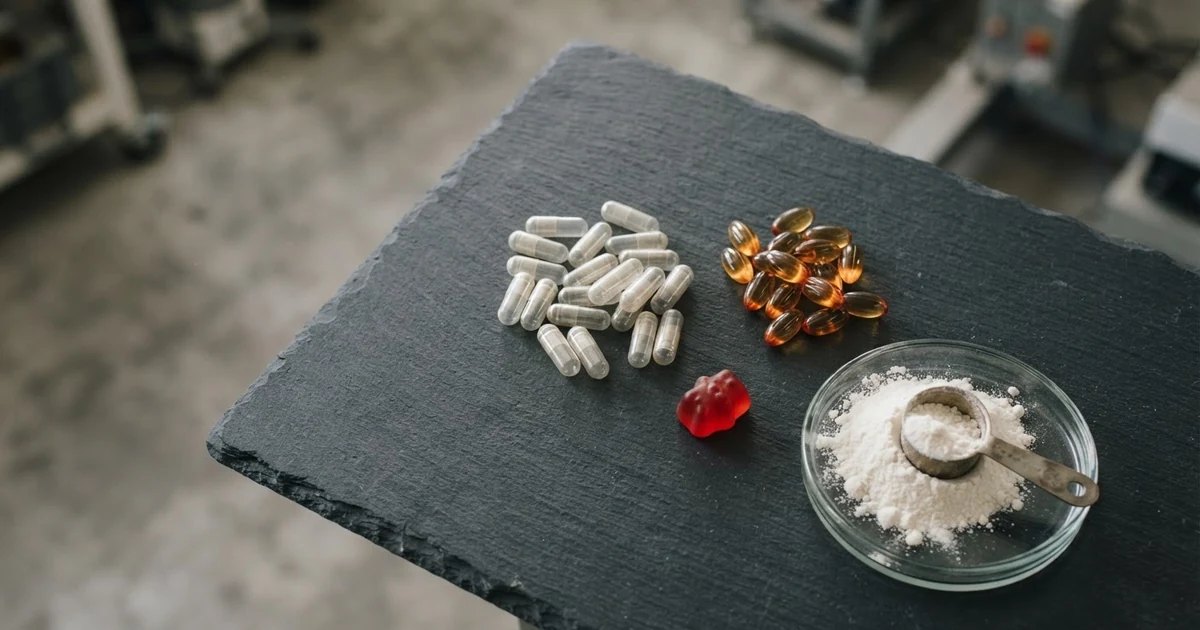
Dosage form selection is usually framed as a marketing decision, but it is first a cost-allocation decision. Each format carries different fixed setup, minimum order quantities (MOQs), yield losses, stability risk and testing burden, and those differences often outweigh the active ingredient cost. Buyers who model unit economics before choosing a format avoid late-stage repricing and rework.
Why unit economics differ by format
Unit cost is not simply material cost divided by count. It includes setup and changeover, minimum batch sizes, process yield, in-process and finished testing, packaging, and the cost of holding inventory while stability and release testing complete. Formats differ most in fixed cost per SKU and in the minimum scale at which those fixed costs amortize.
As a rule of thumb, for small runs the fixed cost per unit dominates; for large runs, material and yield dominate. Capsules and softgels are typically the most capital-efficient at moderate volumes; gummies carry higher setup and drying-related losses; powders have low per-unit fill cost but higher packaging and scoop-accuracy considerations. Treat all figures below as typical industry ranges, not quotes.
Capsules: two-piece hard shell economics
Two-piece capsules (gelatin or HPMC) are filled on automatic or semi-automatic machines. Typical commercial MOQs range from 50,000 to 250,000 capsules per SKU, with smaller pilot runs possible at higher per-unit cost. Typical lead times are 4-6 weeks after approval of specifications and receipt of materials, excluding stability testing.
Key cost drivers include shell type and size, fill weight and powder flow, and whether the formula requires granulation. Yield losses of 1–3% are typical; poor flow or hygroscopic ingredients can push losses higher and slow line speed. Release testing usually covers identity, assay, uniformity of dosage units (USP <905>), microbial limits, and where relevant heavy metals by USP <232>/<233>. Buyers should confirm whether the supplier performs these in-house or outsources, since outsourced testing adds calendar time.
Failure modes to watch: fill-weight drift on low-density powders, shell brittleness in low-humidity environments, and cross-contamination risk if allergen changeover controls are weak. For capsule-specific process detail, see capsule manufacturing.
Softgels: higher setup, strong unit cost at scale
Softgels require encapsulation, drying and often polishing. Setup and changeover are more expensive than capsules because die changes and drying tunnel time are format-specific. Typical MOQs range from 100,000 to 500,000 softgels per SKU, and lead times of 4-6 weeks are common, with drying alone taking several days.
At scale, softgels can be cost-competitive per milligram of oil or suspension, especially for lipid-soluble actives. The economics turn on fill weight, shell formulation, and drying yield. Yield losses of 2–5% are typical during startup and drying; higher losses occur with large or thin-walled shapes.
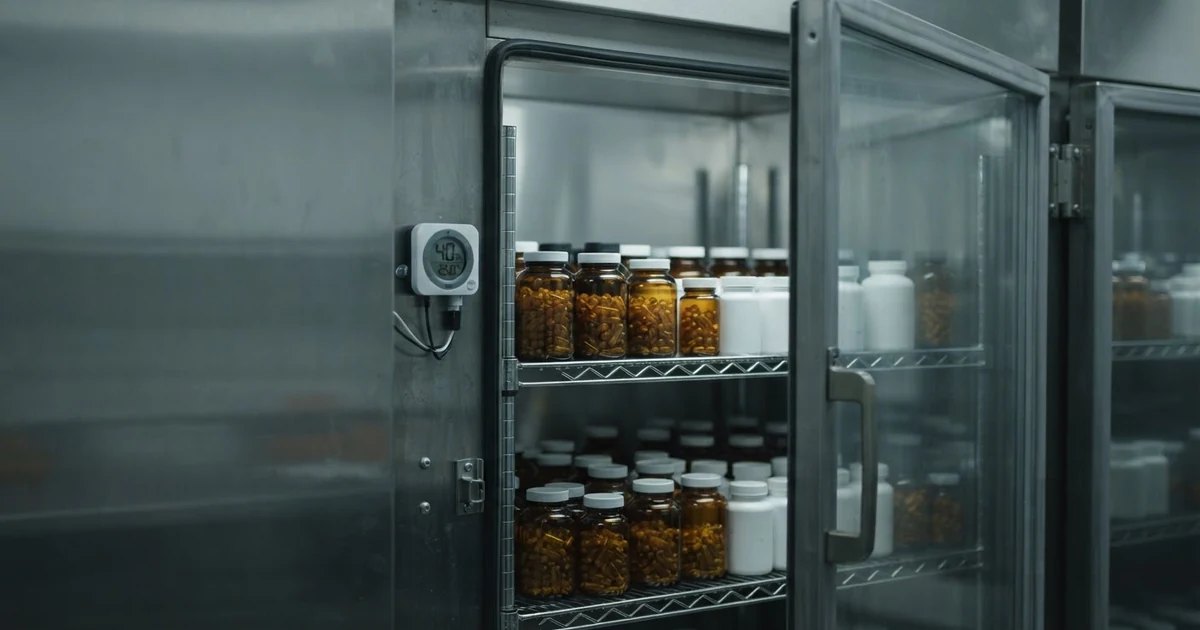
Stability is a major cost variable. Softgels are sensitive to heat and humidity, and oxidative actives may require nitrogen flushing and appropriate packaging. Buyers should request stability data under ICH Q1A(R2) conditions (25°C/60% RH long term, 40°C/75% RH accelerated) for the specific shell and fill combination, not just the active. Failure modes include shell cross-linking, fill leakage and oxidation; these often appear only after months on stability, so early stability commitment matters.
Gummies: setup-heavy, sensitive to yield and moisture
Gummies involve cooking, depositing, curing and drying. Setup costs are high because starch molds or depositor tooling are product-specific, and changeovers are slow. Typical MOQs range from 100,000 to 500,000 pieces per SKU, with lead times of 6–12 weeks including curing and testing.
Unit cost is driven by pectin or gelatin type, sugar-free or reduced-sugar systems, active ingredient stability during cooking, and drying yield. Yield losses of 3–8% are common; heat-sensitive actives may require post-cure addition or overage, which raises cost. Moisture control is critical: water activity outside target ranges can cause mold, stickiness or hardness drift.
Testing typically includes assay, uniformity, microbial limits, water activity, and where relevant heavy metals. Buyers should confirm the supplier's process for verifying active dispersion in the batch, since gummy matrices complicate homogeneity testing. Failure modes include active degradation during cooking, sugar bloom, and texture changes over shelf life.
Powders: low fill cost, higher packaging and dosing considerations
Powders have the lowest per-unit fill cost for large doses, but packaging and dosing accuracy change the economics. Typical MOQs range from 1,000 to 10,000 units for tubs or stick packs, with lead times of 3–6 weeks. Stick packs and sachets add fill-and-seal cost but improve portability.
Cost drivers include bulk density, flowability, flavor masking, and whether the powder is agglomerated or instantized. Homogeneity is the main quality risk; segregation of minor ingredients can occur during blending and filling. Testing typically includes assay, uniformity, microbial limits, and moisture. Failure modes include segregation, caking, and flavor degradation. Buyers should require blend uniformity data and a sampling plan that reflects the package size.
Documents and compliance that affect landed cost
Compliance is not a separate line item, but it changes timelines and total cost. In the US, dietary supplement manufacturing must follow 21 CFR 111 current good manufacturing practice. Labeling must meet 21 CFR 101.36 (Supplement Facts) and 21 CFR 101.4 (ingredient statements). Heavy metals testing commonly references USP <232>/<233>, and dissolution or disintegration may reference USP <711> where applicable.
For imported ingredients or finished goods, FDA Prior Notice (21 CFR 1005) and the Foreign Supplier Verification Program under FSMA (21 CFR 117) add documentation and lead time. In the EU, labeling must meet EU 1169/2011, and where applicable, GMP expectations align with EU GMP Annex 1 for sterile products (not typical for supplements but relevant for some formats). California Prop 65 warnings may be required based on heavy metal or other listed substance exposure, which can affect packaging and labeling cost.
Ask for certificates of analysis, stability protocols, and a written quality agreement. Confirm which tests are performed in-house versus outsourced, and who owns the release decision. For a broader view of certification scope, see certifications.
Checklist: what to verify before committing to a format
- MOQ and scale-up: Confirm pilot, commercial and annual volumes, and how unit price tiers change.
- Lead time: Get a written timeline from PO to release, including material lead time, production, testing and quarantine.
- Yield and overage: Ask for typical yield by format and whether overage is required for stability or processing.
- Stability commitment: Request ICH Q1A(R2) protocol and available data for the exact formula and package.
- Testing scope: Confirm identity, assay, uniformity, microbial, heavy metals and any format-specific tests.
- Change control: Verify notification timelines for supplier, process or specification changes.
- Compliance documents: Collect 21 CFR 111 quality agreement, COAs, and import documentation where relevant.
- Packaging: Model bottle, blister, stick pack or pouch costs separately from fill cost.
Questions to ask your supplier
- What is your typical yield for this format, and how do you handle losses above that?
- Which tests do you run in-house, and which are outsourced?
- What is your changeover process for allergens and potent actives?
- Can you share stability data for this exact shell or matrix and package?
- What is your MOQ for a pilot run versus commercial scale, and how does pricing tier?
- How do you verify blend or fill uniformity for this format?
- What is your notification period for material or process changes?
Frequently asked questions
Which dosage form has the lowest unit cost?
Powders usually have the lowest fill cost per unit at large doses, but packaging and dosing accuracy can narrow the gap. Capsules and softgels are often more cost-effective at moderate volumes once packaging and stability costs are included. Gummies typically carry higher setup and yield-related costs. The right answer depends on dose size, MOQ and stability profile.
How do MOQs affect unit price?
MOQs amortize fixed setup and testing costs. Below the MOQ, suppliers may still run a batch but at a higher per-unit price because setup and quality testing are spread over fewer units. Typical commercial MOQs range from 50,000 to 500,000 units depending on format, with pilot runs smaller but priced higher.
What documents should I request before signing?
Request a quality agreement referencing 21 CFR 111, certificates of analysis for each lot, a stability protocol aligned with ICH Q1A(R2), and confirmation of testing methods such as USP <232>/<233> for heavy metals. For imported materials, ask for Prior Notice and FSVP documentation under 21 CFR 1005 and 21 CFR 117.
How long does stability testing add to the timeline?
Accelerated stability typically runs three months at 40°C/75% RH, and long-term studies run 12–24 months at 25°C/60% RH. Many suppliers release product on accelerated and initial long-term data while continuing studies. Plan for at least three to six months of stability work before launch if no prior data exist for the formula.
What are common failure modes by format?
Capsules can suffer fill-weight drift and shell brittleness; softgels can leak or oxidize; gummies can lose active during cooking or develop moisture-related texture issues; powders can segregate or cake. Most failures trace to formula-process fit or packaging, so early pilot runs and stability data are the best safeguards.
Dosage form unit economics should be modeled before formula lock. Build a simple cost sheet that separates setup, materials, yield, testing, packaging and stability time, then validate it with supplier quotes and written timelines. Buyers who compare formats on total landed cost, not headline per-unit price, make better sourcing decisions and fewer late-stage changes.