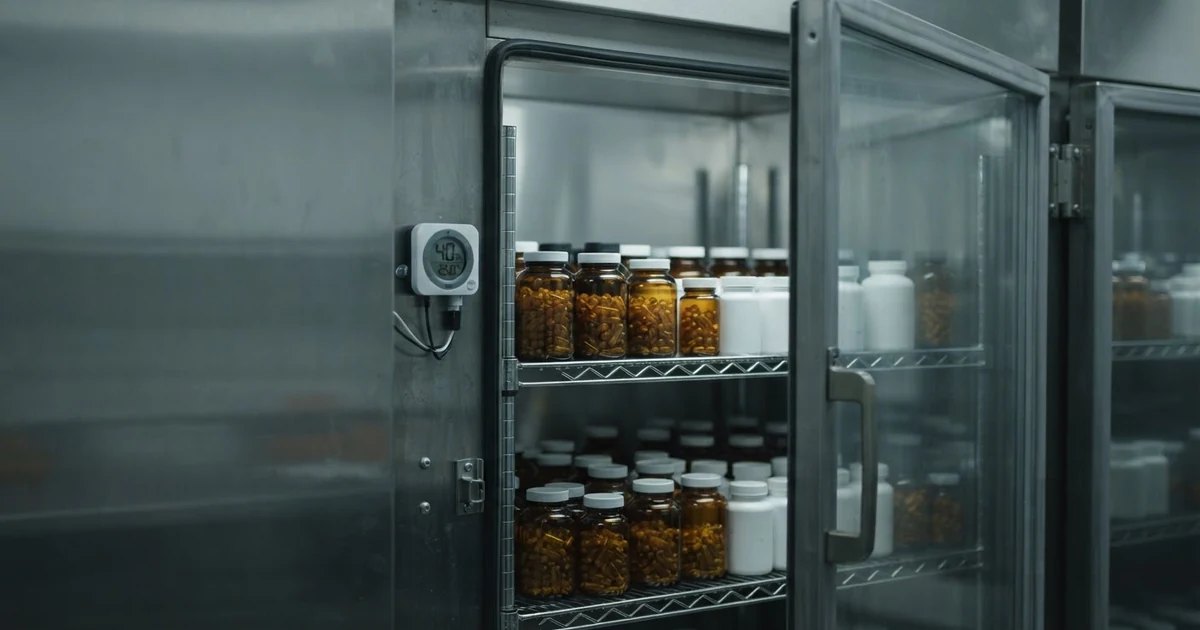

Shelf life is a regulatory commitment, not a marketing estimate, and the data behind it has to survive an FDA inspection and a retailer's technical review. Brands that assign an expiration date before stability data exist are guessing, and the cost of guessing wrong shows up as potency failures, customer complaints, and in the worst case a recall. This article covers how stability studies are designed, what timelines and acceptance criteria are realistic, and how to audit the data your contract manufacturer hands you.
What shelf life actually means under 21 CFR 111
Under 21 CFR 111, a dietary supplement must bear an expiration date unless it is exempt, and that date must be supported by data. The regulation does not prescribe a specific study design, but it does require that you establish and follow written procedures for stability testing and that you hold the records to back the label claim. In practice, FDA investigators and third-party auditors expect the study design to follow a recognized standard, and ICH Q1A(R2) is the default reference even though it was written for drug substances and products.
Two practical consequences follow. First, the expiration date applies to the product in its original, unopened container under labeled storage conditions — not to a capsule left in a car. Second, the date must cover every claim on the label that degrades: potency of each active, and where relevant, disintegration, dissolution, moisture, and microbiological quality. A label stating "1,000 mg vitamin C" on the expiration date is a claim that the assay will still read at or above label at that date.
Designing the study: batches, conditions, and timepoints
A credible stability program typically uses at least three production batches, ideally from different lots of raw material and, where possible, different batch sizes. Bracketing and matrixing are acceptable under ICH Q1A(R2) when justified, but a single batch is weak support for a two-year date, and auditors know it.
Storage conditions depend on the product. For general supplements, long-term testing at 25°C ± 2°C and 60% RH ± 5% RH is standard, with an intermediate condition of 30°C/65% RH where the product is likely to be exposed to higher humidity. Accelerated testing at 40°C ± 2°C and 75% RH ± 5% RH is used to screen formulations and to support tentative dates, not to replace real-time data. Products labeled for refrigeration need 5°C ± 3°C long-term data. Probiotics, enzymes, and softgels with volatile actives often need custom conditions and should not be forced into a default protocol.
Timepoints for a two-year shelf life typically run 0, 3, 6, 9, 12, 18, and 24 months long-term, with 0, 3, and 6 months accelerated. If you intend to claim 36 months, add 36-month points and expect to hold the product that long before the claim is fully supported. A common industry range for a complete real-time program is 24 to 36 months of calendar time, which is why brands often launch on accelerated and 12-month data and extend the date as data accrue — a practice that must be documented and defensible, not improvised.
What gets tested and what the numbers should look like
Test panels should be product-specific, but a typical panel includes:
- Assay (potency) of each active marker by a validated method, usually HPLC; acceptance is normally 90.0–110.0% of label claim, with tighter windows for some vitamins and botanicals.
- Degradation products where the actives are known to break down, with limits set from toxicology or compendial monographs.
- Disintegration per USP <701> for tablets and capsules, typically under 30 minutes for most immediate-release dosage forms.
- Moisture or water activity for hygroscopic powders and capsules; water activity above roughly 0.6 supports microbial growth.
- Microbiological limits — total aerobic count, yeast and mold, and absence of specified pathogens — aligned with USP <2021> or <2022> and the product's water activity.
- Heavy metals per USP <232>/<233> using ICP-MS, with elemental impurity limits set by the ICH Q3D risk assessment.
- Appearance, color, odor, and where relevant, dissolution or weight variation.
Acceptance criteria must be written before the study starts. A criterion invented after a failing timepoint is a finding waiting to happen. For a branded ingredient, ask the raw material supplier for its own stability data — many hold 24- to 36-month data on the isolated ingredient, which supports but does not replace finished-product testing.
Accelerated data, extrapolation, and the honest limits
Accelerated studies are useful and widely used, but they over-predict stability for some systems and under-predict for others. Vitamin C in a moisture-permeable tablet may fail accelerated while passing real time; a probiotic may look fine at 40°C for a month and collapse at 25°C over a year because the failure mode is oxygen and water ingress, not heat alone. ICH Q1A(R2) permits limited extrapolation from accelerated to long-term data when there is no significant change, but the extrapolation must be justified in writing.
A defensible approach: launch on 6-month accelerated plus 6- to 12-month real-time data with a conservative initial date, then extend the date only when the next real-time timepoint supports it. Document each extension with a signed stability report and a change control record. If a supplier offers "two-year shelf life" with no timepoint data beyond six months, treat that as a claim, not a finding.
Failure modes to watch before you launch
Most stability failures trace back to formulation or packaging rather than the actives themselves. Common ones:
- Moisture ingress through inadequate blister or bottle seals; hygroscopic actives lose potency and capsules soften.
- Oxidation of oils, omega-3s, and carotenoids, detected by peroxide value and anisidine value rather than assay alone.
- Interaction with excipients — reducing sugars with amines (Maillard browning), or alkaline fillers degrading acid-labile actives.
- Light exposure where the container is clear or the label does not specify protection from light.
- Overages used to mask poor stability; a 20% overage at release can push the product above the upper assay limit at time zero.
- Microbial growth in high-water-activity powders or syrups with marginal preservative systems.
Each of these should have a corresponding control in the specification and a monitoring plan. If your capsule manufacturing partner cannot describe how it controls moisture ingress and shell integrity, the stability data will not save the product.
Questions to ask your supplier
Use these in a technical audit or a supplier questionnaire, and ask for the underlying reports, not summaries:
- How many production batches are in the stability program, and were they from different raw material lots?
- What are the storage conditions and timepoints, and does the protocol reference ICH Q1A(R2) explicitly?
- Which test methods are validated, and can I see the validation summaries for assay and micro?
- What acceptance criteria were set before the study, and who approved them?
- Has any timepoint failed or trended toward failure, and what was the corrective action?
- How is the expiration date extended, and is there a change control record for each extension?
- What is the container closure system, and is there data on moisture and oxygen transmission?
- Can you provide the stability summary in a format my retailer's QA team will accept?
For imported finished product or ingredients, the picture widens. Under the FDA's FSMA Foreign Supplier Verification Program (21 CFR 117), you need supplier verification records, and Prior Notice (21 CFR 1005) must be filed for each shipment. Ask for the certifications and audit reports that sit behind those records, and confirm the foreign facility's GMP status independently.
Labeling, claims, and jurisdiction-specific rules
The expiration date must appear in the Supplement Facts panel format required by 21 CFR 101.36, and the storage statement must match the conditions actually tested. In the EU, Regulation 1169/2011 governs date marking and storage instructions, and the format differs from US practice; a single label rarely satisfies both. Allergen and ingredient declarations follow 21 CFR 101.4 in the US and 1169/2011 in the EU, and any structure/function claim must carry the DSHEA disclaimer in the US.
California's Prop 65 adds a separate exposure assessment for heavy metals and other listed substances; a product that passes USP <232> can still trigger a Prop 65 warning if exposure exceeds the safe harbor level. Build this into the stability program by testing heavy metals at release and at the final timepoint, not only at time zero.
Frequently asked questions
How long does a real-time stability study take?
For a 24-month shelf life, plan on 24 months of calendar time plus reporting, so 25 to 27 months end to end. A 36-month claim takes at least 36 months. Accelerated data can support an interim date, but the full claim requires the real-time points.
Can I launch before stability data are complete?
Often yes, with a conservative initial expiration date supported by accelerated and early real-time data, provided the decision is documented and the date is extended only as data accrue. The risk is commercial: if the product fails at 12 months, you face a reformulation and a market withdrawal.
How many batches do I need?
Three production batches is the common expectation, ideally from different raw material lots. Bracketing or matrixing can reduce the testing burden for multiple strengths or package sizes, but the justification must be written into the protocol.
Does packaging really change shelf life?
Yes, frequently more than the formula does. A switch from a polyethylene bottle to an induction-sealed HDPE bottle with a desiccant can add 12 months to a moisture-sensitive product. Test the commercial container closure system, not a lab surrogate.
What documentation should I keep?
Keep the approved protocol, raw data, method validation summaries, the final report, and change control records for every date extension. Under 21 CFR 111 these are records you must retain and produce on request, and retailers increasingly ask for them during supplier qualification.
Start by asking your manufacturer for the stability protocol and the most recent timepoint data before you sign a purchase order. If the answer is a summary slide rather than a report with timepoints, batch numbers, and acceptance criteria, you have found the first gap to close — and it is cheaper to close it before launch than after.