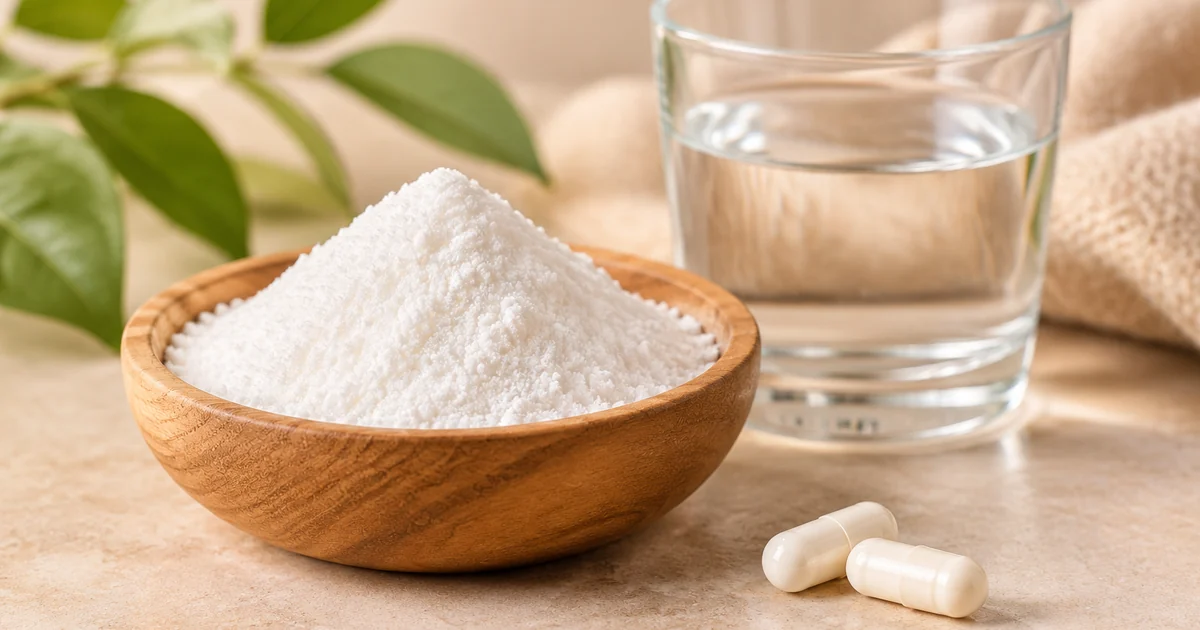

Quick answer: A useful electrolyte powder delivers 300 to 1,000 mg of sodium and 200 to 500 mg of potassium per serving, with magnesium in the 50 to 100 mg range and little or no sugar unless the goal is rapid rehydration during exercise. Anything below 200 mg of sodium is flavoured water, not an electrolyte product.
The category has a measurement problem: serving sizes vary from a 3 g stick to a 15 g scoop, and labels quote compound weights in whatever way looks best. Comparing two products properly takes about two minutes with the nutrition panel, and almost nobody does it.
What electrolyte powder actually contains
An electrolyte powder is a blend of mineral salts plus a carrier. The carrier is usually dextrose, maltodextrin, citric acid and a flavour system; the salts are what matter. Sodium almost always arrives as sodium chloride or sodium citrate. Potassium arrives as potassium citrate, gluconate or chloride. Magnesium arrives as citrate, glycinate, oxide or lactate. Calcium, if present, is usually gluconate or lactate.
The label problem is that these are compound weights. Sodium citrate is roughly 23% sodium by weight, so 1,000 mg of sodium citrate delivers about 230 mg of sodium. Sodium chloride is about 39% sodium. A label that lists "sodium citrate 1,000 mg" is not the same as "sodium 1,000 mg," and the gap is often a factor of four. Read the elemental column, not the ingredient list.
Osmolarity is the second hidden number. It is the total concentration of dissolved particles in the prepared drink, expressed as mOsm/L. It depends on the powder weight, the water volume and the number of particles each salt dissociates into. A 5 g stick in 250 ml is roughly twice as concentrated as the same stick in 500 ml. The label rarely states osmolarity, but you can estimate it from the serving weight and the instructions.
What the evidence shows
1. Sodium is the electrolyte lost in the largest quantity. Sweat sodium concentration varies widely between individuals, roughly 500 to 1,500 mg per litre in most studies, with heavy sweaters exceeding 2,000 mg. A product with 100 mg of sodium per serving does not replace meaningful losses. This is consistent across field studies of athletes and occupational heat exposure.
2. Glucose accelerates sodium and water absorption via SGLT1. The sodium-glucose cotransporter couples one glucose molecule to one sodium ion, and water follows osmotically. This is the mechanistic basis of oral rehydration therapy, and it is well established in intestinal perfusion studies in humans. The effect is dose-dependent: too little glucose does not activate the transporter, and too much makes the solution hypertonic.
3. Hypotonic fluids empty from the stomach faster than hypertonic fluids. Gastric emptying studies in exercising humans show that solutions below about 270 mOsm/L leave the stomach more quickly than isotonic or hypertonic solutions. Faster emptying does not always mean faster net absorption, because absorption also depends on transporter activity, but the direction is consistent.
4. Carbohydrate-electrolyte drinks improve endurance performance in some, not all, trials. Meta-analyses of sports drink trials in trained cyclists and runners show a modest benefit for exercise lasting more than 60 to 90 minutes, mainly through fuel delivery rather than electrolytes. For shorter sessions, the evidence is weak or mixed.
5. Potassium loss in sweat is small relative to sodium. Sweat potassium is roughly a tenth of sweat sodium in most measurements. Potassium matters for the sodium-potassium pump and for taste, but it is not the limiting electrolyte in most exercise scenarios. The evidence for high-potassium formulas improving rehydration is limited.
Forms compared
| Form | Typical sodium per serving | Typical carbohydrate | Practical notes |
|---|---|---|---|
| Stick pack powder | 300–1,000 mg | 0–6 g | Portable, fixed dose, needs 250–500 ml water; osmolarity depends on dilution |
| Jar powder (scoop) | 200–1,000 mg | 0–30 g | Flexible dosing, but scoop size varies; easy to under- or over-dilute |
| Effervescent tablet | 200–500 mg | 0–2 g | Lower dose per unit, carbonate salts raise pH and taste; convenient but limited sodium load |
| Liquid drops | 100–400 mg per serving | 0 g | Easy to add to any drink; taste of concentrated salt is hard to mask |
Dosage and timing
| Population / context | Dose | Notes |
|---|---|---|
| General daily hydration | 300–500 mg sodium, 200–300 mg potassium | One serving is usually enough; check total dietary sodium |
| Exercise under 60 minutes | 300–500 mg sodium | Water is often sufficient; electrolytes are optional |
| Endurance exercise 60–180 minutes | 500–1,000 mg sodium, 30–60 g carbohydrate per hour | Carbohydrate matters more than electrolytes here |
| Heat exposure / heavy sweating | 500–1,000 mg sodium per litre of fluid | Match intake to sweat losses where possible |
| Diarrhoeal illness (WHO ORS) | ~1,300 mg sodium per 500 ml, ~13 g glucose | Use a proper ORS formula, not a sports drink |
Timing is less important than total intake. For exercise, drinking to thirst is adequate for most sessions under two hours. For longer events, a planned schedule of 400 to 800 ml per hour with 500 to 1,000 mg sodium per litre is a common starting point, adjusted for sweat rate and heat.
Safety, side effects and interactions
Healthy kidneys handle typical electrolyte loads without difficulty. The main risk is excessive sodium in people with hypertension, heart failure or kidney disease, who should discuss intake with a clinician. The US Dietary Guidelines suggest keeping sodium below 2,300 mg per day for most adults; two servings of a 1,000 mg formula plus a normal diet can approach that limit.
Potassium is the more serious concern in kidney disease. Reduced renal function impairs potassium excretion, and high-potassium formulas can push serum potassium into a dangerous range. People taking ACE inhibitors, angiotensin receptor blockers, potassium-sparing diuretics or trimethoprim should be cautious with high-potassium products.
Magnesium at 50 to 100 mg is generally well tolerated. Higher doses, especially as magnesium oxide or citrate, can cause loose stools. Magnesium can reduce absorption of some antibiotics and bisphosphonates; separate doses by two hours.
Sugar-free formulas often use erythritol, sorbitol or maltitol. These can cause bloating and diarrhoea in sensitive people, particularly when consumed quickly during exercise. Sugar alcohols also have a laxative effect that scales with dose.
How to read the label
Start with the serving size and the elemental mineral column. Compare sodium, potassium and magnesium in milligrams, not compound weights. Check the carbohydrate line: 0 g, 2 to 6 g, or 20 to 60 g tells you what the product is for. Look at the ingredient list for the salt forms; citrate salts taste softer than chloride salts but add alkalinity. Check for excipients: anti-caking agents, desiccants, artificial colours and sweeteners. Finally, look for third-party testing or a CoA. Heavy metal and microbial testing is not universal, and a certificate of analysis per batch is the minimum evidence of control.
| Label item | What to check | Red flag |
|---|---|---|
| Sodium | Elemental mg per serving | Only compound weight listed |
| Potassium | 200–500 mg per serving | Above 1,000 mg with no warning |
| Carbohydrate | Matches intended use | 30 g sugar in a "daily hydration" product |
| Salt forms | Citrate, chloride, gluconate | Undisclosed "mineral blend" |
| Testing | CoA, third-party heavy metals | No testing documentation |
Making it: what changes in production
Electrolyte powders are hygroscopic. Sodium chloride and potassium citrate pull moisture from the air, and magnesium citrate is worse. In a stick pack, that means a desiccant or an anti-caking system, and a foil laminate that blocks moisture. In a jar, it means a tight seal and a scoop that does not cake.
Flavour is the hard part. Salt suppresses sweet perception and amplifies bitterness. A 1,000 mg sodium formula needs acid (citric or malic), a masking system and often a small amount of sugar or erythritol to round the edges. This is why high-sodium products tend to be citrus or berry rather than vanilla.
Dosage form feasibility matters. Effervescent tablets need carbonate salts and a low-moisture environment; sodium citrate and sodium chloride can be compressed, but potassium chloride is bitter and hygroscopic. Liquid drops are easy to formulate but hard to mask at high sodium loads. Stick packs and jars are the most flexible for high-dose formulas.
Overage is a real production decision. Sodium and potassium are stable, but magnesium and some vitamins degrade over shelf life. A formulation scientist sets an overage at the target dose plus a margin based on stability data, not guesswork. Every batch ships with a CoA, and third-party testing for heavy metals, micro and potency is available on request.
At ZOOMSHEAL's factory in Huadu District, Guangzhou, electrolyte powders are made in-house as jars, sachets and stick packs. MOQ starts at 500 units per SKU for gummies, powders and liquids and 1,000 for capsules, tablets and softgels; stick packs need higher first runs. Lead time is 4 to 6 weeks for a pilot run after formula and artwork approval, with sampling in 7 to 10 days. The factory holds GMP (Intertek), ISO 9001:2015, ISO 22000:2018, HACCP, NSF audit, Halal and FDA facility registration via a US agent. FDA registration is not FDA approval; dietary supplements have no pre-market approval in the US.
Buying checklist for brands
- Ask for the elemental mineral breakdown per serving, not compound weights.
- Confirm the osmolarity at the instructed dilution, or calculate it from the formula.
- Check the carbohydrate source and amount against the intended use case.
- Request a CoA per batch and third-party heavy metal and micro testing.
- Confirm the dosage form can handle the sodium load without caking or taste failure.
- Ask about stability data and overage for magnesium and any vitamins.
- Verify certifications are line- and product-specific, not just company-level.
Frequently asked questions
How much electrolyte powder per day?
One to two servings is standard for general hydration. In heat or heavy training, two to four servings spread across the day. Check total sodium against your diet; two servings of a 1,000 mg formula plus a normal diet approaches the daily limit for most adults.
Is it safe to drink electrolyte powder every day?
Yes for healthy people, but check total sodium against your diet. Two servings of a 1,000 mg formula plus a normal diet approaches the daily limit. People with hypertension, heart failure or kidney disease should discuss intake with a clinician before using high-sodium products daily.
Do I need electrolytes if I drink enough water?
If you sweat heavily or drink large volumes of plain water, yes. Excessive plain water without sodium can dilute blood sodium, a condition called hyponatremia. For most people, drinking to thirst is adequate; for endurance athletes and people in heat, a planned electrolyte intake is safer.
Are electrolyte tablets the same as powder?
Usually lower dose. Tablets typically carry 200 to 300 mg sodium; check the panel rather than assuming. Effervescent tablets also contain carbonate salts that raise pH and change taste. Powder in a stick pack or jar is more flexible for high-sodium formulas.
What is the best sodium-to-potassium ratio?
A ratio of roughly 2:1 to 3:1 sodium to potassium is a sensible target for exercise formulas. Sweat loses sodium at roughly ten times the potassium rate, so a 1:1 ratio overweights potassium. For daily hydration, the ratio matters less than total intake and dietary balance.
Does sugar-free electrolyte powder work?
For everyday hydration, yes. For rapid rehydration during illness or endurance exercise, some glucose helps because it activates the SGLT1 cotransporter and accelerates sodium and water absorption. A zero-sugar formula is not equivalent to an oral rehydration solution for severe dehydration.
References
- National Institutes of Health, Office of Dietary Supplements. Sodium fact sheet for health professionals. https://ods.od.nih.gov/factsheets/Sodium-HealthProfessional/
- National Institutes of Health, Office of Dietary Supplements. Potassium fact sheet for health professionals. https://ods.od.nih.gov/factsheets/Potassium-HealthProfessional/
- National Institutes of Health, Office of Dietary Supplements. Magnesium fact sheet for health professionals. https://ods.od.nih.gov/factsheets/Magnesium-HealthProfessional/
- World Health Organization. Oral rehydration salts: production of the new ORS. https://www.who.int/publications/i/item/WHO-FCH-CAH-06.1
- European Food Safety Authority. Scientific opinion on dietary reference values for sodium. https://efsa.onlinelibrary.wiley.com/doi/10.2903/j.efsa.2019.5772
- European Food Safety Authority. Scientific opinion on dietary reference values for potassium. https://efsa.onlinelibrary.wiley.com/doi/10.2903/j.efsa.2016.4592
- PubMed search: carbohydrate-electrolyte beverage exercise performance meta-analysis. https://pubmed.ncbi.nlm.nih.gov/?term=carbohydrate-electrolyte+beverage+exercise+performance+meta-analysis
- PubMed search: gastric emptying hypotonic hypertonic beverage exercise. https://pubmed.ncbi.nlm.nih.gov/?term=gastric+emptying+hypotonic+hypertonic+beverage+exercise
Reviewed by Dr. Xu Wei, PhD, formulation scientist at ZOOMSHEAL in Guangzhou (23 years of supplement contract manufacturing). Last updated: November 2026. This article is for education and does not replace medical advice.