
What Is Nutraceutical Powder Processing? A Guide for Brands
Nutraceutical powder processing is the set of steps that turns raw ingredients into a finished, drinkable or mixable supplement powder. It is one of the most flexible formats in the supplement industry, and also one of the least forgiving. A powder that clumps, separates or tastes wrong is not a small defect; it is a product that customers stop buying. For any brand sourcing manufacturing powders, understanding the process is the fastest way to control quality, cost and lead time.
This guide explains what nutraceutical powder processing actually involves, the equipment and steps behind it, and the decisions that separate a repeatable formula from a problem batch.
What does nutraceutical powder processing include?
Powder processing covers every operation between raw material intake and packaged, sellable powder:
- Receiving and testing of incoming ingredients against specifications
- Milling and sieving to reach a target particle size
- Weighing and dispensing of each active and excipient
- Blending into a homogeneous mix
- Granulation or agglomeration when flow or dissolution needs improvement
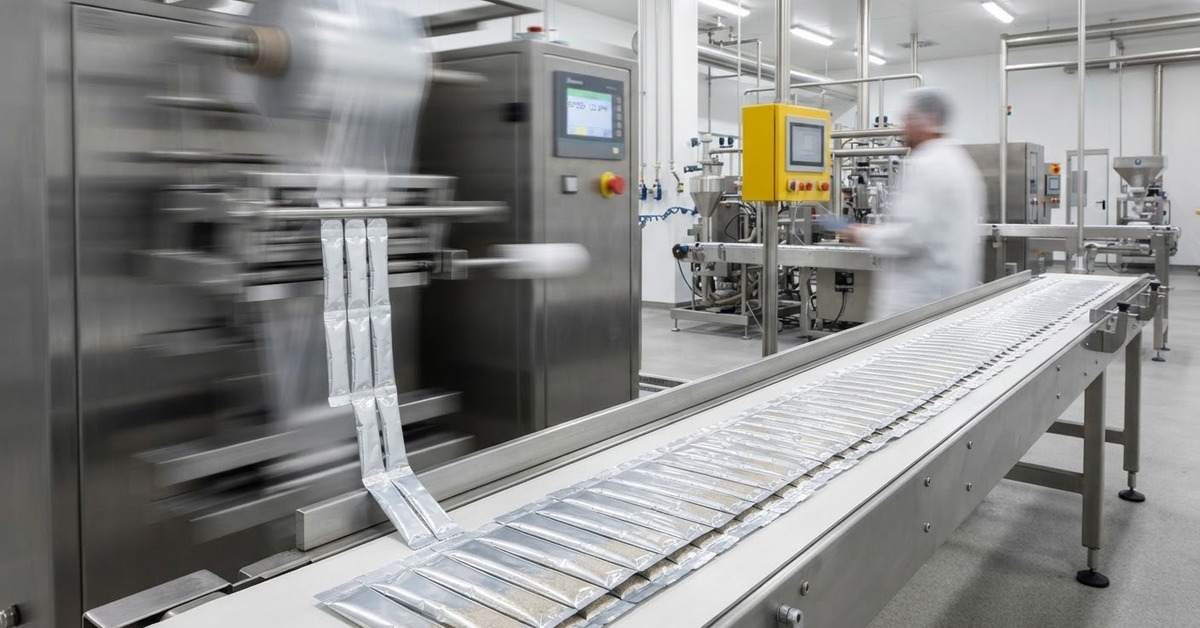
- Filling into jars, pouches, stick packs or sachets
- In-process and finished testing before release
Not every product needs every step. A simple filler-based blend may only need weighing, blending and filling. A high-protein or high-mineral formula can demand granulation, drying and several blending passes.
Core powder processing steps
1. Milling and particle sizing. Particle size affects flow, mixing, mouthfeel and dissolution. Fine powders blend evenly but create dust and flow poorly; coarse powders flow well but separate. A powder manufacturer targets a defined particle size distribution rather than a single number, and adjusts the mill and screen to match the product.
2. Weighing and dispensing. Minor ingredients such as vitamins, minerals or botanicals are often a tiny fraction of total weight. Small weighing errors become large dosage errors, so controlled dispensing, often with automated systems, protects label accuracy.
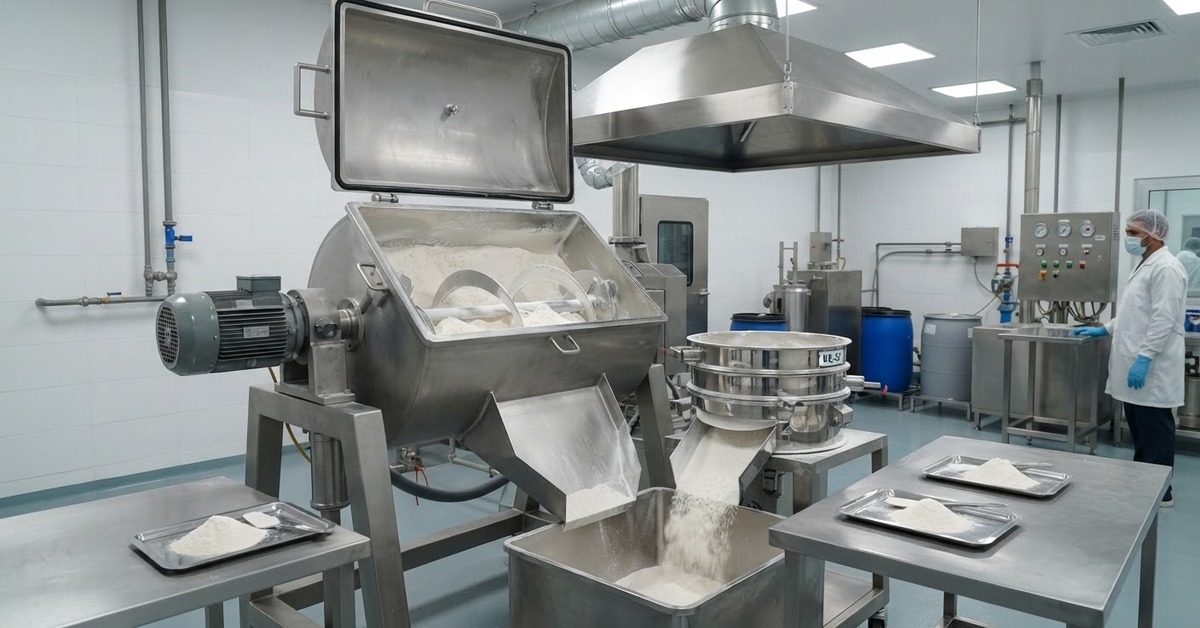
3. Blending and homogeneity. Blending must produce a uniform mix across the whole batch, not just on average. This is verified by sampling from several points in the blender and testing active concentration. Blend uniformity is the backbone of a trustworthy batch record.
4. Granulation and agglomeration. Wet or dry granulation improves flow, reduces segregation and supports dissolution. It also cuts dust, which matters for ingredients that are unpleasant to handle. This step is common in protein, creatine and high-mineral formulas.
5. Filling and sealing. Powder is filled by weight into the final container. Head space, seal integrity and moisture protection all influence shelf life.
Powder product types
The same process supports very different finished products:
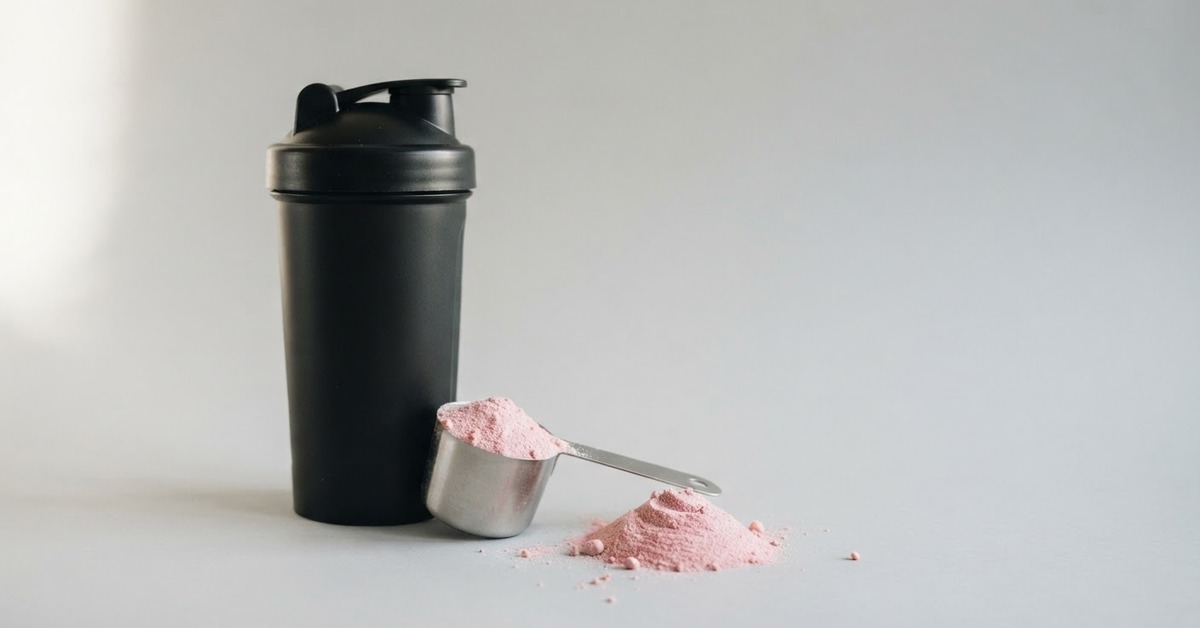
- Protein and sports powders for recovery, muscle and hydration
- Greens and superfood blends with high fibre and botanical loads
- Collagen and beauty powders with flavour and dissolution challenges
- Fibre and gut-health powders where texture is the main hurdle
- Pre-workout and energy blends with caffeine, amino acids and stimulants
- Kids and wellness powders with taste and dosing requirements
- Stick pack and sachet formats for single-serve use
Because these products pull in opposite directions on flow, taste and stability, the manufacturing plan has to be set per formula, not applied as a template.
Nutraceutical powder processing specifications
Typical commercial parameters, using a Guangzhou-based GMP-certified facility as the reference:
| Item | Typical specification |
|---|---|
| Forms | Bulk powder, jar, pouch, stick pack, sachet |
| Particle size | Custom target, commonly 40-80 mesh |
| Sweetening | Sugar, polyol, stevia, monk fruit, sucralose or blends |
| Flavours | Natural or nature-identical, multi-flavour runs possible |
| Actives | Vitamins, minerals, protein, collagen, creatine, botanicals, probiotics |
| Bulk MOQ | 25 kg bulk, or 5,000 bottles / 3,000 jars per SKU |
| Lead time | 4-6 weeks after formula and artwork approval |
| Testing | Potency, microbiology, heavy metals, moisture, bulk density, flow |
| Packaging | PET jar, pouch, sachet, stick pack, drum |
What drives powder processing cost
Five factors decide unit price, roughly in this order:
- Active ingredients. Protein, branded actives and high-dose botanicals can dominate the cost.
- Sweetening and flavour system. Natural and sugar-free systems cost more than simple sugar and basic flavour.
- Processing complexity. Granulation, multiple blending passes and tight particle-size specs add labour and equipment time.
- MOQ. A 25 kg bulk run spreads setup and cleaning over fewer units than a multi-tonne run.
- Testing. Potency, microbiology and heavy-metal analysis add cost but are non-negotiable for most markets.
Be cautious with a quote that sits far below the others. It usually means untested actives, an unqualified use of overages, or packaging minimums that appear later.
Quality control in powder manufacturing
Powder QA rests on documentation and reproducibility:
- Identity and supplier verification for every incoming lot
- Blend uniformity testing across the batch
- Moisture and water activity checks, since moisture drives clumping and spoilage
- Bulk density and flow rate, which predict how the powder behaves on a filling line and in the customer's scoop
- Microbiology and heavy metals on the finished lot
- Retained samples for the full shelf life
A serious partner can show batch records and a certificate of analysis template during evaluation, not after the order.
How to choose a custom powder manufacturer
A practical checklist when comparing custom powder manufacturers:
- Certification scope. Confirm GMP, ISO 22000 or HACCP on the certificate itself, and which lines are covered.
- Blending capacity. Ask about blender sizes, minimum batch weight and how uniformity is validated.
- Flow and taste capability. Request samples with your intended sweetening and flavour system.
- MOQ and scalability. Confirm the same site can move you from 25 kg bulk to full production without changing process.
- Documentation turnaround. COA, specification and traceability records should be routine.
- One accountable contact with predictable response times.
Price differences between serious facilities are usually far smaller than the differences in what they can prove. A slightly higher quote backed by documentation and stability data is almost always the cheaper decision.
Common problems in powder processing
Even experienced brands hit the same powder issues, and each one has a manufacturing cause:
- Clumping in the jar. Usually moisture ingress or an unbalanced anticaking system, solved with better flow aids, granulation or a stronger moisture barrier in packaging.
- Separation in the mix. A sign of mismatched particle sizes, corrected by tightening the particle size distribution.
- Poor mixability. Often caused by a powder that is too fine or too coarse, or by actives that resist wetting; granulation and dispersing aids help.
- Off-taste. Frequently the sweetening or flavour system failing under a high actives load; the fix is reformulating the taste system, not adding more flavour.
- Label claim failure. Almost always a weighing or blend uniformity problem, corrected with tighter dispensing and validated blending.
Identifying the cause early is far cheaper than reformulating after a production run.
Powder format compared with other dosage forms
Powder is not always the right answer, and it helps to know where it wins:
- Powder allows the largest dose per serving and the easiest customisation of flavour and sweetness.
- Capsules and tablets offer precise unit dosing with no mixing, but cap the dose per unit.
- Gummies win on consumer appeal but limit actives load and add stability risk.
- Liquids and drops deliver fast absorption but need preservation and careful packaging.
- Stick packs take powder into a portable single-serve format.
For high-dose actives such as protein, creatine, collagen and greens, powder remains the practical choice.
Start your powder project
ZOOMSHEAL Health has run nutraceutical powder processing in Guangzhou since 2003, alongside gummies, capsules, softgels, tablets and liquids. We handle custom formulation, blending, granulation, filling and packaging, with bulk MOQ from 25 kg and container MOQ from 5,000 bottles, on a 4-6 week lead time.