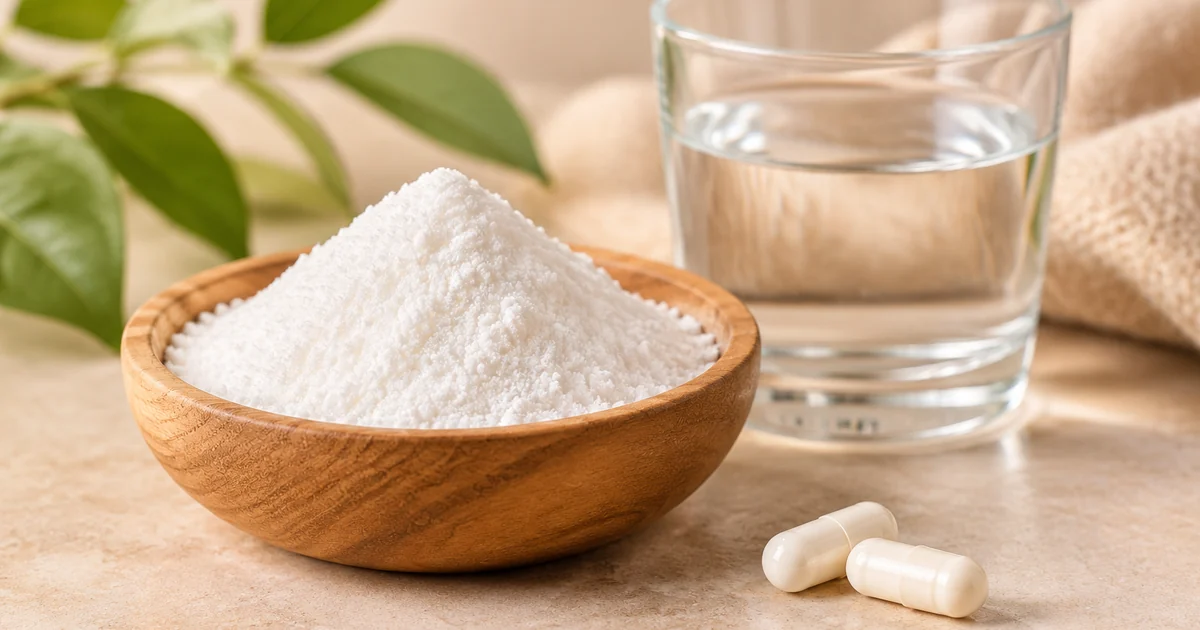
Quick answer: A targeted synbiotic pairs specific Lactobacillus strains with prebiotic fibers chosen to feed them. For women, the goal is to support a lactic-acid-dominant vaginal and gut environment. Strain identity, CFU at end of shelf life, and prebiotic match matter more than total CFU count. Evidence is strongest for some gut outcomes and mixed for vaginal ones. Quality depends on manufacturing controls and a batch CoA.
What a targeted synbiotic is — and what it is not
A synbiotic is a product that combines live microorganisms with substrates those microorganisms can use. The word "targeted" means the pairing is deliberate: a named strain plus a prebiotic that supports it, not a random blend. A probiotic is the live microbe. A prebiotic is the food for it. Neither term is regulated as a drug claim.
It is not a drug. It is not a treatment for bacterial vaginosis, candidiasis, or urinary tract infections. It is not a replacement for antibiotics or prescribed therapy. It is not "FDA approved" — dietary supplements in the US have no pre-market approval. A synbiotic is a supplement category with strain-specific evidence that ranges from solid to weak depending on the outcome.
How the mechanism works: lactic acid, adhesion, and the gut-vagina axis
Lactobacilli convert sugars to lactic acid. That lowers vaginal pH toward 3.5–4.5, a range where many pathogens grow poorly. Some strains also produce hydrogen peroxide and bacteriocins. Adhesion to epithelial cells helps them occupy sites that pathogens would otherwise colonize.
The gut is the other half. Orally ingested strains must survive stomach acid and bile. Those that do can transiently colonize the gut, interact with gut-associated lymphoid tissue, and influence the wider microbial community. The gut-vagina connection is real but indirect; oral strains do not simply travel to the vagina and set up residence. Estrogen metabolism is also shaped by gut bacteria — the so-called estrobolome — but this is an area of active research, not a settled mechanism you can promise on a label.
Prebiotics change the math. Inulin, FOS, and GOS are selectively fermented by beneficial bacteria. Pairing them with a matching strain can improve survival through processing and storage, and can support the strain once it arrives. A mismatched prebiotic does little.
Forms and delivery systems: capsules, sachets, gummies, and more
Live probiotics are sensitive to heat, moisture, and compression. The form you choose is a manufacturing decision as much as a marketing one.
Hard capsules and softgels protect strains from gastric acid and are the most common delivery format. Powders in jars, sachets, and stick packs allow higher doses and easy blending with prebiotics, but moisture control is critical. Gummies are popular but require careful water-activity control and often use spore-forming or highly stable strains. Liquid drops suit infants and some adult formats but have shorter stability windows. Effervescent tablets are possible but the moisture and compression involved make them a harder home for live cultures.
| Form | Typical use | Stability challenge | Prebiotic fit |
|---|---|---|---|
| Hard capsule | Daily adult dose | Moisture ingress | Good — powder blend inside |
| Softgel | Oil-suspended strains | Water activity in fill | Limited |
| Sachet / stick pack | Higher CFU, easy dosing | Seal integrity | Excellent — prebiotic carrier |
| Powder jar | Multi-gram doses | Repeated opening | Excellent |
| Gummy | Consumer appeal | Heat and water activity | Difficult |
| Liquid drops | Flexible dosing | Short shelf life | Limited |
Dosing and specification ranges: what numbers actually mean
CFU means colony-forming units — live cells that can grow on a plate. The number on the label should be the count at end of shelf life, not at manufacture. A product labeled 10 billion CFU at expiry is a different product from one labeled 10 billion at production.
Common adult ranges in women's synbiotic products sit between 1 billion and 50 billion CFU per day, with many formulas in the 5–20 billion range. Strain identity matters more than the total. Lactobacillus rhamnosus, Lactobacillus reuteri, and Lactobacillus acidophilus are frequently studied. Prebiotic inclusion typically runs from about 1 g to 5 g per serving of inulin, FOS, or GOS, depending on tolerance and format.
| Parameter | Common range | What to check |
|---|---|---|
| Total CFU at expiry | 1–50 billion | Stated as end-of-shelf-life |
| Strain designation | Genus + species + strain code | Full strain ID on label |
| Prebiotic dose | 1–5 g per serving | Type and amount listed |
| Overage | Formulation-dependent | Disclosed in CoA, not label |
| Water activity | Low, form-specific | CoA value |
Who may benefit — and who should be careful
People most often drawn to women's synbiotics include those with recurrent vaginal discomfort, those recovering from antibiotic courses, and those going through perimenopause when estrogen decline can reduce Lactobacillus dominance. People with digestive complaints such as bloating or irregular bowel habits sometimes report benefit from gut-focused strains.
Caution is warranted for immunocompromised individuals, people with central venous lines, those with short bowel syndrome, and critically ill patients. Probiotics are not risk-free in these groups. Pregnant women and children should consult a clinician before starting. Anyone with persistent symptoms — odor, itching, discharge, pain — needs a diagnosis, not a supplement. This article is education, not medical advice.
What the evidence actually shows — including where it is weak
Evidence for probiotic use in antibiotic-associated diarrhea is relatively consistent across trials and reviews. Evidence for general gut symptoms like bloating is mixed and strain-dependent. For bacterial vaginosis, some trials of specific Lactobacillus strains show improved cure or reduced recurrence when used alongside standard treatment; others show little effect. The strain, dose, and duration differ across studies, which makes sweeping claims unsafe.
For urinary tract infections, the picture is similarly uneven. Some strains show promise for prevention; results are not uniform. For menopausal symptoms and estrogen metabolism, the mechanistic story is interesting but human trial evidence is thin. Say so plainly on any label or marketing page. A formulation scientist would rather under-claim and keep the customer than over-claim and lose trust.
Quality signals: how to read a label and a CoA
A serious label lists genus, species, and strain code. It states CFU at end of shelf life. It names the prebiotic and its amount. It gives storage conditions and a lot number. It avoids disease claims.
A certificate of analysis (CoA) is the batch record. Look for identity confirmation of each strain, total viable count at release, water activity, heavy metals, microbial contaminants, and appearance. Every batch should ship with one. GMP, ISO 9001, ISO 22000, HACCP, and Halal (line-specific) certificates tell you the facility has been audited. FDA facility registration means the site is registered with the US agent — it is not FDA approval.
| Quality test | What it confirms | Where it appears |
|---|---|---|
| Strain identity (PCR or sequencing) | Correct organism | CoA |
| Total viable count | CFU at release | CoA |
| Water activity | Stability risk | CoA |
| Heavy metals | Contaminant control | CoA |
| Microbial contaminants | Safety | CoA |
| Facility audit | Process control | GMP / ISO certificates |
Common mistakes brands and buyers make
Buying on CFU alone is the most common error. A 50 billion product with an unverified strain is worth less than a 5 billion product with a documented one. Another mistake is ignoring end-of-shelf-life overage — if the formula has no overage, the label number may be gone by month twelve.
Mismatching prebiotic and strain wastes money. So does choosing a gummy for a strain that cannot survive low water activity. Skipping stability testing to save time is a false economy. And treating FDA facility registration as approval is a compliance risk that surfaces in audits and advertising reviews.
How a targeted synbiotic is manufactured at scale
At ZOOMSHEAL's facility in Huadu District, Guangzhou — operated by Zhongci Health Products Technology Development Co., Ltd. — production starts with strain and prebiotic sourcing, identity confirmation, and a pilot blend. In-house capabilities cover hard capsules, softgels, tablets, gummies, powders in jars, sachets and stick packs, liquid drops, and effervescent tablets.
Blending happens under controlled humidity. Filling and packaging follow validated parameters. Samples go to stability chambers. Most forms start at 500 units per SKU MOQ; softgels can run 1,000–2,000 for a pilot. Lead time is 4–6 weeks after formula and artwork approval, with sampling in 7–10 days. The company has 23 years of contract manufacturing experience and is a factory, not a trading company.
A practical checklist before you order
- Full strain ID with genus, species, and code on the label.
- CFU stated at end of shelf life, with overage disclosed in the CoA.
- Prebiotic type and dose named, and matched to the strain.
- Form chosen for the strain's stability profile, not for trend.
- Stability data covering the intended shelf life and storage conditions.
- CoA per batch, with identity, count, water activity, and contaminants.
- Facility certificates current: GMP, ISO 9001, ISO 22000, HACCP, Halal where relevant.
- Claims reviewed against evidence; no disease claims.
- MOQ and lead time confirmed in writing.
- FDA registration understood as registration, not approval.
Frequently asked questions
What makes a synbiotic "targeted"?
Targeted means the probiotic strain and the prebiotic are chosen as a pair. The prebiotic should feed that specific strain, and the strain should have evidence for the intended outcome. A random blend of many strains plus generic fiber is a synbiotic by definition but not targeted. Ask for the strain codes and the prebiotic rationale before you buy.
Do oral probiotics actually reach the vagina?
Not directly in large numbers. Oral strains must survive stomach acid and bile, then interact with the gut community. Some trials show changes in vaginal flora after oral dosing, likely through immune and microbial signaling rather than direct colonization. The effect is strain-specific and modest. Vaginal probiotics exist as a separate category and are not interchangeable with oral products.
How many CFU should a women's synbiotic contain?
There is no single correct number. Many studied formulas fall between 1 billion and 20 billion CFU per day at end of shelf life. Strain identity and documented stability matter more than a large headline count. A product with a verified 5 billion CFU at expiry can outperform an unverified 50 billion claim. Check the CoA, not just the front of the pack.
Can I take a synbiotic with antibiotics?
Often yes, but timing matters. Many clinicians suggest separating the probiotic dose from the antibiotic by a few hours. Evidence is strongest for preventing antibiotic-associated diarrhea with specific strains. For vaginal infections, probiotics are supportive, not a substitute for prescribed treatment. Ask your clinician, especially if you are immunocompromised or pregnant.
Are prebiotics necessary in a probiotic product?
Not always. Prebiotics can improve strain survival during processing and storage, and can support the strain in the gut. But a mismatched prebiotic adds cost without benefit. Some well-studied probiotics are sold without prebiotics and perform fine. The pairing should be justified by data, not by marketing language on the label.
What should I look for on a certificate of analysis?
Look for strain identity confirmation, total viable count at release, water activity, heavy metals, and microbial contaminants. The CoA should match the lot number on the pack. It should be issued by the manufacturer, not a broker. If a supplier cannot provide a batch-specific CoA, that is a signal about their quality system.
Does FDA registration mean a synbiotic is approved?
No. FDA facility registration means the manufacturing site is registered with the agency through a US agent. Dietary supplements have no pre-market approval in the US. Companies are responsible for safety and labeling, but the FDA does not approve products or claims before sale. Any page saying "FDA approved" for a supplement is inaccurate.
How long does contract manufacturing take?
At ZOOMSHEAL, lead time is typically 4–6 weeks after formula and artwork approval. Sampling takes 7–10 days. Most forms start at 500 units per SKU MOQ, with softgels available at 1,000–2,000 for a pilot. Timelines depend on raw material availability and stability testing requirements, so confirm in writing before committing to a launch date.
References
- NIH Office of Dietary Supplements — Probiotics
- PubMed — Probiotics and bacterial vaginosis trials
- PubMed — Lactobacillus vaginal colonization
- PubMed — Probiotics and antibiotic-associated diarrhea
- EFSA — Probiotics
- FDA — Dietary Supplements
- WHO — Food safety
- PubMed — Estrobolome and estrogen metabolism
Reviewed by Dr. Xu Wei, PhD, formulation scientist at ZOOMSHEAL in Guangzhou (23 years of supplement contract manufacturing). Last updated: November 2026. This article is for education and does not replace medical advice.