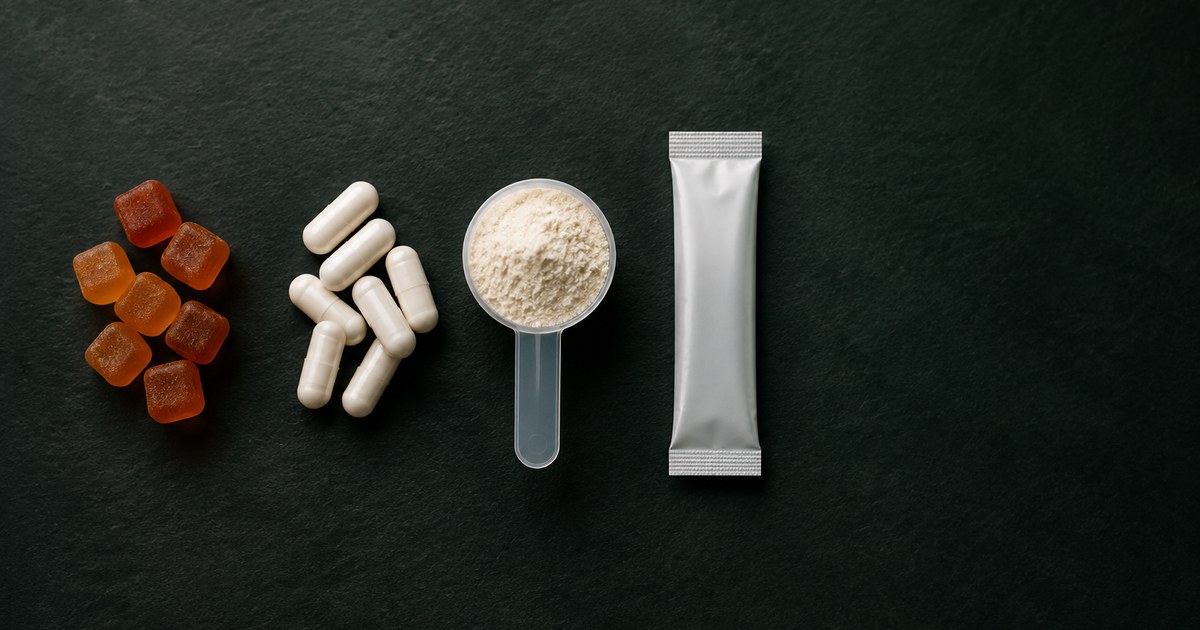
Electrolyte powders look like the easiest product to source and the hardest to get right. The formulation is a handful of salts and a flavour, the packaging is a stick or a tub, and the market price band is wide enough that almost any cost structure can look viable. Then the powder cakes in the stick, the flavour turns metallic in the heat, the sodium claim does not match the label, and the first repeat order never arrives.
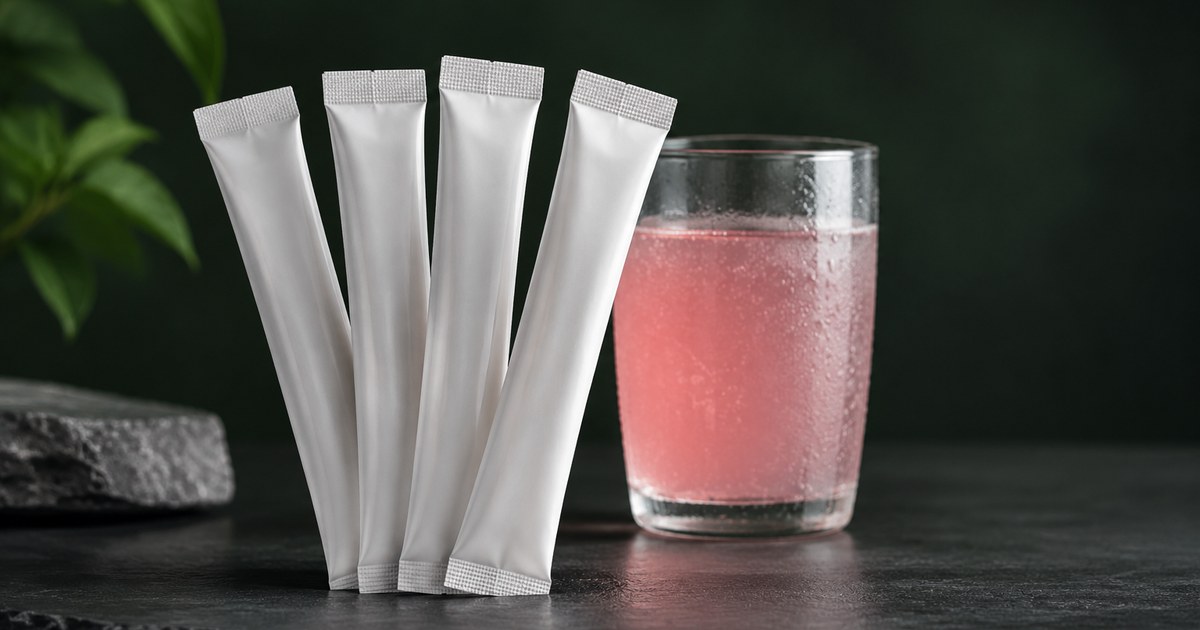
This guide covers the manufacturing side of electrolyte stick packs and tubs: the salt system, osmolality targets, flavour masking, stick film and seal parameters, fill accuracy at 5 g, testing, MOQ and the 2026 cost build per serving.
The salt system: what actually goes in
| Component | Function | Typical level per stick | Cost/kg | Notes |
|---|---|---|---|---|
| Sodium chloride | Sodium + chloride | 0.5–1.5 g | $0.3–0.6 | Cheapest sodium; tastes salty at high dose |
| Trisodium citrate | Sodium + buffer | 0.5–2.0 g | $2–4 | Smoother taste, better pH stability |
| Potassium chloride | Potassium | 0.2–0.6 g | $1.5–3 | Bitter/metallic above 0.4 g per serving |
| Potassium citrate | Potassium + buffer | 0.3–1.0 g | $3–6 | Preferred for taste |
| Magnesium citrate | Magnesium | 0.1–0.4 g | $6–12 | Laxative effect above ~0.4 g elemental |
| Magnesium malate / glycinate | Magnesium, taste-neutral | 0.2–0.5 g | $12–25 | Premium positioning |
| Dextrose or glucose | Energy, osmolality control | 0–10 g | $0.8–1.4 | Needed for true ORS; omitted in sugar-free |
| Citric acid | Acid, flavour balance | 1.0–3.0 g | $2–3 | Drives pH; affects sweetness perception |
| Sweetener | Taste | 0.05–2 g | $4–60 | Stevia Reb M or sucralose dominate |
| Anticaking | Flow, no caking | 0.1–0.5 % | $2–5 | Silicon dioxide or tricalcium phosphate |
The pattern in the market: sugar-free electrolyte sticks are essentially a mineral blend plus acid and sweetener, at 4–6 g per stick. A true oral rehydration product follows the WHO formula — 2.6 g sodium chloride, 2.9 g trisodium citrate, 1.5 g potassium chloride and 13.5 g glucose per litre — which is a different product with a different claim and a much higher stick weight.
Osmolality: the number that makes or breaks the claim
| Product type | Osmolality (mOsm/kg) | Claim you can make | Practical implication |
|---|---|---|---|
| Hypotonic | <250 | Faster gastric emptying, less bloating | Low sugar, low mineral load; hard to hit with high sodium |
| Isotonic | 250–340 | Standard sports hydration | Balanced; easiest to formulate |
| Hypertonic | >340 | Energy delivery, not hydration | Can worsen dehydration if used as a hydration drink |
| WHO ORS | 245 | Rehydration therapy | Specific ratio of sodium to glucose (1:1 molar) |
Osmolality is calculated from the molar concentration of every dissolved species, then confirmed by measurement (freezing-point depression). A stick with 1 g sodium chloride, 1 g potassium citrate, 3 g citric acid, 1.5 g stevia blend and no sugar in 500 ml typically lands near 180–260 mOsm/kg — hypotonic, which is the claim most brands want. Adding 8 g of dextrose pushes it to isotonic or above.
Flavour: masking salt is the whole game
| Challenge | Cause | Tool | Cost effect |
|---|---|---|---|
| Saltiness | Sodium chloride | Shift to citrate salts, add acid, use sweetener blend | +5–15 % |
| Metallic note | Potassium chloride | Potassium citrate, masking flavour, citric/malic acid | +5–20 % |
| Bitter linger | Magnesium salts, stevia | Reb M stevia, monk fruit, bitter blocker | +10–30 % |
| Chalkiness | Insoluble minerals | Use soluble salts only | Neutral |
| Colour fading | Natural colours, light | Opaque film, beta-carotene, colour stabiliser | +2–6 % |
Two practical rules from the bench. First, taste the powder dissolved at the exact ratio your consumer will use — 5 g in 500 ml, not in 250 ml. Second, taste at 40 °C, because a drink consumed after a workout or in a hot car is not at 4 °C, and salt perception rises with temperature.
Stick film and seal: where shelf life is decided
| Layer | Typical material | Thickness | Purpose |
|---|---|---|---|
| Outer print | PET or OPP | 12 µm | Print surface, stiffness |
| Barrier | Aluminium foil or metallised PET | 7–9 µm | Moisture and oxygen barrier |
| Tie | Adhesive / extrusion | 3–5 µm | Bonding |
| Sealant | PE or CPP | 50–80 µm | Seal strength, product contact |
| Seal parameter | Typical range | Failure if wrong |
|---|---|---|
| Jaw temperature | 150–180 °C | Low: channel leaks. High: film burn and pinholes |
| Dwell time | 0.3–0.6 s | Short: weak seal; long: reduced line speed |
| Pressure | 2–4 bar | Low: incomplete fusion; high: sealant squeeze-out |
| Seal width | 6–10 mm | Narrow: weak; wide: product trapped in seal |
| Powder in seal area | Zero tolerance | The #1 cause of leakers — needs brush/vacuum and fill-tube tuning |
Ask for seal strength data (typically ≥25 N/15 mm for a 60 µm sealant) and a dye-penetration or vacuum leak test on each batch. Sticks with pinholes look perfect for months and then arrive as bricks.
Fill accuracy at 5 g
| Machine type | Accuracy at 5 g | Speed | Notes |
|---|---|---|---|
| Volumetric auger VFFS | ±3–5 % | 40–60 sticks/min/lane | Needs density control per lot |
| Servo auger with weight feedback | ±2–3 % | 35–50/min/lane | Best for premium blends |
| Multi-lane sachet (8–12 lanes) | ±3–4 % | 400–700 sticks/min total | Standard for high volume |
At 5 g per stick, a 1 % systematic overfill is 0.05 g — trivial per unit, but on 500,000 sticks it is 25 kg of blend and a visible margin loss. Underfill is worse: it breaks the sodium claim. Set the target at mean plus 1.5 standard deviations and verify with check-weighing every 15 minutes.
Tub or stick: the same blend, different engineering
| Parameter | Stick pack | Tub / jar | Consequence |
|---|---|---|---|
| Dosing accuracy | Pre-measured, exact | Depends on the scoop | Sticks protect the sodium claim; tubs need a sized scoop |
| Unit cost | $0.05–0.09 per serving | $0.02–0.04 per serving | Tubs win on cost, sticks win on convenience |
| Moisture protection | Foil barrier, sealed | Reopened repeatedly | Tubs need more anticaking and a desiccant |
| Flow and caking | Not an issue once sealed | Critical — scoop clumps | Tubs need free-flowing salts and 0.3–0.5 % anticaking |
| Portability | Pocket, gym bag, bottle | Home use | Different consumer occasions |
| Fill line | Multi-lane VFFS | Auger or volumetric filler | Different MOQ drivers |
| Shelf life | 18–24 months | 12–18 months after opening | Tubs are judged on the opened product |
The common mistake is treating these as one formulation with two packages. A blend that flows beautifully into a 5 g stick can cake into a brick in a 300 g tub within weeks, because the tub is opened thirty times and each opening admits humid air. Tubs need coarser salts, more anticaking, and often a silica sachet in the lid.
Claims by market
| Market | What you can say | What needs care |
|---|---|---|
| United States | Structure/function claims with the DSHEA disclaimer; “electrolyte replacement” is treated as a structure/function statement | No disease claims; “treats dehydration” is out of bounds |
| European Union | Only authorised claims from the EU Register; sodium, potassium and water balance entries exist | “Hydration” wording must map to an authorised claim |
| United Kingdom | Great Britain nutrition and health claims register | Post-Brexit divergence from the EU list |
| Canada | NPN or DIN issuance before sale; claims per the monograph | Selling before the licence number is issued |
| Australia / NZ | Therapeutic Goods or food-medicine interface; sports supplements have specific guidance | Category choice changes the whole compliance path |
The practical takeaway: write the claim first, then check it against the market register, then formulate. Formulating first and discovering the claim is not authorised in the EU is the most expensive sequencing error in the category.
Auditing a stick line in one visit
| Check | What to look for | Red flag |
|---|---|---|
| Powder in the seal area | Brush or vacuum at the jaw, clean film path | Visible dust on the seal band |
| Check-weigher | Inline, logging, alarms enabled | Bypassed or alarm muted |
| Batch record | Signed at each step, with actual weights | Pre-printed values, no corrections |
| Film lot traceability | Lot number on the batch record | “Standard film” with no lot |
| Seal strength testing | Pull test per shift, recorded | Only done at validation |
| Room humidity | Logged, controlled below 45 % RH | Open doors, no hygrometer |
| Allergen and changeover | Documented cleaning between flavours | Same line, no cleaning record |
Cost build per stick
| Line item | 5 g sugar-free stick | 12 g ORS sachet |
|---|---|---|
| Mineral and acid blend | $0.021 | $0.038 |
| Flavour, sweetener, colour | $0.006 | $0.010 |
| Film | $0.014 | $0.022 |
| Filling and sealing | $0.008 | $0.010 |
| Carton and outer | $0.004 | $0.006 |
| Ex-works per stick | $0.053 | $0.086 |
| 30-stick carton cost | $1.59 | $2.58 |
That carton cost is why the category supports a $30 retail price: the physical product is $1.60 and the marketing is $28. It also explains why margin collapses at low volume — below about 100,000 sticks, film setup and line changeover add 15–30 % to the per-unit figure.
Testing and specification
| Test | Spec | Why |
|---|---|---|
| Sodium, potassium, magnesium assay | ±5 % of label | Claim basis; must be finished product |
| Osmolality | Declared class ±10 % | Supports hypotonic/isotonic claim |
| Moisture / water activity | <3 % / aw <0.35 | Caking is the main complaint |
| Uniformity of fill | RSD <3 % | Per-stick dose honesty |
| Seal strength | ≥25 N/15 mm | Leaker prevention |
| Pinhole / dye test | Zero failures per batch sample | Barrier integrity |
| Microbiology | TAMC <104; pathogens absent | Standard release |
| Heavy metals | Per market limits | Salt sources vary widely |
Failure modes
- Sticks turn into bricks. Film barrier too thin, or a sealant layer that lets moisture through; check the foil layer and the leak test.
- Flavour fades in three months. Spray-dried flavour oxidising on a metallised (not foil) film; use foil or add an antioxidant.
- Powder in the seal. Fill-tube timing or a static charge; adds bulk density variation and leakers.
- Metallic aftertaste. Too much potassium chloride, or magnesium oxide rather than citrate.
- Sodium claim fails. Sodium citrate is only ~23 % sodium by weight; the label was built on the salt weight, not the elemental figure.
- Colour separates in the stick. Insoluble colour; switch to a soluble or encapsulated grade.
If you are weighing formats before you choose a supplier, our pages on electrolyte formulation and stick pack filling set out the equipment, testing and minimum volumes behind each one. For the next decision in the sequence, read None.
Frequently asked questions
Is a sugar-free electrolyte as effective as one with glucose?
For hydration after normal exercise, yes. For true rehydration therapy, no — glucose drives sodium co-transport, which is why WHO ORS contains it.
What is a realistic MOQ for a custom flavour?
Around 100,000 sticks for a custom flavour and film print, 30,000–50,000 for a stock flavour with a generic film.
Can I make a stick that mixes in 250 ml instead of 500 ml?
Yes, but the concentration doubles, the osmolality roughly doubles, and salt perception rises sharply. Most brands that do this end up reformulating.
Do I need a foil layer?
For an 18–24 month shelf life in a humid market, yes. Metallised PET is cheaper and adequate only for shorter dates or dry climates.
How do I keep the powder from caking?
Control aw below 0.35, add 0.2–0.5 % anticaking agent, use a foil barrier, and avoid hygroscopic sweeteners like allulose at high levels.
What is the shelf life of an electrolyte stick?
18–24 months is achievable with a foil structure and aw under 0.35. Flavour, not chemistry, usually sets the real limit.
Can the same blend go into a tub?
Yes, with changes: tubs need better flow and a scoop that measures the label serving, and the anticaking level usually rises because the product is opened repeatedly.
How is the sodium figure calculated?
From the elemental sodium contributed by each salt — sodium chloride is 39.3 % sodium, trisodium citrate about 23 % — not from the total salt weight. This is the most common labelling error in the category.
Sources and further reading
Regulatory and standards
- World Health Organization, Oral rehydration salts: production of the new ORS — the reference formula used in the comparison above.
- US FDA, 21 CFR Part 111; nutrition labelling requirements for sodium and potassium declaration.
- EFSA, scientific opinion on dietary reference values for water and electrolytes; EU Regulation 1924/2006 via EUR-Lex.
Peer-reviewed research
- Maughan RJ, Shirreffs SM. Development of individual hydration strategies for athletes. Int J Sport Nutr Exerc Metab. 2008;18:457–472. PMID 19033609 — sweat sodium losses and why the right sodium dose is individual, not universal.
- Evans GH, James LJ, Shirreffs SM, Maughan RJ. Optimizing the restoration and maintenance of fluid balance after exercise-induced dehydration. J Appl Physiol. 2017;122:945–951. PMID 28104766 — sodium dose and retention, the basis for the 500–1,000 mg per serving range.
- Baker LB, Jeukendrup AE. Optimal composition of fluid-replacement beverages. Compr Physiol. 2014;4:575–620. PMID 24715561 — osmolality and gastric emptying.
- Jeukendrup AE, Moseley L. Effect of different osmolalities, CHO types, and [CHO] on gastric emptying in humans. Med Sci Sports Exerc. 2017. PMID 27898643 — measured gastric emptying across osmolality bands.
Standards and industry references
- ISO 22000; GFSI; US FDA HACCP principles.
- United States Pharmacopeia, general chapters <2021>, <232>, <905>.
Costs are 2026 ex-works ranges for China-based contract manufacturing at 100,000+ sticks; film, flavour and fill weight drive most of the variation.