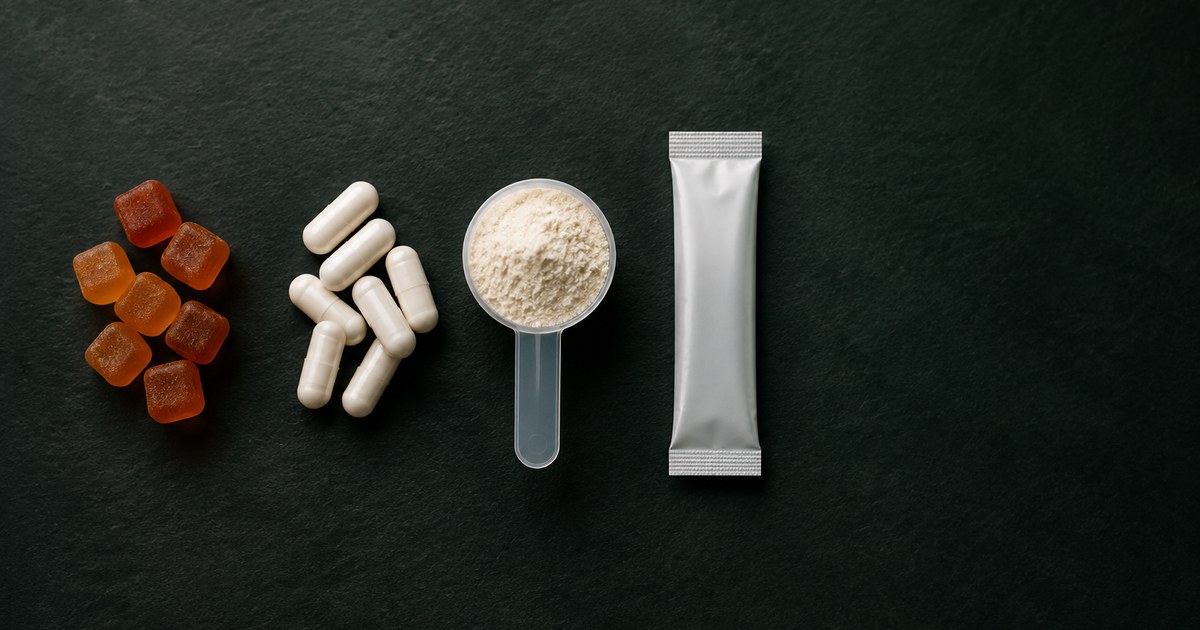
Most first-time supplement brands underestimate the gummy project because the product looks simple. A gummy is sugar, gelatin or pectin, colour, flavour and an active — and yet the process from brief to pallet runs 12 to 16 weeks, involves four rounds of samples, and fails most often on things the brand never thought to specify: texture, water activity, mould release, or the way the active behaves once it is inside a 100 °C syrup.
This is the operational timeline a contract manufacturer actually follows, with the decisions, documents and failure points at each stage, and the costs that sit outside the per-unit quote.
Stage 0: the brief that decides everything
| Brief element | Why it matters | Common mistake |
|---|---|---|
| Active and dose per piece | Sets piece weight, texture and taste strategy | Specifying a dose that cannot fit in a gummy |
| Pieces per serving and per bottle | Drives cost, label, and the dosing story | Quoting “2 gummies” then discovering 3 are needed |
| Texture target | Gelatin, pectin or starch; firmness and chew | Not naming a reference product |
| Dietary positioning | Vegan, halal, gelatin-free | Choosing gelatin then asking for vegan claims |
| Sugar strategy | Full sugar, reduced, sugar-free, allulose | Assuming sugar-free is a simple swap |
| Markets | Permitted colours, claims, labelling | Designing for one market and launching in three |
| Volume | MOQ, mould choice, packaging | Planning 3,000 units with a custom mould |
A good brief names a commercial reference product for texture and flavour. “Like a firm wine gum, not a soft jelly baby” saves two sample rounds on its own.
Stage 1: formulation and bench samples (2–3 weeks)
| Activity | Output | Cost |
|---|---|---|
| Formula design | Bench formula with percentages | Often free with a committed order |
| Bench batch (1–5 kg) | Hand-poured samples, 3–5 variants | $150–500 |
| Stability pre-check | 2–4 weeks at 40 °C to screen the active | $200–600 |
| Taste panel | Scored preference, masking assessment | Internal |
This is where most projects learn the truth about their active. Creatine degrades to creatinine in a warm, acidic syrup; vitamin C oxidises and browns; probiotics die; caffeine at 100 mg per piece tastes unmanageably bitter. A bench batch costs almost nothing compared with discovering it after a 500 kg production run.
Stage 2: pilot run on production equipment (2–3 weeks)
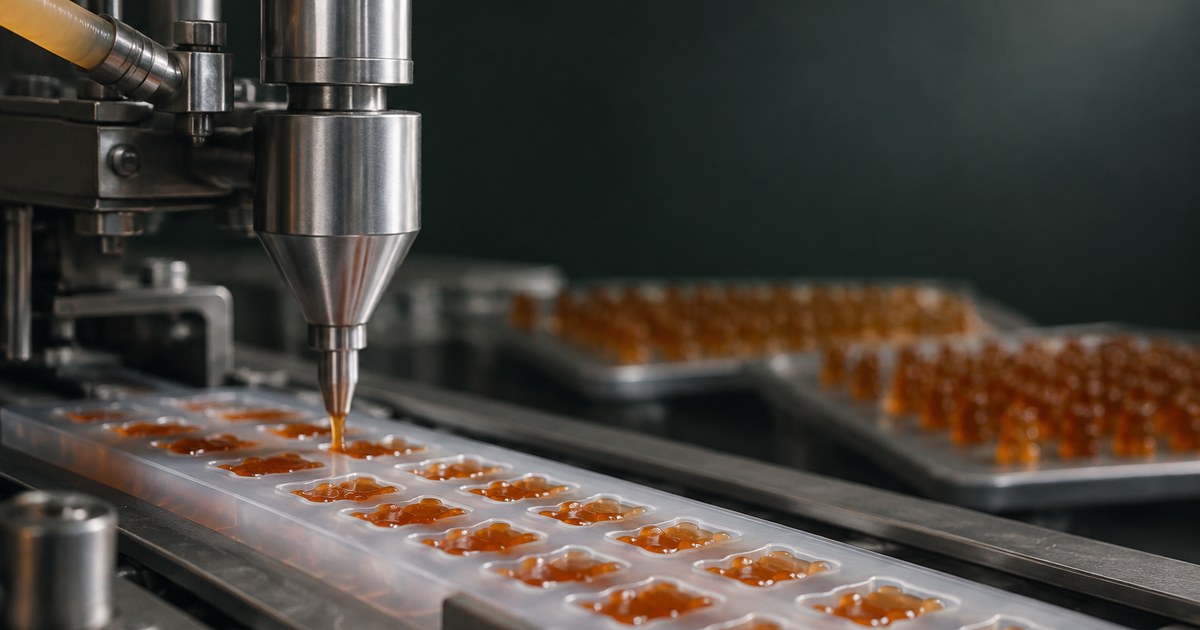
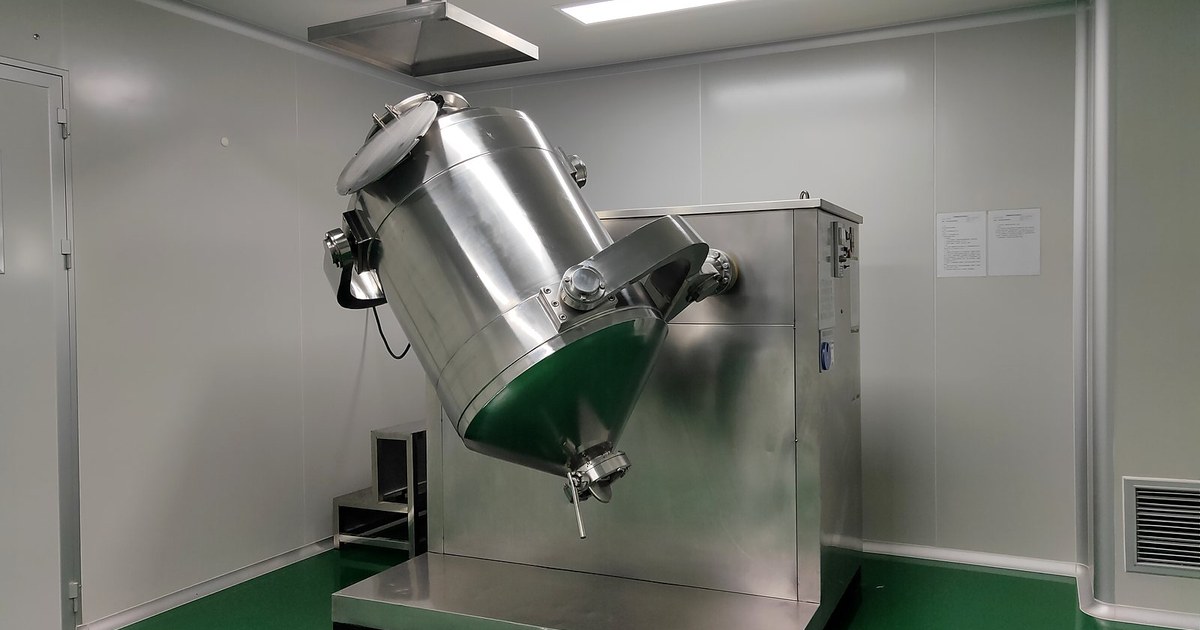
The bench sample is cast by hand. The production sample is deposited on a real machine, cured in a real room, and polished in a real drum — and it behaves differently.
| Parameter | Bench | Production | What changes |
|---|---|---|---|
| Batch size | 1–5 kg | 200–500 kg | Heat history, mixing time, evaporation |
| Depositing | Hand mould | Hopper + depositor | Residence time, temperature drift |
| Curing | Room air | Climate-controlled room, 24–72 h | aw gradient, case hardening |
| Demoulding | Manual | Starch or silicone mould, release agent | Sticking, deformation |
| Coating | None or manual | Oil + carnauba polishing | Shine, anti-stick, moisture barrier |
Ask for the pilot report, not just the samples: depositing temperature, brix at deposit, curing time, final aw, piece weight distribution and hardness. Those five numbers predict whether the production run will match the sample.
Stage 3: stability and analytical method (runs in parallel)
| Test | Duration | Cost | What it protects |
|---|---|---|---|
| Accelerated stability, 40 °C/75 % RH | 3 months | $800–2,500 | Shelf-life claim, formulation change decisions |
| Real-time, 25 °C/60 % RH | 6–24 months | $600–2,000 | The claim you can legally keep |
| Assay method development/validation | 2–6 weeks | $1,000–4,000 | Whether the active can be measured at all |
| Microbiology and heavy metals | 1–3 weeks | $200–600 | Release and market compliance |
The assay method matters more than brands expect. Many actives have no validated method in a gummy matrix, and developing one takes longer than making the product. If your supplier says the assay is “by calculation” — that is, they assume the input equals the output — you have no idea what is in the gummy.
Stage 4: packaging, artwork and compliance (2–4 weeks)
| Item | Lead time | Cost | Blocker risk |
|---|---|---|---|
| Jar or pouch sourcing | 1–3 weeks stock, 4–8 custom | $0.15–0.45 per unit | Custom mould MOQ 30,000+ |
| Label artwork and proofing | 1–2 weeks | $100–600 design | Supplement Facts format errors |
| Print plates | 3–7 days | $200–800 | Colour matching |
| Compliance review | 3–10 days | $150–800 per market | Claims not permitted in the target market |
| Barcode / GS1 | 1–5 days | $30–750 | Retailer requirements |
The most expensive delay in the whole project is a label reprint. Print 30,000 labels with “supports immune health” on an EU product and you will reprint all of them. Get compliance sign-off before print, in every market you intend to sell into.
Stage 5: production run and release (2–3 weeks)
| Step | Duration | Control |
|---|---|---|
| Raw material release | 3–7 days | COA review, identity testing |
| Syrup preparation and depositing | 1–2 days | Brix, pH, temperature logs |
| Curing | 24–72 h | aw check at 24 and 48 h |
| Finishing and packing | 1–2 days | Piece weight, count, seal integrity |
| QC release | 5–10 days | Assay, micro, aw, organoleptic |
| Quarantine release to pallet | 1 day | Batch record review |
The full timeline, realistically
| Phase | Duration | Cumulative |
|---|---|---|
| Brief and quote | 1–2 weeks | Week 2 |
| Bench samples | 2–3 weeks | Week 5 |
| Pilot run | 2–3 weeks | Week 8 |
| Stability (accelerated, parallel) | 12 weeks | Week 17–20 |
| Packaging and artwork | 2–4 weeks | Week 10–12 |
| Production | 2–3 weeks | Week 12–15 |
| Release and shipping | 1–2 weeks | Week 13–17 |
Fastest realistic path to a first pallet: 12 weeks if you use a stock formula, stock jar, stock flavour and accept launching with 3-month accelerated data. Sixteen weeks is the normal case for a custom formula. Anyone promising six weeks is skipping stability or using an existing product under a new label.
What to lock before you pay a deposit
Most disputes in gummy projects are not about quality; they are about a detail that was agreed verbally. These nine items belong in the specification document, signed before the deposit invoice is paid.
| Item | What “locked” means | If left vague |
|---|---|---|
| Piece weight | A nominal weight with a tolerance, e.g. 3.0 g ±5 % | The label serving size no longer matches reality |
| Active overage | A percentage per active, tied to stability data | Short potency at expiry, or a taste change nobody approved |
| Texture reference | A named commercial product plus a hardness target | The sample “feels different” and both sides are right |
| Water activity | A maximum at release, e.g. 0.60 | Sticking, mould growth, short shelf life |
| Colour standard | A physical retention sample plus a measured shade range | Batch-to-batch drift that customers notice |
| Serving size on label | Pieces per serving, checked against the dose | “2 gummies” on the jar, 3 needed to hit the claim |
| Yield allowance | Finished kilos per blend kilo, per SKU | You absorb every loss silently |
| Release testing scope | Named tests, named methods, named lab | “Assay by calculation” is offered and accepted |
| Delivery term | Incoterm, port, and who pays which leg | Freight and duty become a margin surprise |
Nine lines of specification prevent the three disputes that consume the most time: texture, potency and colour. All three are subjective until someone writes a number down.
Choosing the manufacturer: twelve questions that separate the real from the reseller
| # | Question | What a real factory says | What a reseller says |
|---|---|---|---|
| 1 | Can I see the depositor and cure room? | Yes, here is a date, or here is a live video walkthrough | “Our partner factory, we can arrange later” |
| 2 | How many depositing lines do you run? | A specific number and a capacity figure | “Large capacity” |
| 3 | What is your cure-room temperature and RH? | Numbers, with the control range | “Controlled” |
| 4 | Which certifications are yours, not a partner’s? | Certificates with their own legal entity | A PDF with another company’s name |
| 5 | Who validates the assay method? | A named third-party lab | “We test internally” with no method |
| 6 | What is the smallest batch you will run? | A specific kilo figure, with a reason | “Depends” |
| 7 | What is your on-time delivery rate? | A percentage from the last 12 months | “Always on time” |
| 8 | Show me a recent batch record, redacted. | A real signed record | “Confidential” |
| 9 | Who writes the stability protocol? | In-house with a defined schedule | “We can do stability if you pay” |
| 10 | What is your change-control process? | A written procedure with notification | Silent substitution of a raw material |
| 11 | Which markets have you shipped to? | Named markets and documentation | “Worldwide” |
| 12 | Who is my single point of contact? | A named person with a direct line | A rotating chat account |
Questions 4, 8 and 10 are the ones that matter. Certifications held by a partner entity are marketing; a redacted batch record proves the QMS exists in practice; a change-control process is what stops a raw material being swapped after approval because a lot was unavailable.
Costs outside the per-unit quote
| Item | Typical cost | When |
|---|---|---|
| Custom mould | $800–3,500 | Only for a differentiated shape, MOQ 30,000+ |
| Flavour development | $300–1,200 | Custom flavour, 25–100 kg minimum |
| Colour matching | $150–500 | Brand-specific shade |
| Stability programme | $1,500–4,500 | Per formula |
| Assay method development | $1,000–4,000 | If no method exists |
| Regulatory review per market | $150–800 | Before print |
| Third-party certification | $2,000–10,000 | Organic, NSF, Informed Sport |
On a 3,000-unit first order these one-off costs can add $2–6 per unit. They are not waste — they are the difference between a product and a prototype — but they must be in the business plan before the price is set.
Failure points, ranked by how often they happen
- Texture mismatch. The sample was hand-cast; production is deposited. Always approve a pilot sample, never a bench sample.
- Active loss. Degradation during cooking or over 12 months. Select heat-stable forms, add overage based on data.
- Sticking in the jar. aw too high or insufficient polishing; gummies fuse into a block in a warm warehouse.
- Label non-compliance. Claims, units, or the Supplement Facts panel; reprint cost dwarfs the compliance review fee.
- Colour drift between batches. Natural colours vary by lot; specify a measured shade range and approve a retention sample.
- Late packaging. Jars arrive after the gummies are made; gummies wait in bulk and pick up moisture.
- Underestimated MOQ. Discovering the real minimum after the packaging is printed for a smaller run.
If you are weighing formats before you choose a supplier, our pages on gummy manufacturing and turnkey supplement production set out the equipment, testing and minimum volumes behind each one. For the next decision in the sequence, read first order volumes and costs.
Frequently asked questions
How long does a gummy project take from brief to delivery?
12 weeks at the fastest with stock components, 14–16 weeks for a custom formula with proper stability work, and longer if a new assay method is needed.
Do I need a custom mould?
Only if the shape is part of the brand. Stock shapes cost nothing and are available at 3,000-unit volumes; a custom mould is $800–3,500 plus a 30,000-unit minimum in most factories.
Can I skip stability testing to launch faster?
You can launch with 3-month accelerated data and continue real-time testing, which is common. You cannot launch with no data and then defend a shelf-life claim if a customer complains.
What is the real minimum order?
3,000–5,000 units for stock formula, jar and flavour; 10,000–30,000 for custom moulds or new flavours, because the depositor batch and cure-room slot set the floor.
Why is my second batch a different colour?
Natural colours and fruit concentrates vary by lot. Specify a measured shade tolerance, keep a retention sample, and expect the factory to match against it, not against memory.
Can the factory make a sugar-free gummy with the same texture?
Close, but not identical. Sugar does more than sweeten — it controls aw, body and crystallisation. Sugar-free systems use polyols or allulose with different texture outcomes.
How do I compare two factory quotes fairly?
Give both the same brief and ask for the same five numbers: piece weight, active overage, aw at release, stability scope, and what is included in the one-off costs.
What documents should I receive with the shipment?
Certificate of analysis for the finished batch, the batch record summary, stability data to date, allergen and certification statements, and the packaging artwork proof.
Sources and further reading
Regulatory and standards
- US FDA, 21 CFR Part 111 — batch records, component testing and finished-product release.
- US FDA, nutrition and supplement labelling guidance; EU Regulation 1169/2011 via EUR-Lex.
- Health Canada, Natural and Non-prescription Health Products Directorate — product licence requirements before sale.
Peer-reviewed research
- Klayraung S, Viernstein H, Okonogi S. Development of tablets containing probiotics: effects of formulation and processing parameters on bacterial viability. Int J Pharm. 2009;370:54–60. PMID 19059323 — how processing parameters, not just formula, decide active survival.
- Challenges of dissolution methods development for soft gelatin capsules. Pharmaceutics. 2021. PMID 33557167 — method development for gel-based dosage forms, directly relevant to gummy assay work.
- Gorissen SHM et al. Protein content and amino acid composition of commercially available plant-based protein isolates. Amino Acids. 2018;50:1685–1695. PMID 30167963 — why incoming-material assay, not label trust, drives formulation.
Standards and industry references
- ISO 22000; GFSI benchmarked schemes; US FDA HACCP principles.
- United States Pharmacopeia, general chapters <2021>, <711>, <905>.
Timelines and costs are 2026 planning figures from contract manufacturers; actual schedules depend on raw-material lead times, cure-room capacity and how many markets require compliance review.