Quick answer: vet a Chinese supplement contract manufacturer on five things you can verify without visiting: the scope on its production licence, the certificate numbers behind its GMP and ISO claims, whether it tests identity and potency in-house or outsources everything, the MOQ and tooling cost per format, and whether it will sign a batch-record audit clause. Price comes last, because a quote 20% below the market usually means the testing, the excipient grade, or the licence scope has been trimmed.
By Jack Liu, Export Manager, ZOOMSHEAL · Reviewed by the ZOOMSHEAL quality and regulatory team · Last updated 8 November 2026
1. What a contract manufacturer does — and what it does not
A contract manufacturer makes a finished dietary supplement to a formula and specification you own or license. It buys raw materials, blends, fills, packages, tests and ships. It holds the production licence and, in China, the health food or food production permit that covers the format you are buying.
What it does not automatically do: develop the formula (that is ODM), register your brand in your market, act as your importer of record, or carry product liability for claims you write. Those are separate scopes and should be separate lines in the agreement. Most disputes we see start when a buyer assumes one of those four is included.
2. The 12-point checklist
| # | Check | Pass condition | Where to verify |
|---|---|---|---|
| 1 | Production licence scope | Lists your exact dosage form (e.g. gummy, hard capsule, powder) | Licence scan + national enterprise credit system |
| 2 | Business licence | Legal name matches the entity on the quote and the bank account | Unified Social Credit Code lookup |
| 3 | GMP certificate | Number resolves on the issuing body's site; scope and address match | Issuer portal (CQC, Intertek, NSF) |
| 4 | ISO 22000 / HACCP | Valid dates, same site address | Issuer portal |
| 5 | In-house lab | HPLC, ICP-MS or AAS, micro lab, stability chamber on site | Video walkthrough, lab photos with your sample |
| 6 | Identity testing | Every incoming lot tested, not Certificate-of-Analysis-only | Batch record sample |
| 7 | MOQ per format | Stated per SKU, not "from 500" across all formats | Written quote |
| 8 | Tooling and artwork cost | Itemised: mould, die, plate, setup | Quote line items |
| 9 | Lead time breakdown | Split into material, production, testing, packing | Written schedule |
| 10 | Batch record access | Contract clause allowing audit or copy on request | Draft agreement |
| 11 | Change control | Written notice before any supplier or specification change | Quality agreement |
| 12 | Recall procedure | Named contact, 24-hour traceability of lot and distribution | Quality agreement |
3. Read the licence scope before the brochure
Chinese production licences are written per category and per dosage form. A factory licensed for hard capsules and tablets is not automatically licensed for gummies, and pressed tablets and effervescent tablets sit under different equipment and often different lines. Ask for the licence page that lists the permitted forms, and check that the form you are buying appears on it.
Two more details worth checking: the production address on the licence must be the address on the certificate and on the shipping documents, and the legal entity on the licence must match the entity that issues your invoice. Trading companies resell factory capacity; that is legal and sometimes convenient, but you should know which one you are talking to, because it changes who answers for a deviation.
4. What each certificate actually proves
| Certificate | What it proves | What it does not prove |
|---|---|---|
| China health food GMP | The site meets China's production practice rules for the licensed category | That the product is compliant in the US or EU |
| ISO 9001 | A working quality management system | Product safety or testing depth |
| ISO 22000 / HACCP | Food safety hazards are identified and controlled | Potency or label accuracy |
| NSF / NSF-173 | Product tested against a public dietary supplement standard | That every SKU you order is covered |
| FDA facility registration | The facility filed with FDA and accepts inspection | Any form of FDA approval — none exists for supplements |
| Halal / | Specific certification body audited the line and inputs | Coverage of ingredients added later |
Certificate numbers are the part buyers skip. A GMP claim without a number is a claim, not evidence. Take the number, open the issuing body's verification page, and compare scope, address and expiry. If a supplier sends a certificate with the address blurred, stop there.
5. Testing: the single best predictor of quality
Ask one question: which tests do you run in-house, and which do you send out? A factory with its own HPLC and ICP-MS can release a batch in days and can tell you what failed. A factory that outsources everything is a broker with a filling machine, and its CoA will be a copy of its supplier's CoA.
| Test | Method reference | Typical acceptance |
|---|---|---|
| Identity of raw material | HPLC / FTIR against standard | Matches reference spectrum |
| Assay (actives) | HPLC, USP method where available | 95–105% of label claim at release |
| Heavy metals | ICP-MS, USP <2232> approach | Pb, As, Cd, Hg below USP limits |
| Microbiology | USP <2021> / <2022> | TAMC, yeast and mould, absence of pathogens |
| Pesticides | GC-MS/MS panel | Below EU MRLs for botanical inputs |
| Residual solvents | GC headspace | Class 2/3 limits per ICH Q3C |
| Dissolution (tablets) | USP <711> | Per your specification |
| Stability | Accelerated + real time | Supports your shelf life claim |
A CoA that lists only "appearance, assay, microbiology" is a minimum, not a full release panel. For botanicals, pesticides and heavy metals are where cheap sourcing shows up, so those two rows matter more than the assay.
6. MOQ and the real landed cost
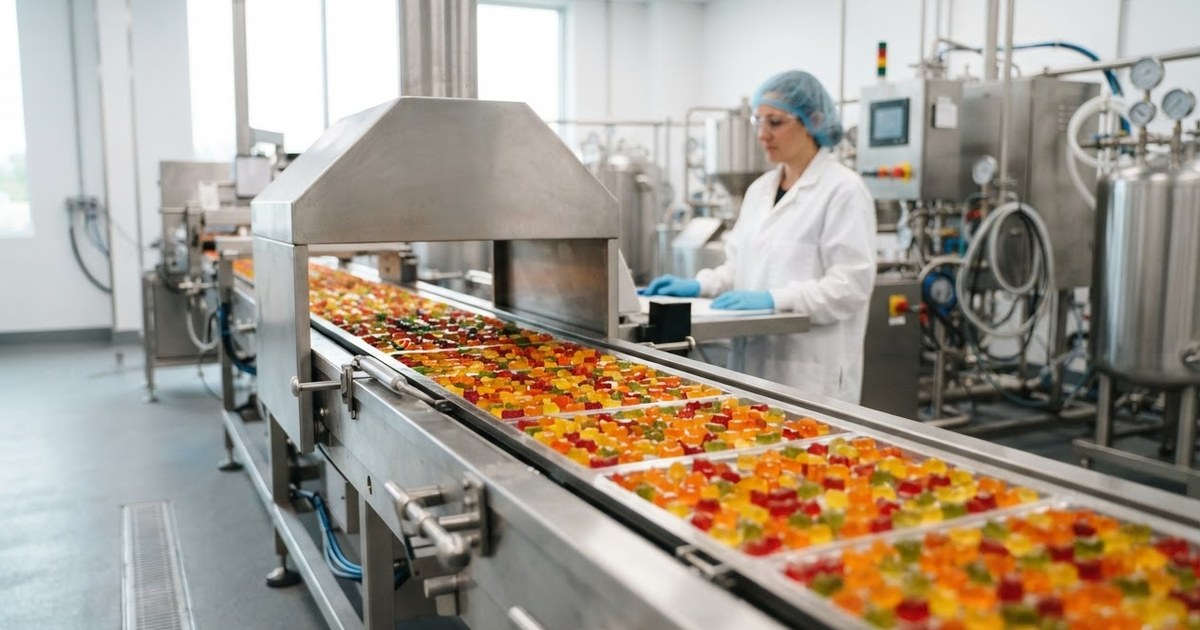
MOQ is set by changeover time, not by raw material cost. That is why the number differs by format: filling lines for capsules and tablets run fast, so the economic batch is larger; gummies need depositing moulds and a drying cycle, so small runs are practical.
| Format | Typical MOQ per SKU | Why |
|---|---|---|
| Gummies | 500 units | Mould set and short depositing runs |
| Powders / stick packs | 500 units | Blending is volume-driven, filling is fast |
| Liquids / shots | 500 units | Small tanks and short pasteurisation cycles |
| Hard capsules | 1,000 units | Capsule filling changeover and yield loss |
| Tablets | 1,000 units | Compression setup and tooling |
| Softgels | 1,000 units | Die change and long drying tunnel |
Landed cost is not unit price. Add tooling and plate fees, artwork and colour proofing, third-party testing if you require your own lab, freight, insurance, duty, and the cost of a re-run if the first batch fails release. A supplier at 8% lower unit price with a 2,000-unit MOQ can cost more per sellable unit than one at a higher price with a 500-unit MOQ, because your cash sits in inventory instead of in marketing.
7. Lead time: ask for the breakdown, not the total
"30 days" is not a schedule. Ask for the four segments separately: raw material lead time (14–30 days depending on whether the actives are imported), production (5–12 days depending on format), release testing (3–7 days), and packing plus documentation (2–5 days). A realistic first order runs 4–6 weeks from approval of formula, artwork and purchase order; repeat orders are usually 2–4 weeks.
Two things delay first orders more than anything else: artwork approval and label compliance review for the destination market. Both are on your side of the table, which is why they are the two you can actually control.
8. Red flags in a quote
- One MOQ quoted for all formats — a sign the quote was written without checking line capacity.
- No tooling line item, then a mould invoice after you pay the deposit.
- Certificate numbers missing, or certificates whose address differs from the licence.
- CoA offered before the batch exists.
- Refusal to accept a batch-record audit clause.
- Price below the cost of the actives at the declared dosage — check the math on the main ingredient; if the finished goods price is under the raw material cost, the dosage is not what the label says.
9. A remote audit that takes ten days
You do not need to fly to Guangzhou to qualify a supplier. Ask for: a live video walkthrough of the receiving area, the blending room, the filling line and the finished goods quarantine; photographs of the lab equipment with a handwritten date card; one redacted batch record showing identity test results for each raw material; the last three third-party test reports; and a list of the last five customers' destination countries (names removed is fine, markets are not). Factories that are proud of their plant answer in a day. Factories that are not, go quiet.
10. What belongs in the contract
Four clauses carry most of the risk: (1) specification and change control — no substitution of an active or excipient supplier without written approval; (2) batch record access and audit right; (3) release criteria and who pays for a failed batch; (4) liability and recall cooperation, including traceability within 24 hours. Everything else — payment terms, Incoterms, packaging tolerances — is negotiable detail around those four.
Frequently asked questions
Is a Chinese contract manufacturer cheaper than a US one?
On unit price, usually yes for labour-intensive formats such as gummies, softgels and stick packs, and the gap narrows for simple capsules. On landed cost the gap shrinks further once you add freight, duty and the working capital tied up in a larger MOQ. Compare per sellable unit at your real order size, not per bottle at 100,000 units.
Do I need to visit the factory before ordering?
Not for a first order in the 500–5,000 unit range. A structured remote audit plus a paid sample run tells you more per dollar than a two-day trip. Visit before you commit to tooling above roughly USD 5,000 or to an exclusive supply agreement.
Can the factory register my brand with the FDA?
No. FDA does not register brands or approve supplement products. The facility files a facility registration and must be inspected under 21 CFR Part 111; your brand's obligations as importer sit with you or your US agent, including prior notice for each shipment.
What is the difference between OEM and ODM here?
OEM means the factory makes your formula. ODM means the factory owns the formula and licenses it to you, often with restrictions on selling to competitors. Ask which one the quote assumes, and who owns the formula file afterwards.
How much does a sample cost?
Expect to pay for materials plus a setup fee, typically USD 200–800 depending on format and whether custom tooling is needed. Sampling takes 7–10 days; a good supplier credits part of the fee against the first production order.
What if the first batch fails testing?
The contract should say who pays. The normal split: the factory reworks or remakes at its cost if the failure is a process or material fault, and you pay if the failure comes from a specification you approved that was not achievable at scale.
Sources
- US FDA, 21 CFR Part 111 — Current Good Manufacturing Practice in Manufacturing, Packaging, Labeling, or Holding Operations for Dietary Supplements. ecfr.gov
- US FDA, 21 CFR Part 1 Subpart H — Registration of Food Facilities. ecfr.gov
- US FDA, 21 CFR Part 1 Subpart I — Prior Notice of Imported Food. ecfr.gov
- US FDA, Dietary Supplements guidance and regulatory information. fda.gov
- USP <2232> Elemental Contaminants in Dietary Supplements; USP <2021>/<2022> microbiological examination. usp.org
- NSF/ANSI 173 — Dietary Supplements. nsf.org
- ICH Q3C (R8) — Impurities: Guideline for Residual Solvents. ich.org
- European Commission, Directive 2002/46/EC on food supplements. eur-lex.europa.eu
About this guide
This checklist is compiled from supplier qualifications run for private label brands in the US, EU, and Gulf markets, and from the documentation set our own plant is audited against. It is updated when the underlying rules change; the date above is the last substantive revision. Corrections are welcome through the enquiry form — we publish corrections rather than editing silently.