Quick answer: MOQ is the smallest batch a factory can run without losing money on changeover, and in supplements it is set per dosage form, not per customer. For gummies, powders and liquids the practical floor is around 500 units per SKU; for capsules, tablets and softgels it is around 1,000. Anyone quoting "3,000 minimum" for gummies is quoting a line configuration chosen for their convenience, not a physical limit.
By Jack Liu, Export Manager, ZOOMSHEAL · Reviewed by the ZOOMSHEAL quality and regulatory team · Last updated 8 November 2026
1. What MOQ is actually pricing
A production line has a fixed cost per run: cleaning and changeover, a line clearance check, a first-article inspection, a mixer that must be filled to a minimum working volume to blend evenly, and a quality release that costs the same whether you make 500 units or 50,000. Divide that fixed cost by the batch size and you get the unit cost. MOQ is simply the point where the fixed cost stops dominating the price.
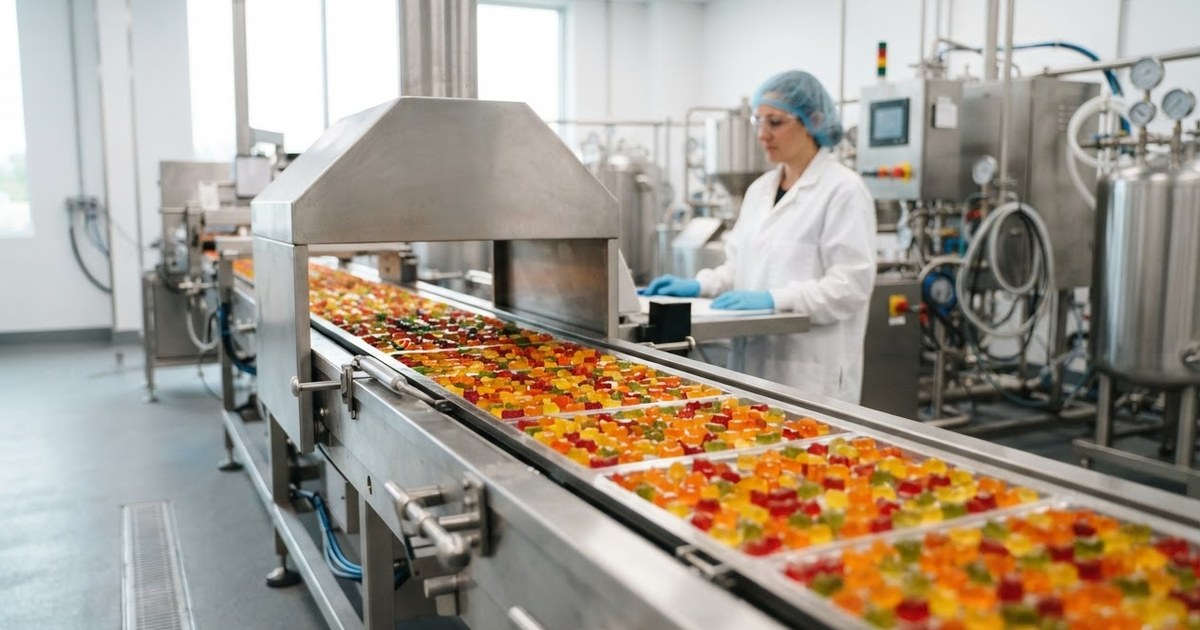
That is why MOQ moves with format and never with "customer size". A gummy line can deposit 500 units in a few minutes; a softgel line has to fill a die, run a long drying tunnel and clean out gelatin, so the same fixed cost spread over 500 units would triple the unit price.
2. The fixed cost per run, by format
| Format | Practical minimum per SKU | Fixed cost driver | Time per run |
|---|---|---|---|
| Gummies | 500 units | Mould set, depositing setup, drying cycle | 1–2 days |
| Powders / stick packs | 500 units | Blender minimum working volume | 1 day |
| Liquids / shots | 500 units | Tank minimum, pasteurisation cycle | 1 day |
| Hard capsules | 1,000 units | Capsule filler changeover, yield loss | 1–2 days |
| Tablets | 1,000 units | Compression tooling, weight uniformity tuning | 1–2 days |
| Softgels | 1,000 units | Die change, long drying tunnel | 2–3 days |
Note what is not in that table: raw material. Actives are usually the largest single cost, but they scale linearly and are not the reason for a minimum. If a supplier tells you the MOQ is high "because the ingredient is expensive", ask for the batch record of a 500-unit run and watch the answer change.
3. The four costs hidden in a large MOQ
Buyers compare unit price and forget that a big first order borrows money from the future. Four costs matter more than the per-unit number:
- Cash tied up. 3,000 units at USD 4 = USD 12,000 sitting in a warehouse instead of in ads or in your second SKU.
- Storage and handling. Amazon FBA storage, 3PL receiving, and the labour to move cartons you will not sell for a year.
- Shelf life burn. Most supplements ship with 18–24 months of shelf life. If you take 12 months to sell a batch, you are selling product with 6–12 months left, which is a customer complaint waiting to happen.
- Locked-in mistakes. The first batch is where label errors, flavour problems and fill-weight complaints show up. A 500-unit batch is a cheap education; a 3,000-unit batch is an expensive one.
4. A worked comparison
| Line item | Supplier A (500 MOQ) | Supplier B (3,000 MOQ) |
|---|---|---|
| Unit price | USD 4.20 | USD 3.40 |
| First order outlay | USD 2,100 | USD 10,200 |
| Tooling / plate | USD 350 | USD 0 (absorbed) |
| Total cash at PO | USD 2,450 | USD 10,200 |
| Units sellable in 6 months | 500 | ~1,200 |
| Inventory left after 6 months | 0 | 1,800 units (USD 6,120 at cost) |
| Retail price at USD 19.90 | Same product, same margin percentage | |
Supplier B looks 19% cheaper per unit. But it asks for 4× the cash before you know whether the product sells, and it leaves you holding 1,800 units — roughly USD 6,100 of working capital — at the point where you would rather be testing a second SKU. For a first launch, the cheap unit price is the expensive choice.
5. Seven ways to get the MOQ down
- Ask per format, in writing. Many quotes quote the highest MOQ across all formats because it is easier to administer. Ask specifically: "what is the minimum for this gummy, this SKU, this label?"
- Use stock tooling. If the factory already has a mould or die close to your shape, you skip the tooling batch that often sets the MOQ.
- Accept a stock colour and stock bottle. Custom bottles are ordered in carton quantities from a packaging supplier; that carton quantity, not the production line, is often the real MOQ.
- Start with fewer SKUs, not smaller SKUs. One flavour at 1,000 units is cheaper per unit than three flavours at 500 each, because changeover is paid once.
- Book a slot, not a batch. Some factories will add a small run to a larger run of the same base formula, charging a slot fee instead of a full changeover.
- Take the pilot in bulk. Unlabelled bulk in food-grade drums, labelled locally, removes the packaging MOQ entirely.
- Trade volume for price later. Agree a first order at 500 and a committed second order at 2,000 within 90 days in exchange for the small-batch price.
6. First order and repeat order are different numbers
The first order carries setup: artwork plates, colour proofing, a line trial, and often a stability sample pulled from the batch. Repeat orders reuse all of it, so a sensible supplier will quote a lower repeat MOQ — 300 units instead of 500, or 600 instead of 1,000 — provided the formula and packaging do not change. Ask for both numbers in the first quote; a supplier who cannot separate them has not thought about your second order.
7. The packaging trap
In practice, the binding constraint is often not the production line but the components. Jars, caps, scoops, labels and cartons come in minimum order quantities from packaging manufacturers, and those minimums are frequently larger than the filling minimum. A 500-unit filling run can require a 2,000-unit jar order, which quietly becomes your real MOQ and your real storage problem.
Fix it before it fixes you: ask whether the factory will supply from its own component stock at a small premium, or whether they will fill components you ship in. Both are normal requests.
8. When a high MOQ is actually correct
If you have 12 months of sell-through data on the same SKU, a 3,000-unit run at a 19% lower unit price is straightforwardly better: you will sell it, the shelf life is consumed by demand rather than by storage, and the cash is working. The mistake is applying that logic to a first order, or to a seasonal product, or to a SKU whose label is still changing. Match the batch size to your confidence, not to the discount table.
9. Cash flow: what a first order really does to your balance sheet
Most first-time launches fail on cash timing, not on product. A supplement order is paid before it sells: 30–50% deposit at purchase order, the balance before shipment, then freight, duty and 3PL receiving before a single unit is sold. At a 3,000-unit MOQ that is four to six months of working capital committed to one bet.
| Stage | 500-unit order | 3,000-unit order | Timing |
|---|---|---|---|
| Deposit (40%) | USD 840 | USD 4,080 | Day 0 |
| Balance before shipment | USD 1,260 | USD 6,120 | Day 25–35 |
| Freight + duty (est.) | USD 350 | USD 700 | Day 35–50 |
| 3PL receiving + storage (6 mo) | USD 120 | USD 480 | Ongoing |
| Total committed before revenue | USD 2,570 | USD 11,380 | — |
| Break-even units at 45% gross margin | ~290 | ~1,270 | — |
Notice the break-even row: the smaller order needs about 290 sales to get your money back, the larger one about 1,270. If your launch plan can realistically move 300 units in 90 days but not 1,300, the 3,000-unit price is a financing decision you did not intend to make.
10. How MOQ interacts with Amazon FBA and 3PL rules
Marketplace logistics quietly set a second minimum. FBA requires units to arrive labelled with the FNSKU, in cartons that meet the shipment limits, and inside the inbound window of your shipment plan. A 500-unit run covers roughly 10–20 cartons depending on format and pack size — easy to split across two shipments. A 3,000-unit run is a pallet-scale inbound, which means freight forwarding, pallet labelling and a longer receiving queue.
- Ask the factory for carton dimensions, gross weight and units per carton before you choose the MOQ; these numbers decide the freight cost.
- For small runs, sea freight is often not economic — the minimum charge and the port fees dominate. Air or consolidated LCL usually wins below about 300 kg.
- If you sell on more than one channel, split the batch into channel-specific packs at the factory. Relabelling at a 3PL costs more than the packaging saving.
Frequently asked questions
Why do some factories quote 3,000 units for everything?
Three reasons: their line is configured for large runs and small runs genuinely cost them more; their sales process is built around container-load buyers; or they are a trading company whose factory partner will not open a line for less. The first is legitimate, the second is a positioning choice, the third means you are talking to the wrong company.
Can I get below 500 units for a sample market?
Yes, as a pilot or a paid sample run, typically at a 30–60% unit price premium plus setup. It is a reasonable way to test a market, and most factories will credit part of the premium against the first production order.
Does MOQ include the tooling batch?
Usually not. Tooling, plate and first-article costs are separate line items. Ask for the total cash at purchase order, which is the only number that matters for your budget.
Is a lower MOQ always better?
No. Below the practical minimum the unit price rises sharply and the risk of a small-batch process deviation rises with it. For a proven SKU, paying 15% less per unit at 3,000 is better than paying 15% more at 500.
Can MOQ be shared across flavours?
Sometimes. If the base formula is identical and only the flavour or colour differs, some factories will run 500 + 500 + 500 as one 1,500-unit campaign. Ask in those terms — "campaign minimum" rather than "SKU minimum".
What happens to the MOQ if I change the label?
Label changes alone usually do not reset the MOQ; they reset the plate or artwork setup fee. Formula changes do reset it, because the batch record, stability data and often the testing panel have to be redone.
Sources
- US FDA, 21 CFR Part 111 — cGMP for dietary supplements, including batch production records and reserve samples. ecfr.gov
- US FDA, Dietary Supplement Labeling Guide. fda.gov
- USP <711> Dissolution; USP <905> Uniformity of Dosage Units. usp.org
- NSF/ANSI 173 — Dietary Supplements. nsf.org
- European Commission, Directive 2002/46/EC on food supplements. eur-lex.europa.eu
- Regulation (EU) No 1169/2011 on food information to consumers. eur-lex.europa.eu
About this guide
Figures here come from production planning for private label runs across gummies, capsules, tablets, softgels, powders and liquids, and are stated per SKU at the point of quotation. Batch economics change with line configuration, so treat the numbers as the range you should expect to negotiate inside, not as a fixed price list. Last substantive revision: 8 November 2026.