Quick answer: Ask whether the factory actually owns production for your dosage form, which certifications cover that line, the true minimum order quantity, and the lead time after artwork approval. Request a sample CoA and confirm who signs it. A real manufacturer answers with line details and batch records. A trading company answers with brochures. The questions below separate the two.
What a supplement contract manufacturer is, and what it is not
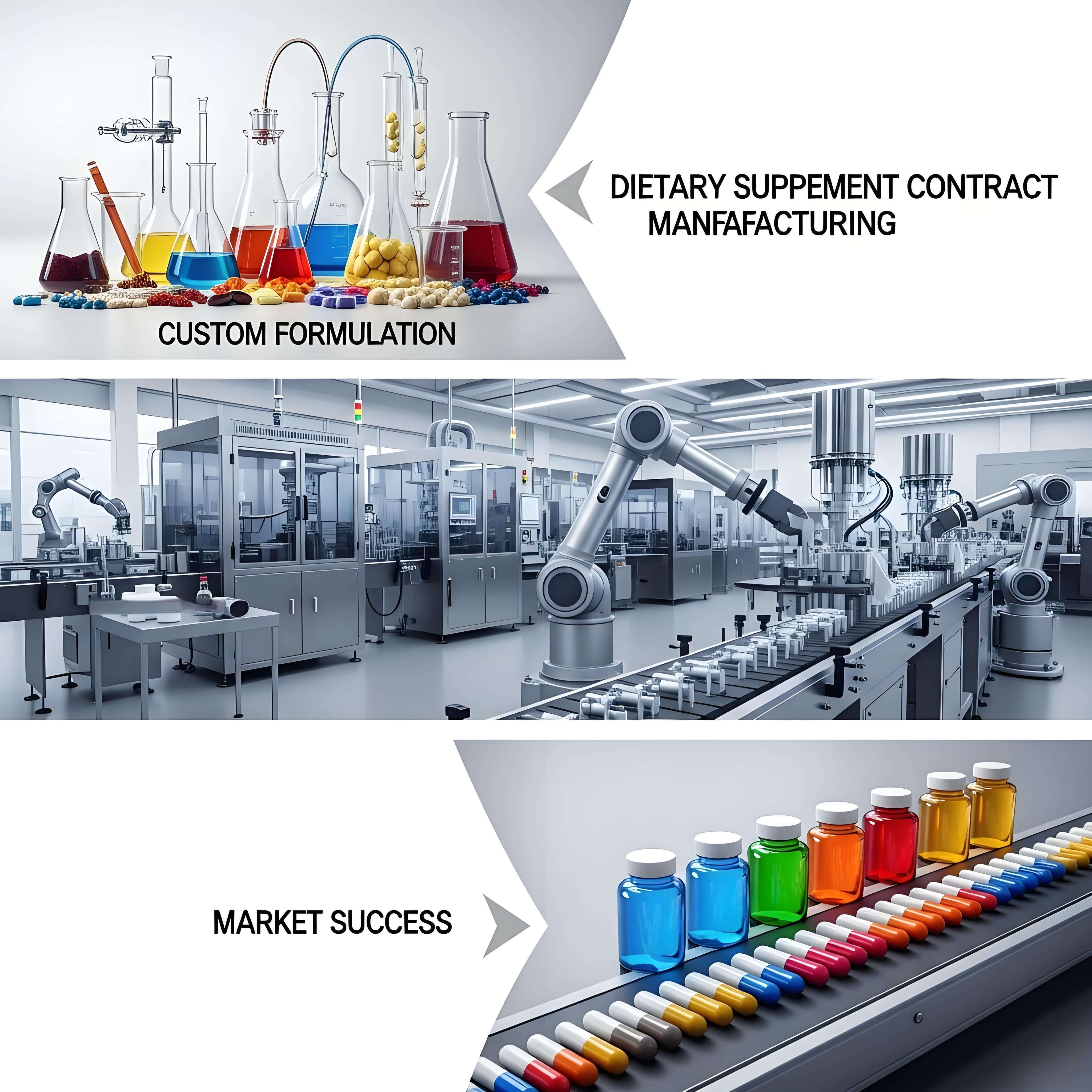
A contract manufacturer owns equipment, runs batches, and holds the quality systems that release product. A trading company brokers the same work to someone else. The difference matters when a batch fails, when a formula needs adjustment, or when an auditor asks who ran the line.
ZOOMSHEAL is the export brand of Zhongci Health Products Technology Development Co., Ltd., based in Huadu District, Guangzhou. The company has run contract manufacturing for 23 years and operates its own factory. It is not a trading company.
What a manufacturer is not: a regulatory approver. In the United States, dietary supplements have no pre-market approval. FDA facility registration is a filing, not an endorsement. Any supplier that says "FDA approved" is either confused or misleading you.
How the manufacturing process actually runs
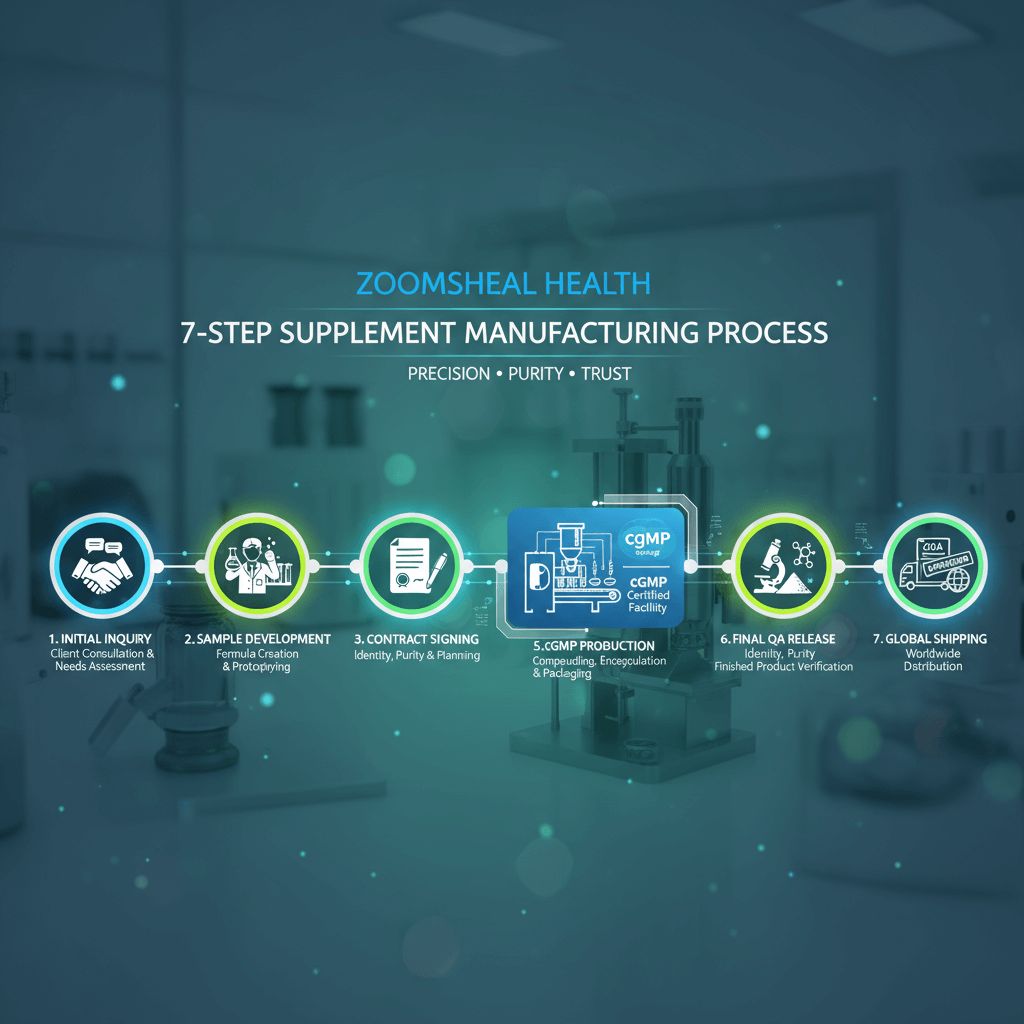
Most projects follow the same sequence. You bring a formula or a concept. The factory checks ingredient compatibility, then produces a pilot batch. You approve samples and artwork. Production scheduling follows. Release testing and a CoA close the loop.
Two timelines drive your launch date. Sampling takes 7-10 days. Production takes 4-6 weeks after formula and artwork approval. Plan backwards from those numbers, not from a sales promise.
In-house capability changes the sequence. When capsule, tablet, gummy, powder, and liquid lines sit under one roof, a multi-form product does not bounce between vendors. That reduces handoff errors and shortens the critical path.
Forms and delivery systems: what the factory can actually run
Ask this question precisely. "Do you make gummies?" invites a yes. "Which gummy line, and what is its current capacity?" invites a real answer.
ZOOMSHEAL runs hard capsules, softgels, tablets, gummies, powders in jars, sachets and stick packs, liquid drops, and effervescent tablets in-house. Each form carries its own constraints. Softgels suit oil-soluble actives. Effervescent tablets demand tight humidity control. Stick packs need powder flow that behaves on a filling line.
| Form | Typical fit | MOQ | Watch point |
|---|---|---|---|
| Hard capsule | Powders, blends, botanicals | From 500 units per SKU (1,000 for capsules, tablets and softgels) | Fill weight uniformity |
| Softgel | Oils, fat-soluble actives | 1,000-2,000 for a pilot | Shell stability, oxidation |
| Tablet | Compressed blends, effervescent | From 500 units per SKU (1,000 for capsules, tablets and softgels) | Hardness, friability |
| Gummy | Chewable delivery, taste-led products | From 500 units per SKU (1,000 for capsules, tablets and softgels) | Moisture, active stability |
| Powder (jar, sachet, stick) | High-dose actives, sports formats | From 500 units per SKU (1,000 for capsules, tablets and softgels) | Flow, segregation, seal integrity |
| Liquid drops | Low-dose actives, dropper formats | From 500 units per SKU (1,000 for capsules, tablets and softgels) | Preservation, pH |
MOQ from 500 units per SKU (1,000 for capsules, tablets and softgels) applies to most forms. Softgels can start at 1,000-2,000 for a pilot. Confirm the number in writing before you build a forecast around it.
Dosing and specification ranges: what to settle before the quote
Dose per serving drives everything downstream. It sets capsule size, tablet weight, powder volume, and the number of units per box. Settle it before pricing, not after.
Overages are a common sticking point. Many actives degrade over shelf life, so formulators add a small excess at manufacture to hit the label claim at expiry. Ask whether the overage is included, how it is calculated, and whether it is disclosed on the specification. A manufacturer who cannot explain overage policy has not thought about your expiry claim.
| Specification item | What to confirm | Why it matters |
|---|---|---|
| Active dose per serving | Label claim vs. input amount | Prevents under-delivery at expiry |
| Overage policy | Percentage, basis, disclosure | Affects cost and label accuracy |
| Excipients | Full list, grade, function | Allergen and clean-label claims |
| Serving size | Units per dose | Drives capsule size and cost |
| Shelf life | Months, storage conditions | Sets expiry dating |
| Release tests | Identity, assay, micro, heavy metals | Defines the CoA content |
Who benefits from a contract manufacturer, and who should look elsewhere
Contract manufacturing fits brand owners who have a formula or a clear concept and no plant. It fits procurement teams scaling a proven product. It fits founders testing a pilot batch before committing capital.
It fits less well when you need a novel molecule developed from scratch, when your volumes sit far below the MOQ, or when your regulatory pathway is a drug rather than a supplement. Be honest about which category you are in.
Small brands should ask about pilot runs specifically. A 1,000-2,000 unit softgel pilot lets you test the market without committing to a full production run. Not every factory offers that flexibility.
What the evidence shows, and where it is weak
Certification schemes are auditable. GMP inspection, ISO 9001:2015, ISO 22000:2018, HACCP, and Halal certification for specific lines can all be verified against a certificate and a scope statement. NSF audit reports exist and can be requested. FDA facility registration can be checked through the US agent.
The weak ground is marketing language. Claims about proprietary encapsulation methods, extended shelf life, or improved bioavailability often lack published data. That does not make them false. It makes them unverified. Ask for the internal study, the batch data, or the stability report behind the claim. If none exists, treat the claim as a hypothesis.
Be equally skeptical of ingredient-level science applied to finished products. A published study on a vitamin in isolation does not automatically transfer to your gummy with its own matrix, processing history, and storage conditions.
Quality signals: how to read a certificate of analysis
A CoA is a batch record, not a brochure. Every batch from ZOOMSHEAL ships with one. Read it in this order.
First, match the lot number to the batch you received. Second, check the tests run: identity, assay, microbial limits, heavy metals, and where relevant, dissolution. Third, look at the specification column against the result column. A result that sits exactly at the limit deserves a question. Fourth, find the signature and the date. An unsigned CoA is a draft.
| CoA element | What good looks like | Red flag |
|---|---|---|
| Lot number | Matches shipping documents | Generic or missing |
| Tests listed | Identity, assay, micro, heavy metals | Assay only |
| Specification vs. result | Clear columns, units stated | Results without limits |
| Method reference | Named method or pharmacopoeial reference | No method stated |
| Authorization | Signed, dated, named role | Unsigned |
On the label side, check that the supplement facts panel matches the approved specification. Mismatches between label and CoA are a documentation failure, and they surface at customs or at retail audit.
Common mistakes brand owners make
The most expensive mistake is treating a quote as a specification. A price without a dose, a form, a test panel, and a packaging spec is not comparable to anything.
Second: skipping the pilot. A 7-10 day sample turnaround is cheap insurance against a 4-6 week production run that misses the mark.
Third: assuming certification covers every line. Halal certification in particular is often line-specific. Ask which line, not whether the company is certified.
Fourth: confusing FDA registration with approval. Registration means the facility is filed with FDA through a US agent. It does not mean the product is reviewed, cleared, or endorsed.
Fifth: approving artwork late and blaming the factory for the delay. The 4-6 week clock starts after formula and artwork approval. Both are yours to control.
How it is manufactured at scale
Scale production is a sequence of controlled steps. Raw materials arrive and are quarantined pending identity testing. Weighing and dispensing follow under separate verification. Blending or encapsulation or compression runs against a batch record. In-process checks sample weight, hardness, or fill at intervals. Finished goods go to the quality unit for release testing. Only then does packaging and shipping begin.
Each step generates a record. The value of a factory audit is seeing those records, not the lobby. Ask to see a batch record for a product similar to yours, with commercial details redacted.
A practical checklist before you sign
Work through this list in order. Any unanswered item is a reason to pause.
- Confirm the legal entity name and factory address, not just the brand.
- Confirm in-house capability for your specific form.
- Get the MOQ in writing, including pilot quantities.
- Confirm lead time from formula and artwork approval, and sampling time separately.
- Request certificates with scope statements for GMP, ISO 9001:2015, ISO 22000:2018, and HACCP.
- Ask which lines hold Halal certification.
- Confirm FDA facility registration and the US agent arrangement.
- Request a sample CoA and check the signature.
- Settle dose, overage policy, and test panel before pricing.
- Agree on packaging specification and artwork approval workflow.
Frequently asked questions
Is ZOOMSHEAL a factory or a trading company?
It is a factory. ZOOMSHEAL is the export brand of Zhongci Health Products Technology Development Co., Ltd., located in Huadu District, Guangzhou. The company has 23 years of contract manufacturing experience and runs its own production lines for capsules, softgels, tablets, gummies, powders, liquid drops, and effervescent tablets. A trading company would broker your order to a third party. That distinction matters when a batch needs investigation.
What is the minimum order quantity?
MOQ starts at 500 units per SKU for gummies, powders and liquids and 1,000 for capsules, tablets and softgels. Softgels can start at 1,000-2,000 units for a pilot run. Pilot quantities let you test packaging, stability, and market response before committing to a full production batch. Always confirm the number in writing for your specific form, dose, and packaging configuration, because fill weight and pack format can shift the threshold.
How long does production take?
Lead time is 4-6 weeks after formula and artwork approval. Sampling takes 7-10 days. The clock starts when both approvals are complete, so delays in artwork review push the whole schedule. Build your launch plan around those two numbers and leave buffer for shipping and customs clearance. Ask for the production schedule in writing before you place a deposit.
Does FDA registration mean the product is approved?
No. FDA facility registration is a filing requirement, handled through a US agent. It is not FDA approval. Dietary supplements have no pre-market approval in the United States. Any manufacturer claiming FDA approval for a supplement is misstating the regulatory position. What you should expect instead is a certificate of analysis for every batch and a facility that follows GMP.
Which certifications should I ask for?
Ask for GMP inspected by Intertek, ISO 9001:2015, ISO 22000:2018, and HACCP. Ask about NSF audit status and request the report. Ask which specific lines hold Halal certification, since that status is often line-specific rather than company-wide. Request the certificate with its scope statement, not just a logo on a website. Verify the certificate number where possible.
What should a certificate of analysis contain?
A CoA should list the lot number, the tests performed, the specification limits, the results, and the method reference. Typical tests include identity, assay, microbial limits, and heavy metals. It should be signed and dated by an authorized person. Every batch from ZOOMSHEAL ships with one. An unsigned CoA or one missing specification limits is not a release document.
Can you run a small pilot batch first?
Yes, for softgels in particular, where pilots can start at 1,000-2,000 units. Pilots are useful for checking taste, mouthfeel, capsule appearance, and packaging fit before a full run. They also generate stability data you can use for shelf-life claims. Ask what the pilot includes, whether testing is part of the price, and how the pilot batch converts to a production order.
What causes most launch delays?
Artwork approval and formula changes after sampling. Both sit on the brand side. A second common cause is a specification that was never written down, leading to a mismatch between what the factory made and what the brand expected. Fix the dose, the test panel, the packaging spec, and the artwork workflow before production is scheduled, and most delays disappear.
References
- NIH Office of Dietary Supplements: Dietary Supplements fact sheet
- FDA: Dietary Supplements
- FDA: Current Good Manufacturing Practices for food and supplements
- FDA: Registration of food facilities
- EFSA: Food supplements
- European Commission: Food supplements
- WHO: Food safety fact sheet
- PubMed: dietary supplement quality analysis
Reviewed by Dr. Xu Wei, PhD, formulation scientist at ZOOMSHEAL in Guangzhou (23 years of supplement contract manufacturing). Last updated: November 2026. This article is for education and does not replace medical advice.